How many times a year does Cattleya bloom? Care for it this way and it will grow well
Cattleya, also known as Akawood and Cattleya labiata, is native to tropical America and is the national flower of countries such as Brazil and Colombia. It is usually grown in pots using fern roots, moss, bark chunks, and similar materials. So, how many times a year does Cattleya bloom? How should you care for it so it grows well?
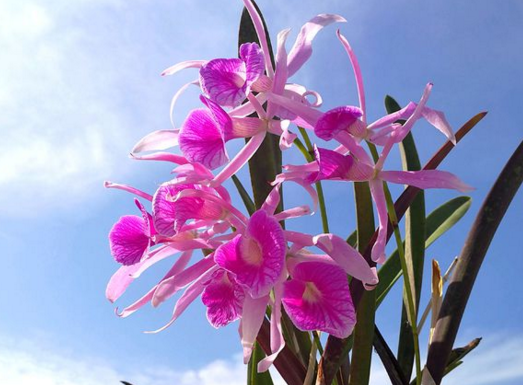
I. How many times a year does Cattleya bloom?
Cattleya blooms 1 to 2 times a year, and the ornamental flowering period is generally about 3 to 4 weeks.
II. How should Cattleya be cared for so it grows well?
1. Temperature: Its optimum growing temperature is 20°C to 30°C from March to October, and 12°C to 24°C from October to March of the following year. During the day, 25°C to 30°C is best, while at night 15°C to 20°C is optimal, and a day-night temperature difference of 5°C to 10°C is more suitable. In winter, the greenhouse temperature should not be lower than 10°C, otherwise the plant stops growing and enters a semi-dormant state. Below 8°C, generally less cold-tolerant varieties are prone to cold damage, while more cold-tolerant varieties can withstand low temperatures of 5°C. In late autumn and early winter, when the ambient temperature drops below 12°C, it should be moved indoors early. In summer, when the temperature exceeds 35°C, measures such as building shade structures, spraying water in the environment, and increasing ventilation should be used to create a relatively cool environment for it, so that it can continue to maintain vigorous growth, pass through summer safely, and avoid stem and leaf rot.
2. Light: It prefers a semi-shaded environment with diffused light. If the light is too strong, its leaves and pseudobulbs are prone to yellowing or sunburn, and diseases may be induced. If the light is too weak, it will instead cause leggy leaves and thin leaf texture. In general, in spring, summer, and autumn, black netting can be used to provide 50% to 60% shade. In winter, no shading is needed in the greenhouse, and plants placed indoors can be put in front of a window to receive a little direct sunlight.
3. Water: Cattleya not only needs moist growing medium, but also requires relatively high air humidity. It is an epiphytic orchid with fleshy roots, so a growing medium with good drainage and aeration should be used to avoid water accumulation and root rot. During the growing season, sufficient water is required, but it should not be overwatered. Especially in winter, when humidity is low and light is poor, the plant is in a semi-dormant state, and watering must be strictly controlled, otherwise it is easy to cause root rot and death. In addition, after Cattleya flowers fade, there is a dormancy period of about 40 days, during which the growing medium should be kept slightly moist. Generally, in spring, summer, and autumn, water once every 2 to 3 days, and in winter, water once a week. When the substrate at the bottom of the pot is slightly moist, that is the most suitable time to water. Watering should be thorough in one go, and slightly acidic water is preferable. It is not advisable to water or spray at night, to prevent moisture from lingering on the leaf surface and causing disease. Cattleya should generally maintain 60% to 65% air humidity. A humidifier can be used to humidify 2 to 3 times a day, along with foliar spraying, to create a moist and suitable growing environment for it.
4. Growing medium: The growing medium for cultivating Cattleya can usually be mixed from fern roots, moss, bark chunks, sphagnum moss, perlite, peat soil, coal furnace slag, and similar materials. For vigorously growing plants, replace the growing medium once every 1 to 2 years, preferably in spring when new shoots have just sprouted or after the flowers fade, combining repotting with division.
5. Fertilizer: A considerable portion of the nutrients Cattleya needs can be obtained through the mycorrhizae symbiotic with its root system, so it requires relatively little fertilizer. Do not apply night soil or urine, and do not use organic fertilizer that has not been fully decomposed. Otherwise, it is easy to cause root rot and death of the plant. Decomposed dry cake fertilizer powder or slow-release compound fertilizer granules can be buried in the growing medium. During the growing season, spray the leaves once every half month with a mixture of 0.1% urea plus 0.1% potassium dihydrogen phosphate. When the temperature exceeds 32°C or is below 15°C, stop fertilizing. During the flowering period and the dormancy period after the flowers fade, fertilization should also be suspended to avoid fertilizer damage to the roots.