How Many Years Does a Crabapple Tree Take to Flower and Bear Fruit? Detailed Guide to Planting Methods and Benefits
Crabapple trees often grow on sunny hillsides, flat ground and beside valley terraces. Eaten raw, the taste resembles apples. There are many varieties, and they can be propagated by grafting, sowing and division. It is a plant native to China. Sweet and sour, it is delicious. So how many years does a crabapple tree take to flower and bear fruit? How is it planted? What benefits and effects does it have?
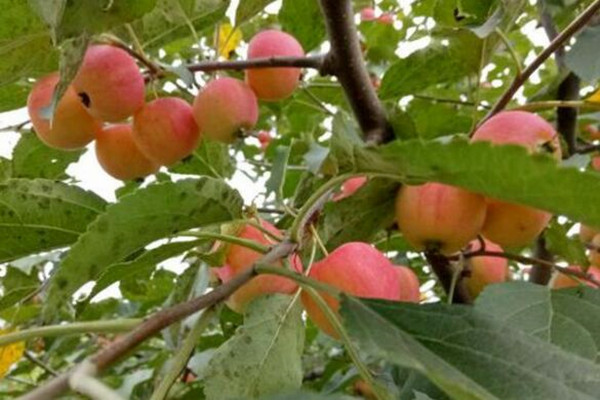
How many years does a crabapple tree take to flower and bear fruit?
From planting to heavy fruiting, a crabapple tree generally needs three years, and it begins to bear fruit in the fourth year after planting. Therefore, to ensure the quantity of fruit, during the three years after planting, field management work such as soil improvement, planting density and seedling management must be done well.
Crabapple usually blooms at the turn of spring and summer, that is, the flowering period is between April and May, while the fruiting period is from August to September.
How is a crabapple tree planted?
Site selection and land preparation
1. Site selection: Crabapple has strong adaptability and can be planted at altitudes below 2,100 m. It prefers a warm, dry climate with plenty of sunlight, tolerates drought and cold, and dislikes high temperature and high humidity. Sandy soil with medium fertility and good drainage is ideal. It should not be planted on low-lying, waterlogged clay.
2. Land preparation: Since crabapple is mostly planted in autumn, previous crops such as soybeans, peanuts, flue-cured tobacco and corn are all suitable. When preparing the land, simply deep-plow the plot once, remove dead branches and weeds, and break up clods so the soil is fine and the ground level; paddy fields can be planted using a no-till method.
Variety selection
Variety selection should follow the principle of matching the tree to the site. The main varieties are k9, 123 (small apple), Huang Taiping, Lingdang and Daqiu.
1. k9: The bark is light green, the crown is large, the buds are wide, and it likes fertilizer, water and light. The harvest period is in mid-August.
2. 123 (small apple): The bark is light brown with small white spots. The seedlings are sturdy, the crown is large, and it likes light, fertilizer and water. The harvest period is in mid-September.
3. Lingdang: The bark is dark brown, the buds are pointed, the crown is large, and it likes light, fertilizer and water. The harvest period is in mid-September.
4. Daqiu: The seedlings are short and can be trained into a large crown. It likes light, fertilizer and water. The harvest period is at the end of September.
5. Huang Taiping: The seedlings are sturdy, with white spots on light brown bark, a large crown, and they like light, fertilizer and water. The harvest period is in mid-August. The lifespan of the above fruit trees is about 25 years.
Seedling selection
1. Seedling height is 80-120 cm.
2. Seedling root system: more than 4 lateral roots, each more than 15 cm long, evenly distributed, with many small lateral roots. Choose high-quality, vigorous seedlings with well-developed roots, no damage and no pests or diseases, and with a quarantine certificate; otherwise, they should not be purchased.
3. Seedling thickness: ground diameter above 1 cm.
4. Seedling quality: there must be more than 8 strong buds at the trunk-cutting position of the seedling, between 40-80 cm below the trunk-cutting point, so that good branches can grow after trunk cutting and the rootstock wound heals well, ensuring graft survival.
5. Check for autumn shoots: choose fruit tree seedlings with smooth surfaces, few fine hairs and no autumn shoots, so as to improve overwintering cold resistance.
6. Check whether the bark is wrinkled or dehydrated: choose fruit tree seedlings with fresh bark color; seedlings that have lost water and dried out are difficult to keep alive even if planted.
Planting density
Tall, large crowns generally use a 3×5 m row spacing, that is, 44 trees per mu. For intercropping fruit trees with crops, wide rows and narrow trees can be used, namely 2×8-9 m and 2.5×6-7 m; for short, small crowns, 2×4 m spacing can also be used, that is, 83 trees per mu; for fruit-grain intercropping, 2×6-8 m can be used, and 3×2 m spacing can also be used, that is, 111 trees per mu. A 3×4 m spacing can be used, that is, 56 trees per mu.
Planting
Dig a round pit 80-100 cm in diameter, press straw into the bottom of the pit and backfill with topsoil mixed with fertilizer. Use 50-100 kg of manure per pit (rotted manure), 1 kg of superphosphate and 0.1 kg of black alum. For spring planting, finish planting from April 25 to May 15, firm the soil and water thoroughly. For autumn planting, finish digging the pits before September, and complete autumn planting, firming the soil and watering thoroughly before the soil freezes. After planting, cut the trunk at 60-80 cm or 80-100 cm. Planting depth: the rootstock graft union should be parallel to the ground. Choose different tree shapes according to different planting densities: use "small-crown sparse-layer shape" for 3×5 m; use "free spindle shape" for 2×4 m; use "basal three-main-branch central-leader cylindrical shape" for 2×8-9 m, 2.5×6-7 m and 2×6-8 m. In the first year, after trunk cutting, leave a shaping zone above 20 cm and remove the remaining buds.
Soil, fertilizer and water management
1. Soil management: Starting from planting, dig tree holes (dig pits around the tree) every other year, press in straw and green manure, add farmyard manure and replace soil (the method is the same as digging the planting pit). The depth is 80-100 cm, and it can be done in spring, summer or autumn. Mulch the tree with grass after watering thoroughly in mid-to-late May, with a thickness of 20 cm.
2. Fertilization: In autumn, apply one round of high-quality farmyard manure to the orchard as base fertilizer. Apply 30 kg per tree for 2-3-year-old trees and 50 kg per tree for 4-5-year-old trees; it is best to mix 2 kg of superphosphate into the fertilizer for each tree. Dig a ring-shaped trench 40-60 cm deep and 30-50 cm wide at the outer edge of the crown, or apply it in combination with deep plowing of the orchard. In June, apply 0.2 kg of urea per tree as a top dressing together with irrigation. Adjust the amount as appropriate according to soil fertility and tree age; methods include shallow trench fertilization or hole fertilization. After all the leaves on new shoots have unfolded, a 0.3% urea aqueous solution can also be sprayed once on the foliage, and a 0.2% potassium dihydrogen phosphate solution can be sprayed once each in July and August. Fertilizer spraying is generally done before 10 a.m. and after 4 p.m. to prevent fertilizer burn.
3. Irrigation: Irrigate promptly when the soil water-holding capacity of the orchard falls below 50%. Generally, 5 irrigations must be guaranteed each year, of which 4 are from March to June and 1 before the soil freezes. In July, August and September, irrigation is decided according to rainfall (the number of irrigations should be appropriately increased in sandy orchards). Method: make tree and irrigate. Drain during the rainy season, and in saline-alkali land, loosen the soil promptly after rain.
What benefits and effects does the crabapple tree have?
1. Promoting fluid production and quenching thirst: Crabapple is very rich in organic acids and vitamins. Eating it has the effect of promoting fluid production and quenching thirst, aiding digestion, relieving restlessness and resolving food stagnation.
2. Astringing essence and stopping diarrhea: Crabapple is sour, astringent and contracting, and has a good effect on astringing essence and stopping diarrhea. It is an excellent dietary remedy for diarrhea and dysentery, and for spermatorrhea and slippery emission.
3. Deworming: The root of crabapple, decocted in water, has the effect of expelling and killing parasites, and can treat diseases caused by tapeworms, roundworms and the like.
4. Improving eyesight: The leaves of crabapple, used fresh or dried in the sun, both have the effect of purging fire and improving eyesight, killing parasites and detoxifying. They can treat blue blindness, eye-covering cataracts and infantile scabies.