What Month Does Hollyhock Bloom? A Full Guide to Planting Methods and Benefits
Hollyhock, also known as yizhanghong, dashuji, and rongkui. It originated in Sichuan, China, and is widely distributed across China, found in East China, Central China, and North China. It is cultivated for ornamental purposes in countries around the world. So, what month does hollyhock bloom? How is it planted? What are its benefits and effects?
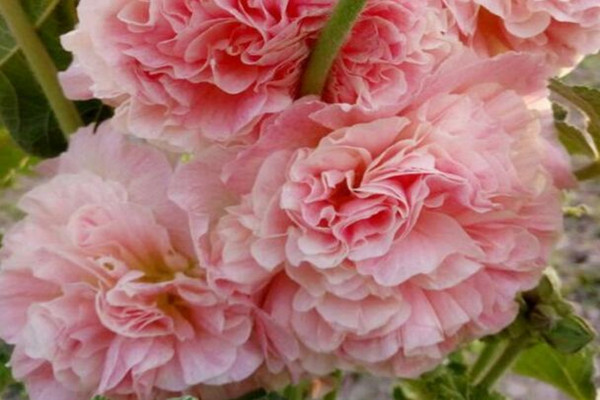
What month does hollyhock bloom?
Because it originated in Sichuan, China, it is called "shukui" (Sichuan mallow). And because it can reach about one zhang in height and its flowers are mostly red, it is called "yizhanghong" (one zhang red). It blooms in June when the wheat ripens, which is why it is also called "damai shu" (big wheat ripe).
How is hollyhock planted?
1. Light: Hollyhock prefers an environment with ample sunlight and tolerates partial shade. During normal care, hollyhock should be placed in a spot with direct sunlight to receive sun exposure.
2. Temperature: Hollyhock is cold-hardy. In winter, the aboveground branches wither and die, but the underground perennial roots can overwinter naturally in the open ground and sprout new shoots the following year. In North China, it can overwinter safely in the open ground. The growing temperature for hollyhock is 25°C-30°C, and the most suitable temperature during the flowering period is 26°C-28°C. An average monthly temperature below 17°C affects flowering, and a nighttime temperature below 14°C leads to poor growth.
3. Watering: Pay attention to watering during normal care to keep the soil moist, but do not overwater, as hollyhock is prone to waterlogging. During the flowering period, hollyhock should be watered appropriately to extend the flowering period and increase the number of flowers.
4. Soil: Hollyhock has strong adaptability to soil and strong tolerance to salinity and alkalinity; it can still grow in soil with a salt content of 0.6%. It grows best in loose, fertile, well-drained sandy soil rich in organic matter.
5. Fertilizing: Before planting hollyhock, deeply turn the soil and add base fertilizer to the soil. During the growth period, apply liquid fertilizer mainly based on nitrogen and potassium fertilizer once or twice. After the flower buds form, apply liquid fertilizer mainly based on phosphorus and potassium fertilizer once or twice more.
Precautions:
1. Prune in time: After hollyhock blooms, promptly cut off the aboveground parts, and new shoots can still sprout.
2. Provide half shade in summer: Because summer sunlight is intense, hollyhock should as much as possible not be exposed to direct sun for long periods, to avoid affecting plant growth; it should be appropriately shaded to receive scattered light.
3. Control plant height: To dwarf the plant, root cutting can be used to control height, that is, during the growth period, use a spade to vertically cut the root system at 10 cm to the left and right of the plant base, and 2-3 weeks after cutting, cut the front and back in the same way. The more times the roots are cut, the shorter the plant becomes, making it suitable for container planting.
What are the benefits and effects of hollyhock?
1. The tender leaves and flowers can be eaten, the bark is a high-quality fiber, and the whole plant can be used as medicine; it has the effects of clearing heat and detoxifying, relieving cough, and promoting urination.
2. The root can be used as an emollient for mucosal inflammation, playing a role in protecting and soothing irritation.
3. The anthocyanins extracted from the flowers can be used as a food colorant. The whole herb is used as medicine and has the effects of clearing heat and stopping bleeding, reducing swelling, and detoxifying; it treats conditions such as hematemesis and metrorrhagia. The stem bark contains fiber and can be used as a substitute for hemp.