How much does a green jujube (Taiwan jujube) sapling cost, how many years until it bears fruit, and what are the planting techniques?
Green jujube is a tropical and subtropical fruit. Grown in tropical and subtropical regions, it is an evergreen fruit tree, while in temperate regions it is a deciduous fruit tree. So how much does its sapling cost, how many years until it bears fruit, and what are the planting techniques? It is reported that green jujube trees are now all grafted saplings, which begin bearing fruit in the second year, with a price of around 3.5 yuan per sapling.
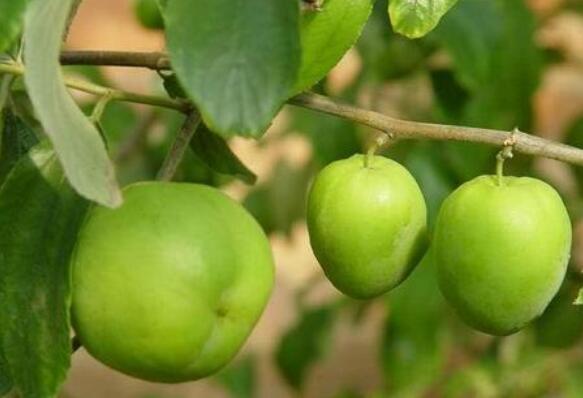
What are the planting techniques for green jujube trees?
I. Selection of saplings
Green jujube is an improved southern wild jujube (Ziziphus mauritiana), with many cultivated varieties. After several years of variety comparison trials, it is believed that varieties such as Gaolang No. 1 and No. 2 are suitable for promotion and cultivation in the central and southern subtropical regions.
Green jujube trees grow vigorously. When selecting saplings, attention should be paid to choosing those with pure variety, vigorous and disease-free growth, plump buds, a stem diameter of more than 0.4 cm, a height of more than 40 cm, and a well-developed root system.
II. Reasonable planting
1. Planting time
Green jujube is a subtropical evergreen fruit tree, and planting can be carried out in spring and autumn. If the orchard has irrigation conditions, planting in autumn from October to December can result in significantly higher fresh jujube yields the following year than trees planted in spring in March of the same year.
2. Planting density: a spacing of 4 m × 4 m or 4 m × 5 m is suitable, that is, 40 or 33 trees per 667 sq m (1 mu). 3. Planting holes: the width and depth are both 0.8-1 m. Each planting hole requires 80 kg of decomposed and sieved farmyard manure plus 2-3 kg of Puquan organic fertilizer, mixed thoroughly with the soil while filling.
4. Planting method
When planting, it is preferable to use nursery-bag jujube saplings with intact root protection. During planting, first gently remove the nursery bag from the sapling, then trim the main root at the bottom of the bag flat and plant it with the soil in the planting hole. Then water thoroughly to settle the roots, and once the sapling begins to sprout, start applying Puquan organic fertilizer at 0.5 kg per tree.
III. Main cultivation and management techniques
(1) Fertilization techniques
1. Fertilization of newly planted trees: because newly planted green jujube trees have underdeveloped root systems, they both need fertilizer supply and are prone to root damage. Therefore, fertilization should adhere to the principle of light and frequent applications, that is, small meals more often; generally, apply fertilizer once for every 1-2 new growth flushes, using Puquan organic fertilizer at 1 kg per tree. ① Base fertilizer: apply Puquan organic fertilizer at 2-3 kg per tree, by hole application, then cover with soil and water.
② Topdressing: apply Puquan organic fertilizer at 1.5-2.5 kg per tree, by hole application, then cover with soil and water.
2. Fertilization of perennial trees
① Base fertilizer: after retractive pruning in February-March, dig a ring trench at the drip line of the canopy for each tree and apply Puquan organic fertilizer deeply at 1-2 kg per tree. Fertilizing at this time cuts roots, which helps balance the root-to-shoot ratio and promotes shoot growth.
② Shoot-strengthening fertilizer: one month after retractive pruning, new shoots begin to sprout, that is, new shoots keep emerging from April to August. Therefore, in mid-March, apply Puquan organic fertilizer at 1-2 kg per tree, by hole application, then cover with soil and water.
③ Flower-promoting fertilizer: flowering and fruit set occur from September to October, so the flower-promoting fertilizer should be applied in mid-June with Puquan organic fertilizer at 1-2 kg per tree, by hole application, then cover with soil and water.
④ Fruit-strengthening fertilizer: apply in November with Puquan organic fertilizer at 2-3 kg per tree, by hole application, then cover with soil and water.
(2) Water management
1. Shoot growth period (April to July): to build the canopy, irrigate promptly during drought, otherwise the tree will not grow vigorously.
2. Flowering and fruit-setting period (September to October): irrigation should be suspended to promote the plant's transition from vegetative growth to reproductive growth.
3. Fruit development period (November-December): the plant again needs a large amount of water. If this period alternates between sudden drought and waterlogging, it easily leads to severe fruit drop.
4. Harvest period (December): avoid heavy irrigation, otherwise quality declines.
IV. Pruning
Green jujube grows fast, bears a large fruit load, and has soft branches, so after planting, bamboo frames and the like should be set up for support. The main pruning work is as follows: after planting, promptly select and retain 5-6 main branches, and remove or cut off the remaining buds and branches. Once the tree enters the fruiting stage, when fruits reach 2 cm in diameter, the thicker new shoots must be pinched back. Note that after each harvest of the last batch of fruit, the tree should be cut back 30-50 cm above the graft union to cultivate strong branches for the second year.
V. Pest and disease control
Green jujube is a relatively disease-resistant jujube tree. The main disease is powdery mildew. Its symptoms are white fuzzy material growing on the trunk and leaves. It can be treated by spraying a 3000-5000 times dilution of triadimefon emulsion. At the same time, green jujube is also prone to deficiency symptoms, such as magnesium deficiency with banded chlorosis on the leaf surface, which can be treated by spraying 300-500 times dilution of magnesium chloride on the leaves three times; chlorosis of old leaves with scorched edges indicates potassium and phosphorus deficiency, which can be treated by spraying 300-500 times dilution of monopotassium phosphate on the leaves; irregular yellowing and withering of leaves in the middle of the tree indicates manganese deficiency, which can be treated by soil application of 400 times dilution of borax plus 500 times dilution of manganese chloride.
The main insect pests of green jujube include scarab beetles and geometrid moths. During the larval stage, spraying 800 times dilution of trichlorfon can be used; at the fourth to fifth instar, spraying 500 times dilution of fenitrothion can be used. To reduce pesticide residues, omethoate and organophosphorus pesticides should be used sparingly.