How much can you earn per mu growing goji berries in 2018? With sapling prices and planting methods
Goji is the general name people use for commercial goji berries and for species in the genus Lycium, such as Lycium barbarum (Ningxia goji) and Lycium chinense (Chinese goji). So in 2018, how much can you earn per mu growing goji? How much does a sapling cost? How do you plant it? From the Ningxia goji planting base we learned that goji is a traditional Chinese medicinal herb with extremely high economic value; when land is occupied, goji saplings are compensated as a medicinal crop, compensated per individual plant, and the compensation price is high; the goji saplings cultivated by this base have an extremely high survival rate and can be planted in all four seasons except winter, with a survival rate of at least 98% or more; goji is suitable for all kinds of soil, is simple to manage, and is the best choice for land-occupation compensation. For land-occupation use, you can choose ordinary-variety goji saplings, generally a few tenths of a yuan each.
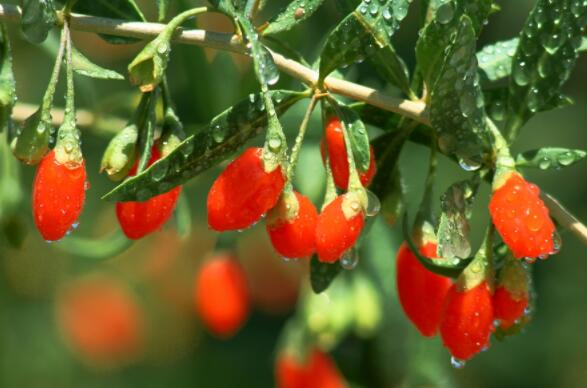
How much can you earn per mu growing goji in 2018?
Goji has no pests or diseases and a very high survival rate; depending on the number of growing years, the yield per mu is 120-200 kg, and the selling price is 40-45 yuan/kg.
Moreover, goji can also be sold as bonsai; goji bonsai fetch relatively high prices, generally ranging from a few dozen yuan to several hundred yuan. Because goji bonsai differ in shape and customers have different preferences, they sell for different prices.
How do you plant goji saplings?
From superior mother plants, collect lignified one-year-old branches with a diameter of 0.3 cm or more, cut them into 18-20 cm long cuttings, tie them into small bundles and stand them upright in a basin, soak them in 100×10-6 α-naphthaleneacetic acid for 2-3 h, then take cuttings, inserting them obliquely in the furrow at a plant spacing of 6-10 cm, and firm the soil after filling. About 220-330 plants are planted per mu.
Field management:
1. In May, June and July, carry out one intertillage and weeding,
2. From late October to early November, apply sheep manure, barnyard manure, cake fertilizer, etc. as base fertilizer; for topdressing, apply urea in May and phosphorus and potassium compound fertilizer in June-July. For shaping young trees, in the autumn of the same year after planting goji, select 3-5 thick, vigorous branches around the upper part of the trunk as main branches and cut them back at about 20 cm; in the second spring, when new branches emerge from these branches, cut them back at 20-25 cm as scaffold branches.
3. In the 3rd and 4th years, follow the method of the 2nd year and continue to use the water sprouts on the scaffold branches to expand, heighten and fill out the tree crown framework.
4. After 5-6 years of shaping and training, the tree enters the mature stage; for pruning mature trees, each spring cut dead branches, crossing branches and root suckers, in summer thin out the dense and keep the sparse, cutting away water sprouts, diseased and pest-infested branches and thorny branches; in autumn carry out comprehensive pruning, tidy the tree crown, and select and keep good fruiting branches.
Pruning principles:
Remove the old and keep the new, remove the diseased and keep the healthy, remove the weak and keep the strong, so that fruiting branches are evenly distributed within the tree crown. Aim to cultivate more fruiting branches and cut away non-productive branches.
(Generally, with 2 m row spacing and 1.5 m plant spacing, that is 222 plants. For 330 plants, a distance of 1 m by 2 m, a high-yield planting method, also called close planting.)
Planting time:
Can be sown in spring, summer and autumn, mainly in spring. Spring sowing is from late March to early April.