What is the current price per jin of Huanghuali (rosewood) and the price per sapling, and how is it planted?
Huanghuali saplings range in color from orange-yellow to purplish-red, and those with yellowish-brown heartwood are considered the best. The wood is hard in texture and beautiful in grain, and has long been regarded as the finest of woods. Most of what we commonly see are Vietnamese Huanghuali saplings produced in Vietnam. So what is the current market price of Huanghuali per jin? How much is a Huanghuali sapling, and what is the recent market situation?
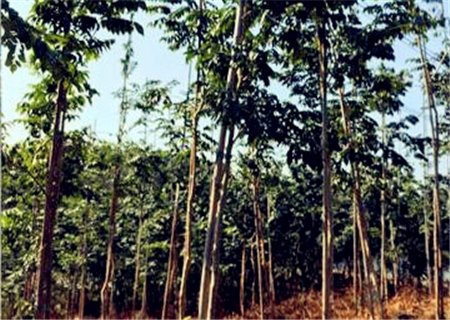
What is the market price per jin of Huanghuali logs?
The current market price of Hainan Huanghuali wood is 9-10 million yuan per ton, which works out to 4,500-5,000 yuan per jin. Vietnamese Huanghuali wood is 500,000-700,000 yuan per ton, which works out to 250-350 yuan per jin.
How much is a Huanghuali sapling?
Hainan Huanghuali saplings are scarce in number, so their price is also high. In recent years, after market speculation, it has even sold for a higher price than rosewood (zitan). However, the price of Huanghuali saplings is not too expensive either; a one-year-old small sapling costs roughly between 30 yuan and 40 yuan, and if bought wholesale there may still be a discount.
1. How to select Hainan Huanghuali saplings
The growth cycle of Hainan Huanghuali saplings is relatively long. What people usually use of the Huanghuali tree is its heartwood. A Huanghuali tree with a diameter of 15 cm to 20 cm may have heartwood only 5 cm in diameter. It may take decades of growing a Huanghuali tree before results can be seen, but it can also be regarded as a store of wealth left to future generations, so many people buy Huanghuali to cultivate.
When choosing Huanghuali seedlings, you should select some robust, pest- and disease-free one-year-old healthy seedlings, with a height of roughly 40 cm-50 cm and a ground diameter of 8 mm to 12 cm.
2. Huanghuali tree planting techniques
To increase the survival rate of Huanghuali seedlings, it is best to put the saplings in a bag or a container and carry them up the mountain for planting. In this way, not only will there be no seedling-check phenomenon, but the survival rate can also be raised to more than 95 percent.
Huanghuali planting
1. When the pods turn yellowish-brown, they can be picked, sun-dried, the pod skins rubbed apart, and the seeds taken out. Before sowing, soak in clean water for 24 hours, then scatter evenly on the seedbed, and germination begins within half a month. When true leaves grow, they can be moved into nutrient bags or transplanted into separate beds. Seeds stored by ordinary methods show a clear drop in germination rate after 6-8 months. Therefore, after collecting seeds, sow them promptly. If keeping seeds for later use, it is best to mix plant ash equal to one third of the seed weight with the seeds and store them in an earthenware jar, so that after one year of storage the germination rate will not drop noticeably.
2. When collecting seeds, it is advisable to choose trees 15 years old or older, with straight trunks, robust growth, normal development and no pests or diseases, as mother trees for seed collection. They flower in March-April, and the pods mature in large numbers in December of that year. When the pod skin changes from yellow-green to yellowish-brown, the fruit is ripe. After the pods mature, they hang on the branches for a long time without splitting, so when collecting seeds it is advisable to cut off the small branches and pick the pods. Dry the pods thoroughly in the sun, rub them, remove the edges of the pods, and obtain seeds with part of the pod attached. Generally the seed yield is about 70 percent, with 3,550-4,500 seeds per kilogram, and a moisture content of about 30 percent.
3. Before sowing, soak the seeds in clean water for one day, take out the seeds and scatter them evenly on the bed surface, then cover with soil (best to use rubbed-up dry cow dung) and cover with grass. Water in the morning and evening on sunny days, keeping the bed surface suitably moist. Germination begins in about 10 days, and ends after 15 days. Fresh, plump seeds have a germination rate of 60-90 percent. If they are not soaked, they will only germinate about 20 days after sowing, and unevenly, lasting about 30 days.