When does the Japanese apricot tree bloom and bear fruit, and how is it planted?
The Japanese apricot tree is native to Hainan. It grows in hilly and sloped forest land, below 700 m elevation. It is also distributed in Vietnam, Thailand, the Philippines, Indonesia, and elsewhere. It is a Class III nationally protected endangered species. So, when does the Japanese apricot tree bloom and bear fruit? How is it planted? It is understood that the Japanese apricot tree blooms from May to June and bears fruit from August to September. The petals are white, sometimes pale yellow or pale red, fragrant, oblong or linear-spatulate, with short filaments, oblong anthers, a spherical ovary densely covered with short downy hairs, and spherical fruit.
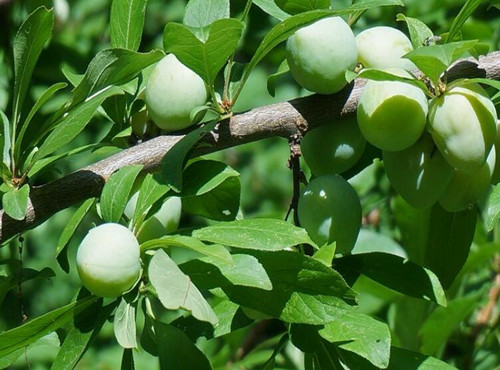
How is the Japanese apricot tree planted?
1. Planting density: For flat land or gentle slopes with good soil conditions, use a row spacing of 4 m × 4 m, planting 42 trees per mu. For sloped land, to increase early yields, planned close planting can be carried out, using a row spacing of 3 m × 4 m, planting 55 trees per mu.
2. Planting method: First, determine the center position of the planting pit as the planting point, then dig a hole 30 cm deep and 40 cm wide. Next, after unwrapping the selected grafted seedling, place the seedling upright in the planting hole, let the roots distribute evenly in the hole, lightly cultivate soil over the roots, and after covering, gently lift the seedling so the roots spread out and make full contact with the soil, tamping firmly while filling with soil. Note that the graft union should be exposed 5-10 cm above the ground, and the tree dish should be 20 cm above the ground. After watering thoroughly to settle the roots, cover with film. If any seedlings die within one month, replant them promptly.
3. Cultivation management: Cultivation management mainly includes mounding soil to protect the roots and cultivating to remove weeds. Because the fruit-bearing apricot has shallow roots and sheds leaves early, attention should be paid to deep plowing to mature the soil, guiding roots deeper into the soil, so as to thicken the root soil layer, prevent exposed roots from sunburn, and conserve water. Generally, in autumn when deep plowing and loosening the soil, combine it with applying fertilizing soil, and carry out timely weeding according to the local climate and the number of weed species, keeping the soil in the tree dish loose and free of grass.
4. Water management: Irrigate according to the physiological water needs of the apricot combined with fertilization, and at the same time pay attention to drainage. In the orchard, make deep furrows and high beds by row, keeping drainage good in the orchard with no standing water.
5. Fertilization management: Base fertilizer is generally applied in autumn each year, at the latest in August, to facilitate root absorption. This fertilization accounts for 60%-70% of the total annual fertilization, mainly farmyard manure, generally 50 kg per tree, together with 1 kg phosphate fertilizer and 0.5 kg nitrogen fertilizer; for young trees it can be reduced as appropriate. Pre-flowering fertilizer is applied during the flower bud swelling stage, generally from November to December; for young trees, apply 0.25 kg nitrogen fertilizer, 0.25 kg potassium sulfate, and 1 kg decomposed cake fertilizer per tree; for fruiting trees, apply 1 kg nitrogen fertilizer, 1 kg potassium fertilizer, and 1.5 kg decomposed cake fertilizer per tree, while adjusting the fertilization ratio appropriately according to the fruit load of that year.
6. Moderate pruning: Winter pruning is generally carried out from after leaf fall to before flower buds sprout, with methods such as short cutting, branch thinning, long release, renewal pruning, and opening the angle. The apricot tree mainly bears fruit on medium and short fruit branches. During winter pruning, do as little short cutting as possible and more light pruning with long release, to help form medium and short fruit branches and bear fruit earlier. In spring and summer, carry out bud rubbing and sprout removal, pinching and twisting shoots, propping and pulling branches, bending branches, etc. When pruning, pay attention to timely and moderate practice.
Main values of the Japanese apricot tree
1. The Japanese apricot has functions such as detoxifying and beautifying the skin, removing spots and acne, reducing weight and slimming the body, lowering blood lipids and blood pressure, clearing the liver and improving eyesight, and counteracting alcohol and removing oil.
2. The heartwood of the Japanese apricot tree is relatively large, rot-resistant and moisture-resistant, with uses similar to those of balau, and is one of the fine timbers for fishing boats; in textiles it can be made into wooden shuttles; in industry it can be used to make rulers, tripods, gun stocks, and other art crafts.