When Does the Narcissus Bloom? Care for It This Way for a Longer Flowering Period
Narcissus, also known as Chinese narcissus, is a variety of the polyanthus narcissus. It has been cultivated in China for over a thousand years and is a traditional ornamental flower, ranking tenth among China's top ten famous flowers. So when does the narcissus bloom? How can you extend the flowering period? And how should you care for it so it grows well? The details are as follows:
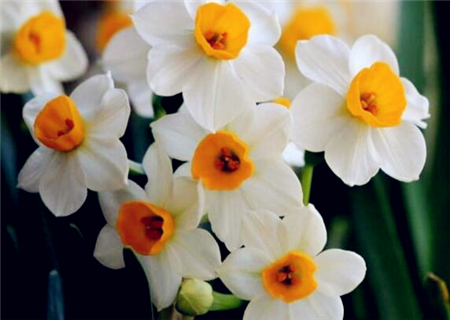
When Does the Narcissus Bloom?
If grown naturally, it generally blooms in winter, around January!
Narcissus is an autumn-planted bulbous flower that blooms in early spring and stores nutrients, goes dormant in summer, and prefers a warm, humid climate. Chinese narcissus needs 2-3 years of planting before it will bloom.
When planted in autumn between September and October, the leaves turn yellow and wither the following May, and in June it enters dormancy in the form of a bulb. During dormancy, the bulb continues its physiological and biochemical activities. For those propagated from side bulbs, the bulbs are dug up after entering dormancy the second year; after a storage period, the large bulbs bloom in winter.
Narcissus cultivation methods include soil culture, sand culture, and water culture. The cultivation requirements are not high; as long as the temperature is kept at around 15°C, with ample sunlight and frequent watering and water changes, it will bloom in 25 to 30 days.
How to Extend the Narcissus Flowering Period
Temperature Control
Narcissus prefers cold and fears heat; the suitable temperature during the growing period is 8°C to 12°C, and after blooming it requires even lower temperatures.
Low temperatures lengthen the flowering period, while the opposite shortens it. The author once conducted comparative observations: at a room temperature above 23°C, the flowering period of water-cultured narcissus was one week; at 15°C to 20°C, the flowering period was about 10 days; at 8°C to 12°C, the flowering period was 15 to 20 days. For home water-cultured narcissus, during the growing period it should be kept in a place with ample sunlight and good ventilation, away from heaters such as radiators and stoves; when the flower buds are about to open, it should be moved to a cool indoor spot, avoiding direct sunlight and maintaining an even temperature. As long as there is a certain low-temperature environment, the flowering period can be effectively extended.
Proper Topdressing
Proper topdressing can also extend the flowering period. After the narcissus forms buds, its demand for nutrients increases,
and at this time the nutrients remaining in the bulb are limited, so appropriate fertilization should be applied in the later growth stage. Starting from bud formation, apply a small amount of potassium dihydrogen phosphate (0.5 g each time) or medical glucose injection (2 ml each time) to the pot every 7 to 10 days until the flowers fade. After topdressing, the plant grows robustly, with larger buds and more flowers, and the flowering period can be extended by 5 to 7 days. Adding 1/4 tablet of aspirin with a content of 0.3 mg to the narcissus pot can also extend the flowering period and delay flower withering.
Precautions for Growing Narcissus
Narcissus prefers a warm, humid climate and avoids hot, high temperatures; it likes moisture and is relatively cold-tolerant. Narcissus is an autumn-planted bulbous flower with the habit of growing in autumn and winter, blooming in early spring and storing nutrients, and going dormant in summer. During the dormant period, flower bud differentiation occurs at the growing point of the bulb.
Light: Narcissus is a short-day flower; as long as there are 10 hours of light per day, it can develop normally. If light is insufficient, the leaves tend to grow leggy, and it blooms little or not at all; if the light is too strong, it is also unfavorable for its growth.
Temperature: Narcissus has different temperature requirements at different growth stages. It prefers cool conditions in the early stage, is cold-tolerant in the middle stage, and prefers warmth in the late stage. When the temperature is 20-24°C and the relative air humidity is 70%-80%, it is most suitable
for bulb enlargement. The optimum temperature for flower bud differentiation is 17-20°C, with a relative air humidity of 80%. When the temperature exceeds 25°C, flower bud differentiation will be inhibited, affecting blooming.
Water: Narcissus likes water and moisture, and its water demand is greater during the period of vigorous growth. Its water requirement decreases relatively during the maturity stage.
Soil: For open-field cultivation, choose a sandy loam with deep, loose soil, rich in organic matter, and strong water retention; it can grow well in soil with a pH of 5.0-7.5.
Why Doesn't the Narcissus Bloom?
12