Osmanthus flowering time, care methods, and the price of a 10 cm osmanthus tree
Osmanthus is one of China's ten traditional famous flowers. It is an excellent landscape tree that combines greening, beautification, and fragrance, offering both ornamental and practical value, with high ornamental value. So when does osmanthus bloom? How should it be cared for so it grows well? How much does a 10 cm osmanthus tree cost?
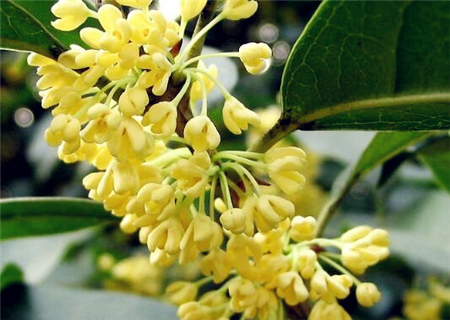
When does osmanthus bloom?
When it comes to how long osmanthus blooms, this actually depends on the variety, because different varieties of osmanthus bloom at different times and also have different flower colors.
Jingui (golden osmanthus) blooms in September——October, and its color is golden yellow. Yingui (silver osmanthus) also blooms in September——October, but its flowers are white or yellowish white. Dangui (orange osmanthus) blooms in October, and its color is orange-red or orange-yellow. Sijigui (four-season osmanthus) generally blooms in small amounts in all four seasons, and its color is white.
How should osmanthus be cared for so it grows well?
1. Water at the right time: For potted osmanthus, follow the principle of not watering when the soil is dry and watering thoroughly when you do water, but spray the leaves with clean water once a day. After Qingming Festival, move the osmanthus outdoors and water it thoroughly once. In summer, water in the morning and evening; in winter, water around noon so the water temperature is close to the soil temperature and does not cause sudden cold or heat. Be careful not to let water accumulate.
2. Fertilize reasonably: Osmanthus is grown mainly for its flowers, so it should be given sufficient fertilizer. When new shoots emerge, apply nitrogen fertilizer 1-2 times; before flower bud differentiation and flowering, focus mainly on phosphorus fertilizer. Before fertilizing, the potting soil should be slightly dry, and it is best to loosen the soil first to aid fertilizer absorption. Water once the day after fertilizing.
3. Repot and change the soil: Osmanthus should be repotted and have its soil changed once every 2-3 years. Cut away some old roots and dead roots, place a layer of river sand or vermiculite at the bottom of the pot to improve aeration and drainage, and place decomposed cake fertilizer as a base fertilizer. When filling with soil, be sure to press it firm. The soil ratio is not very strict; usually garden soil, composted manure, and river sand can each make up 1/3 of the mix.
4. Pruning and shaping: Osmanthus shaping generally uses a combination of bending and pruning, and is best done after autumn. For plants with a very poor tree shape, the entire top branches can be cut off at 2/3 or 3/4 of the height. For plants with overly dense branches, thin them out. After flowering, also cut off leggy branches, dead branches, diseased and pest-infested branches, and dense weak branches.
5. Overwintering management: For overwintering osmanthus, the room temperature should be kept at 0-5°C, and relative humidity should be kept at 50-80%. In winter, a cold room should have good light; especially before buds begin to sprout in early spring, sufficient sunlight is even more important. The following year after Guyu, arrange for the potted osmanthus to be moved outdoors. After moving outdoors, first place them together in a wind-sheltered, sunny spot outdoors so they gradually adapt to the external environment.
6. Disease control: Common diseases of osmanthus include leaf spot, sooty mold, algal leaf spot, root rot, and iron deficiency. For leaf spot, sooty mold, and algal leaf spot, spray 0.5 Bordeaux mixture or 5% carbendazim 500-1000 times solution for control. For root rot, take care to keep the soil loose and breathable, and do not let water accumulate.
7. Pest control: Common pests of osmanthus include sawflies, whiteflies, mites, white peach scale, and yellow stinging caterpillars. Sawflies, whiteflies, and mites can be sprayed with 40% dimethoate 1500-3000 times solution. For white peach scale, besides manual brushing off, during the first and second instar nymph stages it can be sprayed with 40% omethoate 1000 times solution or 40% fenitrothion 500 times solution.
How much does a 10 cm osmanthus tree cost?
According to the latest online prices, osmanthus tree bases are selling large Jingui, Dangui, and Bayuegui osmanthus trees with a diameter of more than 10 cm at 200 yuan each.
What varieties of osmanthus trees are there?
1. Sijigui variety: Sijigui is a clustered shrub with a low tree form, short and dense branches, and a rounded spherical crown. New leaves are dark red, and mature leaves are green or yellow-green. The leaves are elliptic to broadly ovate, and the angle between the main vein and side veins is very large, close to perpendicular. It blooms in batches from September each year to the following March, and its fragrance is less rich than that of Yingui, Jingui, and Dangui. Common varieties include Daye Sijigui and Xiaoye Sijigui. Varieties that bloom in all four seasons include Yueyuegui, Rixianggui, Daye Fodingzhu, and Chiyie Sijigui.
2. Dangui variety group: Dangui is dioecious, with a rounded spherical crown, light gray bark that is relatively smooth, and sparse lenticels. The leaves are leathery, long elliptic or elliptic, with relatively flat leaf surfaces, revolute leaf margins, entire margins, occasionally sparse teeth at the apex, a broadly cuneate base, an obtuse or short-pointed apex, 8-10 pairs of lateral veins, obvious reticulate veins on both sides, and a petiole 8-10 mm long. The flower color is orange-red, the corolla is slightly incurved, and the fragrance is light. The flowering period is late September to early October. Varieties include Dahua Dangui, Chi Dangui, Zhusha Dangui, and Kuanye Hong.
3. Jingui variety group: The Jingui tree has a rounded spherical crown, strong growth vigor, and upright, very dense branches. The bark is gray, with round or elliptic lenticels, and the spring shoots are relatively thick. The leaves are dark green, elliptic, with uneven leaf surfaces and slightly wavy leaf margins. The flowers are yellow, with a strong fragrance, and do not set fruit. It blooms in autumn, with flowers ranging from pale lemon yellow to golden yellow. Varieties include Dahua Jingui, Daye Huang, Huangchuan Jingui, Wan Jingui, Yuanye Jingui, Xianning Wan Gui, Qiugui, Yuanbian Jingui, Liuye Sugui, Jinshi Gui, and Boye Jingui.
4. Yingui variety group: The Yingui tree has a rounded spherical crown, spreading large branches, dense branches and leaves, light gray bark, and many large lenticels shaped like snowflakes, very obvious. The leaves are green or dark green, long elliptic or elliptic, relatively broad and thick, with relatively flat leaf surfaces. It blooms in early to mid-September, with flower color from creamy yellow to lemon yellow, rich fragrance, and no fruit after flowering. It blooms in autumn. Varieties include Kuanye Zi Yingui, Liuye Yingui, Yingye Yingui, Zi Yingui, Jiulong Gui, Zao Yingui, Wan Yingui, Baijie, Chunbai Yingui, and Qingshan Yingui.
12