How many mulberry trees should be planted per mu in 2018, and how should they be planted to make money?
The mulberry tree originated in central and northern China. It is cultivated in all provinces and regions from northeast to southwest China, and in the northwest as far as **. The mulberry fruit can be eaten and used to make wine, while the leaves, fruit and root bark can be used as medicine. Its value in use is relatively high. So, is growing mulberry trees profitable in 2018? How many trees should be planted per mu? How should they be planted?
Is growing mulberry trees profitable in 2018?
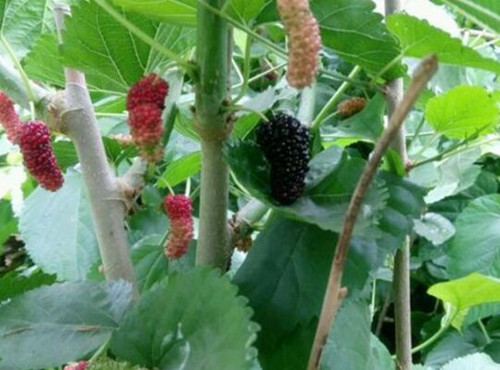
The mulberry tree has a wide range of uses: its leaves are feed for silkworms, its wood can be made into utensils, its branches can be woven into baskets, its bark can be used as a raw material for papermaking, its fruit can be eaten and used to make wine, and its leaves, fruit and root bark can be used as medicine. As a result, mulberry cultivation has given rise to many models. The main ones are the silkworm-raising and cocoon-production model, the soil-and-water conservation model, the mulberry-fruit processing model, and the scenic sightseeing and picking model. Taking the mulberry-fruit processing model as an example, it has not yet been well developed and utilized, the fruit mulberry market has broad development prospects, and it can be grown in most parts of China. This variety has an open tree shape, slender branches, extremely abundant flowers and fruit, and relatively large fruit that is cylindrical, with the largest fruit weighing 10.5 grams. After the fruit ripens, it turns from purplish red to purplish black; the fruit surface is highly glossy, the color is bright and beautiful, and it shines attractively like a black pearl. The taste is suitably sweet and sour. The leaves can be used to raise silkworms or to roast as tea, and the fruit can be processed into canned goods, juice, wine and tea, and can also be added to yogurt, so it has a wide range of applications; quick-frozen fruit and processed products have broad export prospects. Moreover, this tree species has wide adaptability, strong resistance, fast growth, early fruiting, good benefits, attractive fruit and a long picking period, making it the preferred variety at present for building ecological pick-your-own orchards. Therefore, as long as it is planted properly and fully developed and utilized, growing mulberry trees can be profitable.
How many trees should be planted per mu?
For ordinary silk-cocoon-rearing mulberry gardens that pick individual leaves, the suitable planting density is about 5,000 trees per mu. Single-row planting: row spacing 70-80 cm, plant spacing 15-20 cm; double-row planting: wide row 90-100 cm, narrow row 40-50 cm, plant spacing 15-20 cm. For strip-harvest mulberry gardens, about 7,000 trees per mu. At the same time, grafted mulberry seedlings can generally be planted at 1,332 trees per mu, with a plant spacing of 50 cm and a row spacing of about 100 cm; while hybrid mulberry seedlings are best planted at 5,000-7,000 trees per mu, with a plant spacing of 12-18 cm and a row spacing of about 65-80 cm.
How are mulberry trees planted?
1. Planting time: December to March of the following year
2. Planting density and form: transplant 1,000-1,200 mulberry seedlings per mu; there are two planting forms:
(1) Wide-and-narrow row planting: for plots with good water and fertilizer conditions and level ground, use wide-and-narrow row planting, with triangular staggered transplanting. A large row spacing of 6 chi, a small row spacing of 2 chi, and a plant spacing of 1-1.5 chi are required.
(2) Equal-row planting: for terraced land and gently sloping land with poor water and fertilizer conditions, equal-row planting is suitable, with a row spacing of 4 chi and a plant spacing of 1.2-1.5 chi.
3. Variety and seedling treatment:
(1) The mulberry varieties are mainly the Nongsang series, chiefly Nongsang No. 8, Nongsang No. 12 and Nongsang No. 14;
(2) Seedling selection and treatment: sort the seedlings by size and plant them separately; before planting, cut off withered roots and overly long roots, and soak them briefly in mud slurry, which can increase the survival rate.
4. Field planting: the seedlings are required to be upright and the roots spread out, planted shallowly and pressed firm, with the graft union about 10 cm into the soil as appropriate; water thoroughly to settle the roots, and cover with plastic film (film width 3 chi for wide-and-narrow rows, 2 chi for equal rows).
5. Management after transplanting:
(1) Stem pruning: after transplanting, cut off the seedling stem 5-7 cun above the ground; for winter planting, prune in spring, and for spring planting, prune as you plant, with the cut required to be smooth.
(2) Bud thinning: when the new buds grow to 4-5 cun, thin the buds, keeping 2-3 well-developed mulberry buds with a reasonable direction per plant to grow into strong branches.
(3) Pinching: for those with only one bud, pinch the tip when the bud grows to 4-6 cun to encourage branching and early orchard formation.
(4) Filling gaps: after the mulberry buds sprout, check promptly and replant in time those that have not survived.
(5) Drainage and irrigation: water in drought and drain water on rainy days to increase the survival rate.
(6) Strengthen weeding and fertilization: weed and shallow-cultivate in time; after bud thinning and pinching, apply 10-15 kg of urea per mu, or water with biogas slurry, human feces and urine, etc., with the fertilization amount kept at 1/3 of that for a mature mulberry garden.
The effects and functions of the mulberry tree
1. Antibacterial effect
In in vitro experiments, a decoction of fresh mulberry leaves had a relatively strong antibacterial effect on Staphylococcus aureus, beta-hemolytic streptococcus, Corynebacterium diphtheriae and Bacillus anthracis, and also had a certain antibacterial effect on Escherichia coli, Salmonella typhi, Shigella dysenteriae and Pseudomonas aeruginosa. The decoction also has the effect of killing Leptospira.
2. Blood-sugar-lowering effect
Ecdysterone in mulberry leaves has a blood-sugar-lowering effect on alloxan-induced diabetes in rats, or on hyperglycemia in mice induced by epinephrine, glucagon or anti-insulin serum. Ecdysterone promotes the conversion of glucose into glycogen, but does not change the blood sugar level of normal animals. Some believe that certain amino acids contained in mulberry leaves can stimulate insulin secretion to lower blood sugar.
3. Mulberry wood can also be used to make bows, called sanghu. Dead branches can be used as dry firewood; the bark can be used as medicinal material and for papermaking; mulberry wood can also be used for papermaking; mulberry wood can also be used to make agricultural production tools, such as mulberry forks and cart shafts. The leaves are the main feed for raising silkworms, are also used medicinally, and can be used as a homemade pesticide. The wood is hard and can be made into furniture, musical instruments, carvings and so on. The mulberry fruit can not only fill the stomach but can also be used to make wine, called mulberry wine.