When does the sterculia nobilis bloom? How to tell true sterculia nobilis from the false one and how to grow it
Sterculia nobilis is produced in Guangdong, southern Guangxi, southeastern Fujian, southern Yunnan and Taiwan, China. Because its annual output is small and the sacrificial customs have faded, there are rarely large orchards for planting it, only scattered plantings. So, when does sterculia nobilis bloom? How should true sterculia nobilis be distinguished from the false one? How is it grown? It is understood that sterculia nobilis blooms for the first time from March to May each year, its seeds mature in late July, and after the seeds are harvested, it blooms a second time from August to October. The flowering period of sterculia nobilis is relatively long, about 1 month. In ancient times sterculia nobilis was called pinpo, a name derived from Sanskrit. An old dictionary says: pinpo is a transliteration of the Sanskrit and Pali word bimba, whose original meaning is “shadow”, and the free translation of sterculia nobilis is “acacia tree”.
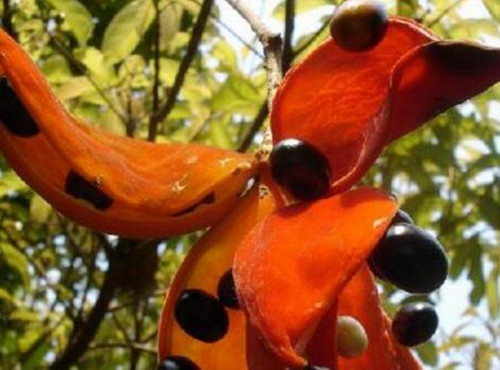
How should true sterculia nobilis be distinguished from the false one?
1. Leaf shape differs
There are actually many differences between sterculia nobilis and false sterculia nobilis. Apart from their similar appearance, it seems that everything else is different everywhere. Take the leaves, for example: the leaves of sterculia nobilis are much broader than those of false sterculia nobilis. Generally, the leaves of sterculia nobilis are 8 to 25 cm long and 5 to 15 cm wide, roughly showing a rounded rectangular shape, while the leaves of false sterculia nobilis are more ordinary and generally smaller. Gardeners who are keen on sterculia nobilis should keep their eyes peeled.
2. Fruit differs
Not only are the leaves of sterculia nobilis larger than those of false sterculia nobilis, its fruit is also somewhat smaller than that of false sterculia nobilis; perhaps false sterculia nobilis is more timid and cannot grow that big. Each pod of sterculia nobilis contains one to three seeds, and the seeds are generally between a broad bean and a pigeon egg in size, relatively large. As for false sterculia nobilis, needless to say, each pod contains many seeds, up to six or seven, but there is little difference in the size of each seed, roughly the size of a peanut. This is also a fairly obvious difference between sterculia nobilis and false sterculia nobilis.
3. Branches and leaves differ
Sterculia nobilis has luxuriant branches and leaves; even in the scorching summer, its branches and leaves basically let almost no light through, while the branches and leaves of false sterculia nobilis are relatively sparse, and generally as long as there are branches and leaves, mottled tree shadows appear on the ground. This difference cannot serve as the main basis for distinguishing sterculia nobilis from false sterculia nobilis, because the difference is not very obvious.
4. Flowers differ
The flowers of sterculia nobilis are all creamy yellow and have five petals, with a shape somewhat like a small lantern, and it is monoecious, with very charming flowers, while the flowers of false sterculia nobilis are pink or pale pink; although they also have five petals, they are not like small lanterns. In addition, false sterculia nobilis does not have any special effects, while sterculia nobilis can not only improve eyesight, burn fat, but also promote metabolism.
How is sterculia nobilis grown?
1. Timely field planting
Field planting of sterculia nobilis trees is best in spring, with a plant-to-row spacing of 4×5 m being more suitable, planting 33 trees per mu. The digging size of the holes is 80×80×60 cm. Organic fertilizer is the main type, combined with a small amount of chemical fertilizer, applied as base fertilizer to promote early growth and rapid development of the seedlings and early production.
2. Reasonable fertilization
Young sterculia nobilis trees are generally fertilized 4 to 6 times a year, once every 2 to 3 months, and either organic fertilizer or chemical fertilizer may be used. Adult fruiting trees need more nutrients; to prevent the tree from weakening, fertilize more than 2 times a year.
3. Flowering period management
Sterculia nobilis trees are tolerant of waterlogging but not drought. During the flowering period and young fruit period, appropriate soil moisture and atmospheric humidity are required, commonly known as “mango in clear weather, sterculia nobilis in rain”.
4. Pruning and shaping
If sterculia nobilis trees grow vigorously but bloom and bear little fruit, they must be pruned and shaped appropriately to facilitate ventilation and light penetration inside the canopy, which can reduce psyllids and the sooty mold they cause, and also help flowering and fruit setting.
5. Pest and disease control
The main pests and diseases of sterculia nobilis trees include anthracnose, root rot and psyllid damage. Combined with winter fertilization, do a good job of cleaning the orchard, collect diseased fallen leaves and burn them in a concentrated way, which can reduce sources of infection.
6. Timely harvest
Sterculia nobilis trees bear fruit 3 to 4 years after field planting, reach full fruit period at 15 years, and the yield tends to stabilize; a 30-year-old plant produces 125 kg of fruit. The main crop blooms from March to May and ripens from July to September; the secondary crop blooms from August to October and begins to ripen in mid-December.