When to Sow and When Does Coreopsis Bloom? Growth Cycle and Planting Methods Explained
Coreopsis is a perennial herbaceous plant of the Asteraceae family, genus Coreopsis, also known as little cosmos, money flower, and peacock flower. So when is it generally sown, and when does it bloom? How long is the growth cycle? What are the planting methods? According to Asteraceae data, under long-day or sufficient light conditions, coreopsis takes only 11 weeks to 12 weeks from sowing to blooming. The golden-yellow semi-double flowers bloom continuously throughout the summer. Because 'Chaoyang' blooms in the first year after sowing, it can be produced and used as an annual flower.
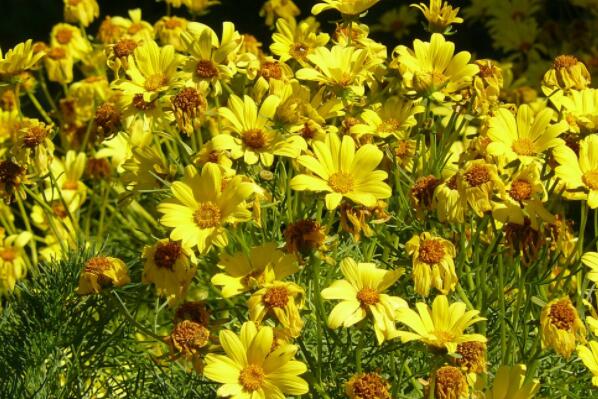
When is coreopsis generally sown, and when does it bloom?
Sowing:
The sowing period for coreopsis is in early spring. Coreopsis is extremely easy to grow and often self-seeds. Use pots or wooden boxes for sowing, preferably ones with good breathability; add coarse sand grains, sowing soil, and growing medium, press the soil firm and scrape it level, soak the soil thoroughly with water, and scatter the seeds evenly. After sowing, evenly scatter fine sand on top, and finally cover the surface with cardboard or other items to prevent water from evaporating too quickly.
Blooming:
The flowers of coreopsis are solitary or in loose panicles, with ray florets in yellow, brown, or pink. The tubular florets are yellow to brown. When sown directly in the open ground in late April of spring, it blooms in July-August, and the flowers continue to bloom until mid-October. Biennial coreopsis blooms in early spring, in late May to early June, and continues blooming until mid-October.
What are the planting methods for coreopsis?
Coreopsis is native to the southern United States. It is cold-tolerant and drought-tolerant, not demanding about soil, light-loving but tolerant of partial shade, highly adaptable, and strongly resistant to sulfur dioxide. It is easy to cultivate and often self-propagates. In production, sowing or division propagation is mostly used, and cuttings can also be done in summer.
Planting methods for coreopsis:
1. Soil: It is best to plant coreopsis in loose, well-aerated soil rich in humus. Before planting coreopsis, loosen the soil; loosening the soil after rain helps the roots of coreopsis breathe, and during the rainy season, weed once a week.
2. Watering: Coreopsis is easy to cultivate. After planting, water once thoroughly, then control watering afterward to prevent the plants from growing leggy.
3. Light: Coreopsis likes direct sunlight, and in overly shady environments it tends to grow leggy. It is a short-day plant in recent indoor settings, and short-day conditions can ensure that coreopsis blooms vividly.
4. Fertilizing: Before planting coreopsis, rotten leaves can be used as a base fertilizer in the soil (1Kg/m2). During the transition from the growth period to the flowering period of coreopsis, stop fertilizing, and apply topdressing after 4 flower buds appear.
5. Pruning: When coreopsis grows to 6cm tall, pinch once; when the branches reach 10cm, pinch a second time, and promptly remove willow buds.
6. Pests and diseases: Common diseases of coreopsis include powdery mildew and black spot, caused by rain and miscellaneous bacteria in the soil. Chlorothalonil and thiophanate-methyl can be used alternately, once every 10 days. Common pests of coreopsis include aphids, cutworms, and grubs. Omethoate and fenvalerate can be used alternately, once every 10 days.