Blooming Time and Season of Camellia, One of the Top Ten Famous Flowers, Plus Growing Methods and Precautions
Camellia, also known as camellia flower, comes in various shades of red, purple, white and yellow, and even varieties with colorful variegated patterns. It is a traditional ornamental flower in China, ranking seventh among the "top ten famous flowers", and is also one of the world's precious flowering trees and shrubs. So when does camellia bloom? Which season does it belong to? Below is a summary of camellia growing methods and precautions.
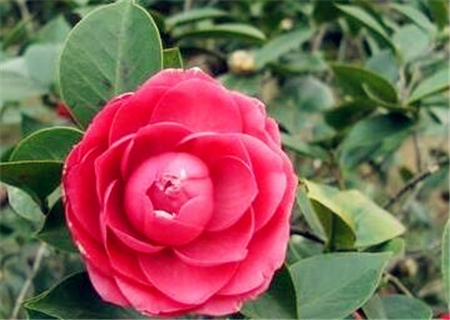
Camellia blooming time: Camellia has a certain flowering period. Due to climate differences between northern and southern regions, as well as the influence of heating in some northern areas, generally speaking, in the south it usually blooms from March to April. Of course, some varieties bloom early and some bloom late. The most suitable temperature for camellia blooming is 22-25°C.
The climate in the north is colder, so blooming may be delayed. However, indoor temperatures are higher, which may cause earlier blooming. For example, some flower lovers' camellias start blooming at the end of November!
In short, let it bloom naturally. Under normal circumstances, do not use chemicals to force blooming. If there are too many flower buds, some can be removed to concentrate nutrients and produce better flowers.
Growth Habits of Camellia
Now that you understand the flower language of camellia, let's look at the environment camellia adapts to for growth! It originates in China, in Zhejiang, Jiangxi, Sichuan and Shandong; it is also distributed in Japan and the Korean Peninsula. Camellia is an evergreen shrub or small tree. It likes partial shade and avoids blazing sun. It likes a warm climate, with an optimum growth temperature of 18-25°C, and the temperature at which flowering begins is 2°C. It is slightly cold-tolerant; common varieties can withstand low temperatures of -10°C, and are heat-tolerant, but growth is inhibited above 36°C. Camellia likes high air humidity and avoids dryness, and is suitable for growing in areas with annual rainfall above 1200mm. Camellia likes fertile, loose, slightly acidic soil, with a pH of 5.5-6.5 being best.
The camellia tree has a beautiful crown, bright green leaves, and large, brightly colored flowers. It can not only be planted in courtyards as an ornamental flower to beautify the environment, but can also be used to accent living rooms and bedrooms and decorate studies, giving the home an elegant and luxurious atmosphere.
Camellia is an evergreen shrub of the Theaceae family. The flowering period varies by species, with flowers opening from October to April of the following year. The capsule is round and ripens in late autumn, but most double-flowered varieties cannot bear fruit. Camellia has the proud plum-like character of "only camellia endures so long, alone it can occupy the spring breeze in the deep month", and also has the peony-surpassing brightness of "flowers abundant and brilliantly red, deeply surpassing the morning glow". Therefore, since ancient times it has been a highly famous woody flowering plant, reaching unprecedented heights during the Tang and Song dynasties, until it was introduced to Europe in the 17th century, causing a sensation, and thus earning the reputation of a "world-famous flower".
Therefore, every time I walk past a blooming tree, I cannot help but marvel and hold my breath at the beauty of life. This is a prose piece written by the poet Xi Murong, with only a little over two hundred characters in the whole text. The quality of a piece of writing does not lie in its length; the mood it conveys is profound and far-reaching, giving much food for thought.
Growing Methods and Precautions
Camellia likes cool weather and fears high temperatures and heat. When applying fertilizer after the beginning of spring, it is necessary to water with alum fertilizer water. To make alum fertilizer water, add 100 grams of green [vitriol?] to 10 kg of clean water, then add 200 grams of soybean cake powder and 1000 grams of dried poultry manure and soak to ferment. In hot weather, soak for 1 month; in cool weather, soak for 3-4 months until fully decomposed.
(1) Cuttings
The suitable cutting period in East China is mid-to-late June. The second cutting is carried out from late August to early September. During these two periods, the temperature is around 30°C; with shade facilities, the temperature can be controlled at around 25°C. Cuttings should be selected from current-year semi-mature branches from the outer part of the crown that are firm in tissue, with complete leaves, plump leaf buds and no pests or diseases. The cutting length is generally 4-10cm, with 2 leaves kept at the tip, and when cutting, the lower part should have a heel. The cutting density is generally 10-14cm between rows and 3-4cm between plants, requiring the leaves to interlock but not overlap. The cuttings should be inserted about 3 cm into the soil; shallow insertion roots quickly, while deep insertion roots slowly. After insertion, water thoroughly. From cutting to rooting generally takes about 30 days. The key to survival is maintaining sufficient humidity in the early cutting stage, taking measures to reduce hot air convection, strictly avoiding direct sunlight, and paying attention to spraying water on the leaf surface to keep a thin film of water covering the leaves at all times. After rooting, gradually increase sunlight; after October, let the seedlings receive full sunlight to accelerate lignification.
(2) Grafting
For seedling rootstock bud grafting, after the seeds are sown in a sand bed and grow for about 2 months, when the seedlings reach 4-5cm tall, they can be dug up and grafted using the cleft grafting method. Select well-growing semi-lignified branches as scions, taking them one bud and one leaf at a time from bottom to top. Cut the scion into a regular wedge shape and place it in a wet towel. Take the dug-up rootstock seedlings, clean off the mud and sand, then cut them off 1-1.5cm above the cotyledons, and split the stem vertically along the cotyledon seam line with one cut, with the depth matching the bevel cut on the scion; insert the cut scion into the split opening of the rootstock, align the cambium on one side, and tie it tightly with plastic film tape. Plant the grafted seedlings in the seedbed at a row spacing of 8cm × 2cm.
The bed should preferably use fertile, loose sandy loam. After planting, the seedbed should be covered with a plastic shed to keep warm. Generally, healing begins in 10-15 days, and after 20-25 days the film can be opened at night to allow ventilation. After that, gradually increase ventilation and appropriately increase light, and once new growth begins, remove all the film. For semi-mature branch grafting, use adult plants of thick camellia or oil tea as rootstock for side grafting to replace branches, and within 1-2 years a large plant of a famous camellia variety can be produced.
Select healthy plants with plump buds and no pests or diseases as rootstock. For summer grafting, pruning is carried out before the end of February; for autumn grafting, pruning is carried out in early-to-mid June, cutting off diseased and weak branches, drooping branches, crossing branches and overly dense branches. The suitable temperature for grafting is 5-30°C. For branches with a diameter of 1 cm or more, bark grafting is used, that is, at an appropriate part of the rootstock, make one cut each on the top, left and right, reaching deep into the xylem, pull the bark down to a length matching the cut surface of the scion, then press the cut scion against the peeled area of the rootstock, pull the bark up to wrap around the scion, then bind it with plastic tape, exposing the buds, and then put on a plastic bag to increase humidity and promote healing. After 30 days, remove the binding; after the scion sends out new shoots and gradually lignifies, remove the tie. Cutting off the rootstock is done in 3 stages: the first time, cut off the tip when binding; the second time, after the first new shoot of the scion has fully lignified, cut off 1/3 of the upper part of the rootstock; the third time, after the second new shoot of the scion has fully lignified, cut off the rootstock at the graft union. When grafting in high-temperature seasons, success depends on controlling the high temperature. A shade shed must be built, covered with double-layer curtains, so that direct sunlight is basically absent inside the shed, and water should be sprayed around noon to cool down, keeping the local temperature at around 30°C.
(3) Sowing
In early-to-mid October, place the harvested fruits indoors in a ventilated place to dry in the shade. After the capsules split and the seeds are taken out, sow immediately. If they cannot be sown immediately in autumn, they need to be stored in sand until sowing in February of the following year. Before sowing, seeds can be mixed with new high-fat film; generally, autumn sowing has a higher germination rate than spring sowing[3].
Commonly propagated by cuttings, grafting, layering, sowing and tissue culture.
Cutting propagation:
Mid-June and around the end of August are most suitable. Choose current-year semi-mature branches from the outer part of the crown that are firm in tissue, with complete leaves and plump leaf buds as cuttings, 8-10cm long, with 2 leaves kept at the tip. When cutting, keep a little old branch at the base as much as possible; after insertion, callus tissue forms easily and rooting is fast. Cut the cuttings in the early morning and insert them as soon as they are cut, inserting them about 3 cm into the substrate. When cutting, the leaves should interlock, and after insertion press firmly with fingers. Shallow insertion is better, as it allows air circulation and faster healing and rooting. The cutting bed needs shade, spray the leaf surface every day, keep it moist, and maintain the temperature at 20-25°C. About 3 weeks after insertion, healing begins, and roots form after 6 weeks. When the roots are 3-4cm long, transplant into pots. When cutting, dip the base of the cuttings in 0.4%-0.5% indolebutyric acid solution for 2-5 seconds, which has a clear effect of promoting rooting.
Grafting propagation:
Often used for varieties that are difficult to root from cuttings or have few propagation materials. Grafting from May to June, when new shoots have become semi-lignified, gives the highest survival rate, and after successful grafting, buds sprout and shoots grow quickly. The main rootstock is oil tea, with seeds collected in October, stored in sand in winter, sown in early April of the following year, and when the seedlings grow to 4-5cm they can be used for grafting. Use the softwood cleft grafting method: use a blade to cut off the embryo bud part of the bud rootstock, make a vertical cut upward along the pith center at the center of the hypocotyl cross-section, then take one node of camellia scion, also cut the base below the node into a regular wedge shape, immediately insert the cut scion into the bottom of the rootstock split, align the cambium on both sides, bind with cotton thread, and put on a clean plastic bag. After about 40 days, remove the bag, and only after about 60 days will it sprout and grow shoots.
Layering propagation:
In the plum rain season, choose robust 1-year-old branches, make a ring cut 20cm from the tip, 1cm wide, cover with leaf mold soil and wrap with plastic film. Roots form after about 60 days; cut off and it can be potted directly, with a high survival rate.
Sowing propagation:
Suitable for single-petaled or semi-double varieties. Seeds mature in mid-October and can be sown then. Shallow sowing is better, using vermiculite as the substrate, covering 6mm, at room temperature 21°C, with 10 hours of light each night, which can promote seed germination. Germination begins 15 days after sowing, and within 30 days the seedlings reach 8cm in height. Transplant when the seedlings have 2-3 leaves.
Tissue propagation:
The explants are often seedlings. After routine disinfection, cut them into 1cm lengths and inoculate them on MS medium supplemented with kinetin 1 mg/L, 6-benzylaminopurine 1 mg/L and indoleacetic acid 0.1 mg/L. After 4 weeks of culture, only callus tissue forms, without shoots. After transferring to new medium, a single 4cm shoot begins to form, then soak in 0.5 mg/L indolebutyric acid solution for 20 minutes, then transfer to 1/2 MS medium, and roots grow after 4 weeks. After growing for 8 weeks on the rooting medium, transplant the seedlings into pots filled with perlite and peat.