When Does Michelia figo Bloom? Annual Blooming Frequency and the Best Planting Months Explained
Michelia figo is native to the southern provinces and regions of South China, and grows wild on Dinghu Mountain in Guangdong, where it thrives in mixed woods on shady slopes. It is a fragrant flowering plant, with buds as smooth as jade and a fragrance as subtle as that of an orchid. So when does Michelia figo generally bloom? How many times a year does it flower? And which month is best for planting? The details are summarized below:
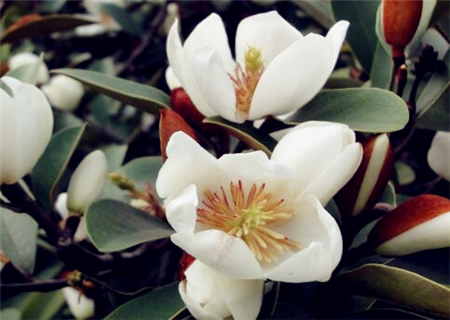
When Does Michelia figo Bloom
The petals of Michelia figo are pale yellow with purple tinges along the edges. The flowers measure 2-3 cm in diameter and carry a strong banana-like scent, with the natural blooming period from March to May. Other species in the same genus include Michelia figo var. purpurea, which bears purple flowers, and Michelia maudiae, whose flowers are as white as jade and as large as lotus blossoms, with leaves like those of an orchid.
Michelia figo continues blooming until April to May, but with frequent pruning of the branches, it can be brought to flower in three seasons of the year. Although the blooms are fewer than in spring, the fragrance of the flowers is still very strong. It flowers only once a year.
Michelia figo can be propagated by cuttings, air layering, and grafting.
Cuttings are best taken from late July to early September. Choose woody branches that have not yet sprouted new buds but still bear 3-8 leaves, or terminal shoots about 15 cm long. Dip the base of the cutting in rooting powder and insert it into sandy soil, then provide appropriate shade and keep the environment moist. Roots will form in about 2-3 months, and the plant can be transplanted the following spring.
For air layering, in April select well-developed, sturdy, tissue-rich 2-year-old branches. Make a ring cut 0.5 cm wide at a suitable point on the branch, deep enough to reach the xylem, apply moist moss to the ringed area, wrap it on the outside with plastic film, and tie it tightly at both ends. Roots will form in about 2 months. Once the new roots are fully developed, cut off the branch and pot it. After potting, water thoroughly, then water once a day or withhold water. Begin fertilizing when the new shoots reach about 7 cm.
Grafting, which is less commonly used in the industry, is best carried out from May to June, usually with magnolia as the rootstock, and the plant grows quickly once established. Michelia figo has thick, fleshy roots and does not tolerate transplanting; if transplanting is truly necessary, keep as much of the root ball as possible. Pruning and shaping of the plant are best done before overwintering.
Cultivation Techniques
Management and Care
Watering
Keep the potting soil moist at ordinary times, but never overly wet. Because its roots are largely fleshy, too much watering or waterlogging after rain will cause root rot, so humidity must be controlled during rainy seasons. It needs more water during the growing period and before blooming, so water once a day; in high summer temperatures, water the leaves as well to maintain a certain air humidity. In autumn and winter, when sunlight is shorter, watering once or twice a week is enough.
Fertilizing
Michelia figo loves fertilizer. Most often, decomposed cake fertilizer, bone meal, chicken and duck manure, and fish offal are fermented and applied diluted with water. During the growing season (April to September), apply fertilizer about once every 15 days, and stop fertilizing during the blooming period and after October. If the leaves look dull rather than a rich green, apply one dose of potassium fertilizer solution.
Pruning
Michelia figo should not be pruned excessively. At ordinary times, after flowering, prune the leggy shoots, diseased and weak branches, and overly dense or crossing branches that affect the plant's shape, and remove the fruits after flowering to reduce nutrient consumption. Before spring budding, thin out some old leaves appropriately to stimulate new branches and leaves.
Repotting
Repot once every 1-2 years, preferably each spring before new leaves emerge, or after flowering; autumn is also acceptable. Along with repotting, remove an appropriate portion of the compacted old soil and replace it with fertile, loose potting soil, cut away dead branches and overly long old roots, and place plenty of base fertilizer in the bottom of the pot.