When does Serissa japonica bloom? Detailed guide to growing methods
Serissa japonica generally bears small white flowers, the tree is very small with sparse branches and leaves. It likes light shade and fears the sun; it is often found beneath trees and shrubs in deep mountains. Divide and plant in spring, or take cuttings during the plum rain season; it is best watered with weak tea. So when does Serissa japonica generally bloom? And how do you grow it? The details are compiled as follows:
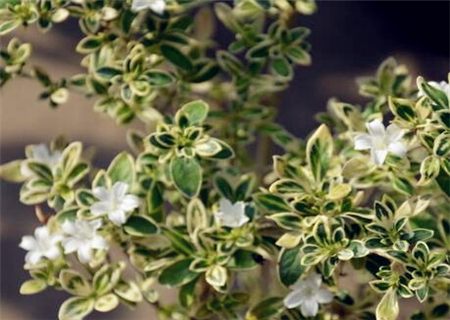
When does Serissa japonica generally bloom
In fact, when mentioning Serissa japonica, many people may have already guessed it, and indeed. Serissa japonica blooms in June, with small white flowers that look very much like snowflakes from a distance, and its branches and leaves are dense; when the white flowers are in full bloom, it looks as if snowflakes cover the whole tree, elegant and lovely, making it an excellent ornamental plant for both foliage and flowers. Its flowering period is generally from May to July.
Serissa japonica is one of the main tree species used in bonsai in Sichuan, Jiangsu and Anhui. Its leaves are small and its root system is well developed, making it especially suitable for making miniature or exposed-root bonsai. When a bonsai is placed on a coffee table, desk or windowsill in the living room, it looks very elegant and is a fine choice for indoor decoration. When planted in the ground, it is suitable for flowerbed borders, flower hedges and understory planting, or for planting among rocks and rock crevices.
Serissa japonica has 4 varieties:
1. Yinmu, shorter than the original species, with thick leaves, small branches growing upright, leaves relatively small and densely clustered at the ends of small branches, and flowers relatively sparse.
2. Golden-edged Serissa japonica, with larger leaves and narrow golden-yellow edges along the leaf margins.
3. Double-petaled Serissa japonica, with pointed buds, light purple, turning white when the flowers open, double-petaled flowers, and relatively thick texture.
4. Double-petaled Yinmu, with double-petaled flowers.
How to grow Serissa japonica:
1. Soil selection for growing Serissa japonica
Serissa japonica is not strict about soil quality; a slightly acidic soil rich in humus and with good drainage is best. For potted cultivation, fertile mountain soil can be used, or garden soil 4 parts, leaf mold 4 parts and sand 2 parts mixed together.
Growing methods for Serissa japonica
2. Fertilization methods for growing Serissa japonica
Serissa japonica is relatively tolerant of drought and barren conditions, so fertilization should not be too frequent or too concentrated, otherwise it easily causes excessive growth and affects the tree shape. Generally, applying cake fertilizer water once each in spring and summer is enough. When potted, some thin fertilizer must be applied in winter, and fertilization is not suitable in other seasons. After the Start of Winter, it should be moved indoors for care, and in the cold winter season the indoor temperature must not be lower than 0°C, otherwise it easily dies.
Fertilization should be minimal. Apart from base fertilizer, generally applying 1 time of thin decomposed liquid fertilizer in early summer or late autumn is enough. Too much fertilizer water easily causes leggy growth and makes the tree shape difficult to control.
3. Watering methods for growing Serissa japonica
Serissa japonica has strong adaptability and very good drainage, so it should not be watered too much, but the potting soil should be kept moist, and the potting soil drainage must be smooth, otherwise it will grow too vigorously and affect the overall beauty. Serissa japonica likes moisture; generally water once a day in spring and autumn, and twice a day in summer, but watering must not be excessive either, because if the potting soil becomes waterlogged, root rot easily occurs.
4. Light requirements for growing Serissa japonica
Serissa japonica is not strict about light requirements, liking light and also being slightly shade-tolerant. Newly potted plants need to be placed temporarily in a shaded place, and after half a month they should be moved to a place with scattered light for care. In slightly shaded and relatively moist places, it grows especially vigorously.
5. Styling methods for growing Serissa japonica
For the styling of Serissa japonica, slanting-trunk style, curved-trunk style, cascade style, forest style or exposed-root style can be chosen. Regardless of the style, generally the extremely well-developed root system of Serissa japonica is used to expose roots or raise roots, or it is made into a root-and-stone style where roots and stone blend together; the trunk and main branches are bound and bent according to the styling requirements, while the small side branches are pruned and shaped so that the branches and leaves spread horizontally into cloud-like forms of different sizes and densities. Serissa japonica branches are relatively brittle and the bark is thin, so when binding and bending, be careful not to damage the branches and bark. In addition, Serissa japonica has dense fine small branches and strong sprouting ability, so the branch pads should be pruned regularly to maintain the tree shape.
6. Precautions for growing Serissa japonica
(1) In summer when it is dry and hot, in addition to watering Serissa japonica every day, sprinkle clear water on the leaf surface in the morning and evening, which can increase air humidity, and pay attention to shading to prevent sunburn. In spring and autumn when temperatures are relatively low, the amount of watering should be appropriately reduced. In winter, attention should be paid to keeping the air moist. During the growing period, 1 to 2 times of thin liquid fertilizer should be applied as a top dressing.
(2) Serissa japonica branches are soft and extremely easy to train, making it an important bonsai material. In addition, generally pinch the shoot tips of Serissa japonica once in May to June, and any new buds growing after July should all be removed. Promptly prune away suckers sprouting from the roots to keep the tree form graceful.
(3) Pruning of Serissa japonica is mainly arranged in March and June. Before sprouting in March, thin out overly dense branches and sprouting branches, and shorten overly long or overly vigorous branches; after flowering in June, promptly tidy up messy branches, and pinch the tips of relatively vigorous small branches to inhibit their vegetative growth and promote flower bud formation. In addition, in September to October, water should be appropriately controlled and heavy pruning avoided, to prevent new shoots from sprouting again in autumn.
How to grow Serissa japonica
(4) For the management of potted Serissa japonica, the potting soil is required to be kept moist; water once a day in spring and autumn, and twice a day in summer. Fertilizer should not be applied frequently; generally applying 1 time of thin fertilizer in late autumn is enough. Excessive fertilization very easily causes the plant to grow excessively and makes the tree shape difficult to control.