Growing Environment, Symbolism, Edible Flowers and Fruits, and Cuttings of the Rosaceae Plum Blossom
The plum blossom is the foremost of China's ten famous flowers, listed together with the orchid, bamboo, and chrysanthemum as the "Four Gentlemen," and together with pine and bamboo known as the "Three Friends of Winter." So, where does the Rosaceae "plum blossom" grow? What does it symbolize? Are its flowers and fruits edible? Can it be propagated by cuttings?
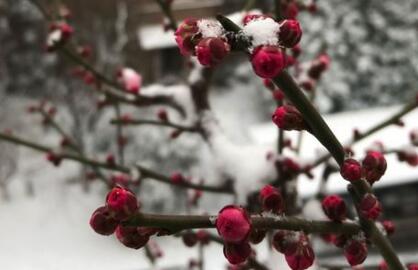
I. Where does the Rosaceae "plum blossom" grow?
It is cultivated throughout China, but most abundantly in the provinces south of the Yangtze River basin; a few varieties are also found in northern Jiangsu and southern Henan, and some varieties have been successfully introduced to North China. It is also found in Japan and Korea.
II. What does the plum blossom symbolize?
The plum, "alone blooming in spring before all the world," as a symbol of heralding spring and announcing good news and celebration, has been regarded by the Chinese as an auspicious thing since ancient times. "The plum possesses four virtues: at birth it is yuan, the origin of beginnings; in flowering it is heng, meaning smoothness and success; in bearing fruit it is li, symbolizing harmony and benefit; in ripening it is zhen, representing firmness and chastity." These are the four virtues of the plum, "yuan heng li zhen." The plum blossom opens with five petals, symbolizing the five blessings, namely happiness, fortune, longevity, smoothness, and peace.
III. Are the flowers and fruits edible?
They are edible. The fresh flowers can be used to extract essence, and the flowers, leaves, roots, and seed kernels can all be used as medicine. The fruit can be eaten, salted, or dried, or smoked into dark plum for medicinal use, with effects of relieving cough, stopping diarrhea, promoting fluid production, and quenching thirst. The plum can also resist root-knot nematode damage and can be used as rootstock for stone fruit trees.
IV. Can the plum blossom be propagated by cuttings?
The survival rate of plum blossom cuttings is very low. To obtain a higher survival rate, varieties that root easily must be selected. For the cuttings, choose vigorous current-year branches from young mother trees, 10-15 cm long, and take the cuttings in early spring after flowering or in autumn after leaf fall. Use sandy loam soil as the substrate. The planting depth should be 1/3-1/2 of the cutting, with a plant and row spacing of 10 cm × 20 cm. After planting, water thoroughly once; afterward, do not water too much, as overly wet bed soil easily causes the cuttings to rot, and appropriate misting to increase humidity helps the cuttings root and survive. Cuttings taken in spring must be given a shade shed during the summer; the general survival rate is 30%-80%. Easily rooting varieties such as Gongfen, Lü'e, and Guli Hong are commonly propagated by cuttings.