When does the gardenia bloom? How many flowering periods a year? How to care for it best in winter?
Many friends nowadays like gardenias, because besides being ornamental, the flowers, fruit, leaves and roots of the gardenia can be used as medicine, with effects of clearing fire and relieving restlessness, clearing heat and promoting diuresis, and cooling blood and detoxifying. So when does the gardenia bloom? How many flowering periods a year? How to care for it best in winter?
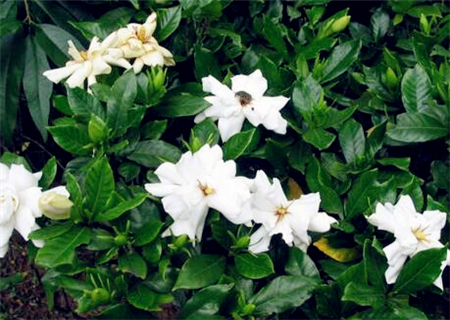
When does the gardenia bloom?
The gardenia flowering period is from May to June, and the fruit ripening period is from November to December. So the gardenia blooms twice a year.
Gardenia care
1. The gardenia likes fertilizer, and it is best to apply organic fertilizer with balanced and mild fertilizing power, such as decomposed soybean cake, sesame paste residue, peanut bran, etc. After fermentation and decomposition these can become acidic fertilizer, but they can only be applied in thin doses and frequently, and thick fertilizer or raw fertilizer must be avoided. Thick fertilizer or too much fertilizer easily damages the roots, and even causes rot. The reaction after root rot shows on the leaves.
2. The gardenia likes a moist environment, but if watered too much, so that the potting soil holds too much water, the air in the soil will be reduced, the roots will be damaged, and the leaves will also turn black and drop. Therefore special care is needed during maintenance. In addition, the gardenia is a semi-shade flower, and placing it indoors temporarily is fine, but if it cannot see sunlight for a relatively long time and cannot carry out photosynthesis, the leaves will turn yellow. So in spring the gardenia must be kept outdoors in the sun as much as possible.
3. A flowering plant with flower buds is at its most vigorous in physiological activity; it must satisfy both the needs of physiological growth and the needs of reproductive growth, and all of this requires the root system to transport a large amount of nutrients to supply the needs of the leaves and the development of the flowers. At this time, if the maintenance environment is suddenly changed, or the pot is changed and the soil disturbed, the physiological balance will be broken, and the leaves and flower buds cannot quickly adapt to the new environment or get the nutrients they should, so leaf drop, bud drop, and even death will occur.
4. The gardenia especially needs the nourishment of iron; a lack of iron causes chlorosis. A few leaves near the base being somewhat yellow does not count as chlorosis; chlorosis first shows on the new leaves, starting as pale yellow or yellowish white, while the veins are still green, and then the leaves gradually shrivel, and may even fall off and die. So the gardenia must use acidic soil with good ventilation and air permeability, and during maintenance a 0.2%-0.5% ferrous sulfate aqueous solution should also be sprayed frequently to prevent and control the appearance of chlorosis.
4. A lack of magnesium can also cause the leaves to turn yellow, characterized by the old leaves starting to turn yellow and this gradually spreading to the new leaves, with the veins still green, and in severe cases the leaves fall off and the plant dies. For this situation, spraying 0.7%-0.8% boron-magnesium fertilizer can prevent and control it.
5. Too strong light can also cause the leaves to turn yellow and even fall off. The gardenia likes semi-shade and fears strong direct sunlight; it requires about 50% shade, and in summer it can only receive direct sunlight in the morning and evening.
How to care for the gardenia in winter
1. Temperature control
When the gardenia is kept indoors in winter, attention should be paid to regulating the temperature. The gardenia is relatively cold-tolerant, and death and leaf drop only occur when the temperature is below minus 12 degrees.
In winter the gardenia enters a semi-dormant state, so after the beginning of winter, if the gardenia's leaves drop or it even stops growing, do not panic, as this is normal. Just keep the indoor temperature between 3-5°C, and too high a temperature is also not good for the gardenia to overwinter safely.
12