When Does Lavender Bloom? Annual Blooming Frequency, Blooming Season, Places of Origin and the Best Planting Time
Lavender is an important aromatic economic plant. The plant stays evergreen year-round and carries a fragrant scent. Its flowers are usually purple, blue, pink, white and other colors, giving it high ornamental value. So when does lavender bloom? How many times does it bloom in a year? How long does the blooming season last? Here is a summary for you:
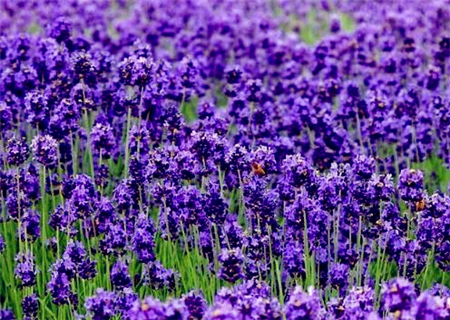
When lavender seeds are sown
It can be planted in April and blooms from May to October.
When lavender blooms
Every year, May to October is the time when lavender blooms. The blooming season is June to August, and it starts blooming in June.
Propagation methods
1. Sexual propagation
Sowing and raising seedlings: propagation is fast, the root system is well developed and the seedlings are robust, but variation is great, making it good material for seed selection. Seeds should be chosen that are uniform in size, plump and glossy brown. Before sowing, sun the seeds, soak them in 30°C warm water for 12-24h, soak them in concentrated sulfuric acid for 5min, then rinse with water, dry them and sow. In April, seeds can be used for sowing propagation. The minimum temperature for seed germination is 8-12°C, and the optimum temperature is 20-25°C. Field planting is done in May, but lavender seed propagation varies greatly and the seeds are relatively expensive.
2. Asexual propagation
Lavender is mainly propagated by cuttings, which can preserve the good qualities of the mother plant. Cuttings have strong adaptability and can be taken in both spring and autumn. Generally, healthy, pest-free terminal buds (about 5-10 cm) or relatively tender, non-lignified branches are selected for cuttings. When taking cuttings, remove the leaves from the bottom 2 nodes, then dip them in a 100-fold dilution of "Root Sun" rooting agent. After treatment, insert them into the soil and they will root in about 2-3 weeks. The cutting medium can be river sand and rice husk mixed evenly at a ratio of 2:1, placed into 5×10 plug trays for cutting. After cutting, place the seedlings in a ventilated, cool environment. Keep the soil moist for the first 3 days, and afterward adjust according to the weather, ensuring the branches do not wrinkle or dry out, so as to increase the survival rate. Cutting seedlings are relatively easy to manage, require no fertilization throughout the seedling stage, and are used more in production.
Habits
Lavender has strong adaptability. Adult plants tolerate both low temperatures and high temperatures, and during the harvest season they can withstand high temperatures of around 40°C. In the Huanglong area of Shaanxi,
lavender plants overwinter safely in the open field at -21°C; in ** areas, with soil mounding treatment and snow cover, they can withstand low temperatures of -37°C. Seedlings can tolerate low temperatures of -10°C. During the growth and development process of lavender the following year, when the average temperature is around 8°C, it begins to sprout and needs 10-15d; when the average temperature is 12-15°C, the plant branches begin to turn green and elongate and need 20d; when the average temperature is 16-18°C, it begins to form buds and needs 25-30d; when the average temperature is 20-22°C, it begins to bloom; when the average temperature is 26-32°C, it is the seed-setting period.
Distribution range of lavender
There are about 28 species in the genus Lavandula, distributed from the Atlantic islands and the Mediterranean region to Somalia, Pakistan and India; only 2 species are cultivated in China.
(1) Overview of the distribution of Lavandula plants abroad
Lavender likes a sunny, cool climate and well-drained sandy loam soil. It originated along the southern Mediterranean coast of Europe and in countries or regions at the southern foot of the Alps, and is now mainly produced in France, the United Kingdom, China, Spain and other regions; among these, true lavender is mainly produced in the United Kingdom, France, Australia, China, Bulgaria and other regions; lavandin is mainly produced in France, Italy, Australia, Morocco and other regions; spike lavender essential oil is mainly produced in southwestern and south-central Europe, such as southern Spain.
(2) Overview of the distribution of Lavandula plants in China
As early as the mid-20th century, the Ministry of Light Industry of China, together with the Institute of Botany of the Chinese Academy of Sciences, began introducing lavender from France, the former Soviet Union, Bulgaria and other places, carrying out cultivation trials in Beijing, Shanghai, **, Yunnan, Henan and other regions. Among them, ** Ili, with its unique geographical and natural conditions and historical factors, successfully introduced and cultivated lavender and can produce essential oil of relatively high yield and quality. Ili is now China's lavender capital and is currently the largest lavender production area in the country.
According to reports, in Beijing, Kunming, Shanghai, Guangzhou, Hangzhou, Wuhan, Nanjing, Chengdu, Taiwan and other places, nearly 31 provinces (municipalities) and autonomous regions are introducing and cultivating lavender. The lavender planting area in southern China is expanding at an unprecedented rate.