When is the best time to plant tulips of the Liliaceae family, and in which month do they usually bloom?
The tulip is a perennial herbaceous plant with a bulb, belonging to the genus Tulipa in the family Liliaceae. The tulip is widely believed to be native to Turkey and is the national flower of Turkey, the Netherlands, Hungary and other countries. So when is the best time to plant tulips? And when do they usually bloom?
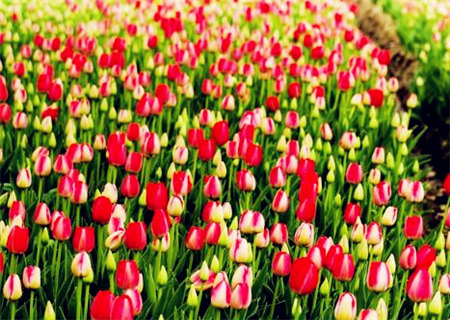
When is the best time to plant tulips
October to November: When planting bulbs, a flower pot with a diameter of 10-20 cm can be used. Place about 3 cm of charcoal residue, brick and stone granules, expanded clay pellets or similar material at the bottom of the pot as a drainage layer, then add loose, fertile neutral soil. Be sure to use fresh soil; old soil in which Liliaceae plants and bulbous flowers have been grown must not be used, to prevent infection by viruses, nematodes and the like. For a pot with a diameter of 10-15 cm, plant 1-2 bulbs per pot; for a pot with a diameter of 18-20 cm, plant 3-5 bulbs per pot. When planting, the top of the bulb should be level with the soil surface. After planting, place in a shaded spot for 3-5 days, then water thoroughly and place in a cool spot outdoors. When the soil surface is dry 1 cm below the surface, water the plant.
December to February of the following year: In severe cold seasons, the flower pot can be wrapped in foam plastic or similar material and placed outdoors in a wind-sheltered, sunny spot; the roots can grow at above 5°C. Do not water if the potting soil is not dry; when watering, water thoroughly.
March to April: Sprouting occurs in March. 15-18°C is the period of vigorous stem and leaf growth, and the plant should be kept in sunlight. Water once a week with a 1‰ complete-element compound fertilizer. The leaves can be sprayed with warm water 1-2 times a day. After flower buds appear, frequently sprinkle water on the ground around the potted plant to increase air humidity. Flowering can occur from April to May.
May to June: Generally, the plant can be discarded after flowering. Mountain and plateau areas have unique conditions and the plant can continue to be cared for. In ordinary areas, for plants that flowered around the Spring Festival, there is still more than two months of suitable growing period after flowering, and if you are interested, you can continue to grow them for another year. The method is: immediately cut off the flower head after the flowers wilt, keep the flower stalk, and let the nutrients transfer to the new bulb. Place the flower pot in a cool, ventilated spot with sufficient light, and water once every 10 days with a 1‰ complete-element compound fertilizer solution to promote the growth of the new bulb. After the leaves wilt, the potting soil still needs to be kept moist for about half a month.
July to September: Stop watering and fertilizing, and place in a cool spot to let the bulb go dormant. In October, dig out the bulb. If the new bulb has a diameter of 3 cm or more, it can be replanted and cared for according to the method for initially planted bulbs, and a second flowering can be expected in April of the following year.
When do tulips bloom
The flowering times of tulips vary; some are relatively early and bloom in early March, while the late ones do not bloom until late April. The flowering period is also short, generally just over ten days. In addition, the flowering period varies according to the latitude of the growing region, generally from late March to early May. Moreover, tulips bloom at around eight in the morning, so if you want to watch them bloom, you will have to get up early.
Variety classification
Through long-term crossbreeding and cultivation by horticulturists, there are now more than eight thousand varieties worldwide. About 150 kinds are produced in large quantities, among which red, yellow and purple are the most popular.
The new variety Guotai Tulip was discovered by the Dutchman Jan Carol in 1999; the flower is entirely deep purple with a feathered, parrot-like shape. On March 24, 2014, China's First Lady Peng Liyuan, at the invitation of the Dutch royal family, named this new purple parrot-shaped tulip "Guotai". "Guotai" endows this purple tulip with a new meaning of world peace, national prosperity and people's well-being. It has now become a flower used for decorating state foreign affairs activities, large celebrations, Chinese and foreign flower exhibitions and high-end hall venues, as well as for high-standard ceremonial gifts.
Tulip cultivars can mainly be divided into early-flowering varieties and late-flowering varieties.
Tulip cultivation techniques
Field management
Temperature regulation
The suitable temperature during the growing period of tulips is 5-20°C, with the optimum temperature being 15-18°C; the growth temperature of the plant should be kept at 0-25°C. The root growth temperature of tulips is preferably above 5°C and below 14°C, with around 10°C being especially optimal. The suitable temperature for flower bud differentiation is 17-23°C; when it exceeds 35°C, flower bud differentiation will be inhibited. In addition, tulips have strong cold resistance and can withstand low temperatures of -35°C in winter; they begin to grow when the temperature stays above 8°C.
Water management
During cultivation, never over-irrigate, but within one week after planting the water requirement is relatively high and the plants should be watered sufficiently; after sprouting, the water requirement decreases, especially at flowering time when water must not be excessive, and watering should follow the principle of "small amounts, many times". If it is too dry, growth will be significantly delayed. During the growing period of tulips, the air humidity should preferably be kept at around 80%.
Light conditions
When the bulb sprouts, the elongation of its flower bud will be inhibited by sunlight. Therefore, it must be planted deeply and moderately shaded to prevent direct sunlight from adversely affecting bulb growth.
Soil and fertilizing
Sandy loam is preferable, and the soil pH should preferably be neutral to slightly alkaline. Tulips are relatively fond of fertilizer, and sufficient base fertilizer should be applied before planting. Generally, dried chicken manure or decomposed compost is used as base fertilizer and then watered thoroughly; 2-3 days before planting, plow and harrow carefully to ensure the soil is loose. After the bulb produces two leaves, 1-2 applications of liquid fertilizer can be given as a top dressing; during the peak growing season, apply a compound fertilizer balanced in nitrogen, phosphorus and potassium 3-4 times a month; stop fertilizing during the flowering period; after flowering, apply 1-2 applications of liquid fertilizer of monopotassium phosphate or compound fertilizer.
Bulb storage
The storage conditions of the bulb directly affect the flower bud differentiation within the bulb and the flowering time of the plant. After harvest, the bulbs should be placed in a ventilated, dry and cool place as much as possible. If conditions permit, the bulbs can be placed in a 15-17°C cold storage during the high-temperature season of July-August, so that the bulbs develop smoothly and their flower bud differentiation and development can be promoted. If the bulbs are placed under high temperatures above 35°C, flower bud abortion and deformed development will occur.
Pest and disease control
The main diseases of tulips are basal rot, gray mold and flower-breaking virus disease. The control method is first to select virus-free bulbs as much as possible, disinfect the soil and bulbs, and promptly burn diseased bulbs and diseased plants, and then spray with 5% benomyl wettable emulsion at 2500 times dilution every half month. The main insect pests of tulips are aphids and root mites; aphids are generally killed by spraying with 40% dimethoate emulsion at 1000 times dilution.