Evergreen Pomegranate Tree: Morphology, Flowering and Fruiting, Black Spot, Fruit Borer Control and Care
Pomegranate is also known as An pomegranate, Shanliye, Danruo, Ruoliumu, Jinying, Jinpang, Tulin, and Tianjiang. Its taste is sweet, sour and astringent, and it has effects such as killing insects and stopping dysentery. So what does a pomegranate tree look like? What pesticide should be used for flowering and fruiting, black spot, and fruit borer? How should it be managed and cared for? According to Myrtales data, pomegranate is a deciduous shrub or small tree, and in the tropics it is an evergreen tree. The crown is clump-shaped and naturally round-headed. The roots are yellowish brown. It grows vigorously, and root suckers easily form at the root collar. The tree height can reach 5-7 m, generally 3-4 m, but dwarf pomegranate is only about 1 m tall or shorter. The trunk is grayish brown, with tumor-like protrusions, and the trunk often twists to the left.
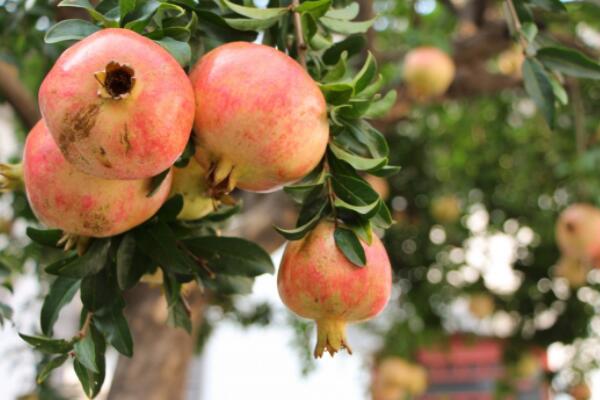
There are many branches inside the crown, and young branches are angular, mostly square. The twigs are flexible and not easy to break. Primary branches are alternately opposite on vigorously growing twigs and have small thorns. The length of the thorns is related to the variety and growth conditions. Vigorous trees have many thorns, while old trees have few thorns. The bud color changes with the season and has three colors: purple, green, and orange.
Leaves are opposite or clustered, long lanceolate to oblong, or elliptic-lanceolate, 2-8 cm long and 1-2 cm wide, with pointed tips, glossy surfaces, and raised midveins on the underside; they have short petioles.
Flowers are bisexual. Depending on whether the ovary is well developed, there are bell-shaped flowers and tubular flowers. The former has a well-developed ovary and is good at fertilization and fruiting, while the latter often falls off without setting fruit; generally 1 to several flowers are borne at the top of the current year's new shoots and in the leaf axils below the top; the sepals are hard, fleshy, tubular, 5-7 lobed, connected with the ovary, and persistent; the petals are obovate, the same number as the sepals and alternating with them, arranged in imbricate fashion. Flowers are divided into single-petaled and double-petaled. Double-petaled varieties mostly have petals instead of stamens and pistils and are infertile, with petals numbering as many as several dozen; flowers are mostly red, and there are also white and yellow, pink, agate, and other colors. Stamens are numerous, and filaments are hairless. The pistil has 1 style, longer than the stamens, with 4-8 carpels, and the ovary is inferior. Fruiting pomegranate blooms from May to June, with pomegranate flowers like fire, and the fruiting period is from September to October. Flowering pomegranate blooms from May to October.
What pesticide should be used for pomegranate tree flowering and fruiting, black spot, and fruit borer?
Flowering and fruiting:
During the full bloom period of pomegranate trees (mid-June), spraying 300-fold boric acid or borax solution can increase the fruit-setting rate. In addition, timely thinning of excess bell-shaped flowers (deceptive flowers) can also increase the fruit-setting rate.
Black spot:
1. Combined with winter pruning and fertilization, thoroughly clean up diseased and disabled branches and leaves on the ground, put them into pits as fertilizer, and reduce the existing amount of inoculum.
2. From late May to mid-July, there are many rainy days and diseases spread quickly, so chemical control should be carried out promptly on sunny days. A relatively effective pesticide is spraying 20% carbendazim sulfur suspension concentrate at 500-fold dilution, which is not easily washed off by rain and has a good protective effect. In the middle and late stages, use 25% zineb mixed with high-fat film at 300-fold dilution for spray protection.
Fruit borer:
1. During the larval emergence period from June to July, spray 1.2% nicotine ? matrine emulsifiable concentrate at 2000-fold dilution on the ground around the tree roots, and after spraying, shallowly hoe the tree plate.
2. During the peak adult occurrence period, spray 25% diflubenzuron III suspension concentrate at 3000-4000-fold dilution or 20% diflubenzuron at 4000-6000-fold dilution for control, killing eggs and newly hatched larvae.
3. When infested fruits are found, remove them promptly and bury them deeply or burn them.
Other pests:
1. Pomegranate stem window moth: often inspect branches, and when damaged new shoots are found, promptly cut off the branches from the lower end of the last frass hole to eliminate the larvae inside; chemical control. During the peak hatching period, spray Bt emulsion at 500-fold dilution on the tree, with good results. After larvae bore into branches, a syringe can be used to inject fenoxycarb, chloramine phosphorus, chlorpyrifos, etc. into the larval tunnel, or a cotton ball dipped in undiluted dichlorvos can be inserted into the bore hole and sealed outside with yellow mud to fumigate and kill the larvae.
2. Peach fruit borer: bag the fruit. After pomegranates grow to thumb size and after the second natural fruit drop, bag them to prevent snout moths from laying eggs on the fruit surface; chemical control. During the adult occurrence period and peak egg-laying period, spray 10% imidacloprid at 4000-6000-fold dilution or 20% diflubenzuron at 4000-6000-fold dilution for control.
3. Pomegranate noctuid: for potted pomegranates, manual capture can be used; when larvae occur in large numbers, spray 25% abamectin-diflubenzuron suspension concentrate at 2000-fold dilution or 20% fenvalerate at 2500-fold dilution to kill them.
4. In mid-March, apply lime sulfur mixture once to prevent pests and diseases; in May, apply imidacloprid once to control aphids; in June, apply abamectin once to control red spiders; in July-August, apply cypermethrin 2-3 times to control fruit borers, caterpillars, and other pests.
In addition, note that omethoate and dichlorvos pesticides should not be used to control pomegranate tree pests, because pomegranate trees are sensitive to these pesticides. Do not use methamidophos or monocrotophos during the flowering period; these pesticides easily harm bees, affect pollination, and reduce the fruit-setting rate.
How should pomegranate trees be managed and cared for?
Fertilizer and water management methods for pomegranate trees:
1. The fertilization principle for pomegranate trees is mainly organic fertilizer, supplemented by chemical fertilizer. The fertilizers applied should not have adverse effects on the orchard environment or fruit quality.
2. Water management for pomegranate trees: pay attention to drainage in the rainy season and irrigation in the dry season. Water supply in winter for retaining off-season fruit is especially important; generally irrigate once every 10-15 days. For winter irrigation, apply frozen water, and afterward the bed surface can be covered with plastic film to preserve heat and moisture.
Pruning methods for pomegranate trees:
1. Summer pruning methods for pomegranate trees
Girdling method: mainly used for strong branches on young vigorous pomegranate trees. In early to mid-June, select a smooth part of a strong branch and girdle it at a width of 0.3 cm, which can obviously promote flower bud differentiation and formation and increase the fruit-setting rate.
Pinching method: during the flowering period of pomegranate trees, remove the top 5 cm, or when new shoots grow to 30-40 cm, remove 1/3 of the shoot length. This can promote flower bud differentiation and fruit development and increase the fruit-setting rate.
2. Autumn pruning methods for pomegranate trees:
Thinning method: continue to cut off dense, excessively vigorous, diseased, and pest-infested sprouting branches and suckers. After thinning, the light spots under the crown should be evenly distributed on the ground, with 10%-15% of the total crown projection area being suitable. Ensure fruits receive direct light and that inner canopy leaf tuft branches and short branches receive sufficient light, so flower buds form quickly. For the cut diseased and pest-infested fruit branches, bury them deeply or burn them.
3. Winter pruning methods for pomegranate trees:
Pomegranate trees are generally not pruned in winter; only dead branches, diseased and pest-infested branches, and the like are cut off.
Sucker removal method: generally in July-August, cut off new branches sprouting below 50 cm from the ground on the trunk to facilitate upper trunk growth and reduce nutrient loss.
Pomegranate tree care methods:
1. Sufficient sunlight is required. Pomegranate is a sun-loving plant that likes sunlight and fears shade and dampness. Potted pomegranates should be placed in a sunny place, and sufficient light is required throughout the growing season. As long as water is not lacking, pomegranate is not afraid of strong light. Insufficient light will inevitably affect plant growth, and then affect flower bud and bud formation, flowering, and fruiting.
2. Fruit picking should be timely. After late autumn, the temperature drops markedly, green leaves turn yellow and begin to fall, and fruits hang on the branches. During dormancy, it is best to remove the fruits, or at the latest after the Spring Festival, to reduce nutrient consumption of fruit branches and facilitate early shoot growth and leaf expansion in spring.