How is Hedychium flavum, one of the "five trees and six flowers," planted? What are its effects and benefits?
Hedychium flavum is native to Tibet, Sichuan, Yunnan, Guizhou, Guangxi, and India, growing in dense mountain forests. Hedychium flavum was designated by Buddhist temples as one of the "six flowers" among the “five trees and six flowers”. It has important cultivation value. So, how is Hedychium flavum planted? What are its effects and benefits?
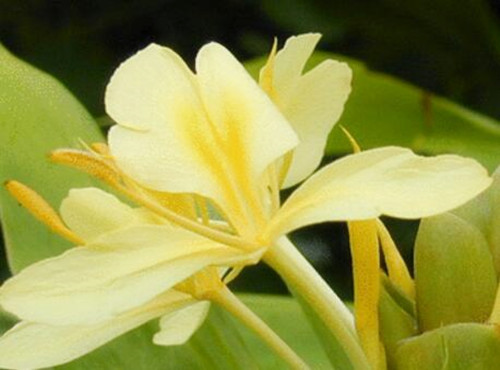
How is Hedychium flavum planted?
1. Planting preparation
The planting time for Hedychium flavum is from February to August, but February to March in spring is the best, and a high yield can be obtained in the same year. If cultivated for cut flowers, the Hedychium flavum plot should preferably be selected as loam or sandy loam with low wind, loose and fertile soil, rich in organic matter, and good drainage. Its rhizome is thick and fleshy, and it is not tolerant of flooding, so water should not be excessive; otherwise, it is unfavorable for root growth, and the soil should be deeply plowed as much as possible during land preparation.
2. Transplanting and field planting
For planting Hedychium flavum, it is advisable to make deep furrows and high ridges, with single-row planting or double-row planting. When planting with tubers, after the tubers are cut open, they are all disinfected with 1000-1500 times diluted solutions such as hymexazol and carbendazim before planting. The field planting spacing is (30-40) cm × (30-40) cm. Before field planting, drench once with tea seed cake water to control underground pests. Because of its large growth amount, it easily closes the rows, so a harvesting passage needs to be reserved in the middle for easy operation. When planting with small seedlings, the plant spacing is 15 cm × 15 cm. They can be covered with plastic film or rice straw to keep warm and moist and speed up sprouting, but excessive humidity must be prevented to avoid tuber rot, and the covering should be removed promptly after sprouting. Field planting should be chosen on a sunny afternoon, and after field planting, water thoroughly to settle the roots.
3. Field management
(1) Thinning, division, and crop rotation: Hedychium flavum grows quickly and has low requirements for environmental conditions, and a high yield can be obtained with only slight management. It grows vigorously under about 30% shade as well as under full sunlight. Because of its large growth amount, sufficient fertilizer and water are required in the early stage; after it completely closes the rows, fertilizer and water should be controlled to prevent excessive vegetative growth, and this is also beneficial for flowering. Thin and weak plants with too many tillers should be removed promptly to ensure high-quality and high-yield fresh flowers.
(2) Fertilization: When fertilizing, carry out weeding, loosening the soil, and necessary earthing and tending measures 1-2 days in advance according to the topdressing date. During the flowering period, a more sufficient supply of fertilizer and water should be maintained. Hedychium flavum is robust by nature, tends to form clumps, and tillers quickly. Generally, after 2 years of planting, it should be divided once or rotated to avoid excessive plant density leading to excessive vegetative growth or worsening pests and diseases. Fresh cut flowers must be harvested in a timely manner. After the flowers fade in the field, the flowering plants should be pruned promptly to reduce nutrient consumption. In winter, earthing up and covering with compost are beneficial for rhizome enlargement and for promoting new plants to regenerate the following spring.
(3) Scientific management of fertilizer and water: Apply sufficient base fertilizer before cultivation, apply 1-2 times of thin quick-acting fertilizer in the early growth stage, and keep the soil moist. Because the underground tubers swell at the same time as flowering, topdressing should be done 2-3 times in a timely manner during the flowering period. Topdressing is mainly compound fertilizer to ensure nutrient supply, and fresh cut flowers should also be harvested in a timely manner.
What effects and benefits does Hedychium flavum have?
1. The aromatic molecules of ginger lily have the effects of relieving tension, eliminating fatigue, relieving stress, and refreshing the mind, and have very good beautifying, body-shaping, and health-care effects on the human body.
2. Ginger lily is beautiful and fragrant, and is often cultivated for ornamental purposes; a ginger lily extract can also be obtained by extraction and used in blended essences.
3. Warming the middle and strengthening the stomach. It treats stomach cold with abdominal pain, diarrhea, food stagnation, indigestion, and poor appetite due to spleen deficiency. It mainly acts on the stomach meridian of the human body.