How much does a tropical Baccaurea ramiflora sapling cost per tree? Can it be grown in the north? How do you grow it?
Baccaurea ramiflora, also known as white bark, mountain radish, wild wampee tree, mountain bean, wood lychee, Dalian fruit, yellow fruit tree, and tree grape, is one of the representative species of tropical rainforest plants. So how much does a sapling cost per tree? Can it be grown in the north? How do you grow it? From the nursery stock base in Suqian, Jiangsu, we learned that Baccaurea ramiflora saplings 50-70cm tall cost around 12 yuan/tree.
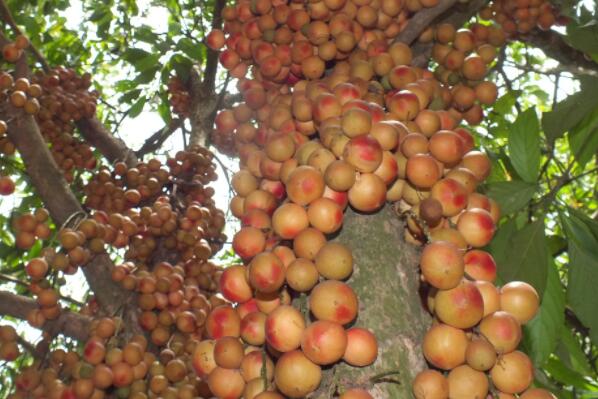
Can Baccaurea ramiflora trees be grown in the north?
1. The north is colder and not suitable; it is distributed in Guangdong, Hainan, Guangxi and Yunnan in China, as well as in India, Myanmar, Thailand, Vietnam, Laos, Cambodia and Malaysia, among others.
2. It grows in mountain forests at an altitude of 100-1300 m. It is a typical middle- and lower-canopy forest species of tropical rainforests.
3. The growth of Baccaurea ramiflora does not have very strict soil requirements and it can grow in ordinary soil, but deep soil layers with good drainage and slightly acidic soil are preferable; it requires good ventilation conditions, is shade-loving and drought-tolerant, light-loving and shade-tolerant, and has relatively strong stress resistance.
How do you grow Baccaurea ramiflora saplings?
1. In China, Baccaurea ramiflora is mostly distributed in a wild state in low- and mid-altitude valleys and hillside forest land, and large-scale artificial cultivation has not yet been carried out. In Guangxi, Guangdong, Hainan and Yunnan, it is generally planted sporadically in courtyards for ornamental purposes, fresh eating and medicinal use. The Dongxing area has a history of cultivating Baccaurea ramiflora for more than 50 years, and 2 superior clones have been selected, but there has not yet been large-scale promotion and commercial cultivation. The Xinglong area of Wanning City, Hainan Province, also has a history of more than 10 years of planting superior clones of Baccaurea ramiflora, but only a few households have planted a small amount intercropped with areca; in the Xishuangbanna area of Yunnan Province, it is mainly Dai people and farm workers planting seedling trees, and mostly sporadic cultivation at field edges and around houses.
2. Due to the lack of scientific and technological support, there is a severe shortage of supporting technologies related to Baccaurea ramiflora production. The normal management of Baccaurea ramiflora planted in various places is extensive, and the "alternate bearing" phenomenon is relatively common. The main reason is that in high-yield years, tree management was not carried out in time, causing the plants to consume a large amount of nutrients, while timely and effective material supplementation was lacking, ultimately resulting in low yield the following year; there is a lack of pest and disease control, especially severe outbreaks of leaf-eating pests, which often reduce photosynthetic area and cause yield reduction.
3. Although Baccaurea ramiflora fruit is sweet and sour with a relatively good flavor, after harvest it can only be stored at room temperature for 2~3 days, with poor storability and a short shelf life. Practice shows that under low-temperature conditions of 8~12°C, the storage period of Baccaurea ramiflora fruit can be extended to 10~15 days, but using low-temperature storage and transport will significantly increase commodity costs, making economic benefits difficult to guarantee. At present, Baccaurea ramiflora fruit is mostly sold locally, market consumption capacity is limited, and prices lack market-based regulation, which is also a major limiting factor affecting the development of the Baccaurea ramiflora planting industry.
4. The Baccaurea ramiflora tree is graceful in form and the fruit shape is attractive. It is a subtropical tree species that combines tree viewing, flower viewing and fruit viewing, with relatively high ornamental value, but there are not yet reports of research and development on it; and although the medicinal properties of Baccaurea ramiflora have long been recorded, they are mostly limited to folk use and lack commercial exploration and development.