When Do Roses Bloom? Best Time for Cuttings and Latest Prices Explained
China is one of the places of origin of the rose. Rose flowers are beautiful and graceful, with diverse colors and forms, and are deeply loved by people. In China, 52 cities have chosen it as their city flower, and it is ranked fifth among China's top ten famous flowers. So when do rose flowers bloom? When is the best time to take cuttings? The details are organized as follows:
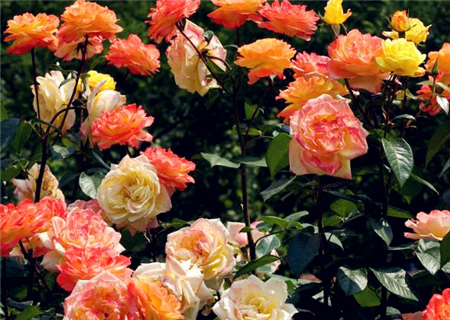
When do rose flowers bloom
The natural flowering period of rose flowers is from August to April of the following year.
Rose flowers form large blooms, opening from the inside outward in a spreading form, with a rich fragrance, and can be widely used in horticultural cultivation and as cut flowers.
Roses have strong adaptability and are cold-tolerant and cold-tolerant. They can be grown whether planted in the ground or in pots, and are suitable for beautifying courtyards, decorating gardens, arranging flower beds, and planting as flower hedges and flower trellises. Roses are easy to cultivate, can be used as cut flowers, and are used to make bouquets and various flower baskets.
Rose cutting methods:
(1) Cutting propagation
It can be divided into softwood cuttings, hardwood cuttings, full-sun cuttings, and bud cuttings.
① Softwood cuttings
This is done in April to May and September to October, the seasons when growth is best, and rooting and survival are easiest when the temperature is 2 to 5°C. To promote rooting, the cut end can be dipped in indolebutyric acid powder at a concentration of 500 to 750 ml. For cuttings, choose vigorous flowering branches of the current year. After the flowers fade, remove the spent flowers and the dead leaves below the flowers. After several days, once the branches have replenished their nutrients, grown plump, and the leaf nodes have swollen, cut in the morning a branch about 10 cm long with 3 to 4 leaf nodes as the cutting, leaving only the upper two compound leaves. Cut off the remaining leaves together with the leaf stalks. Of the two compound leaves left, it is best to leave only the two small leaflets at the base to reduce transpiration. The soil should have good drainage and aeration. When preparing the bed, the soil should be fine and soft. The spacing between cuttings should follow the principle of not shading one another. The depth should be 2/3 of the cutting, with 1 to 3 buds kept above the ground. After inserting, water thoroughly and make the cuttings fit tightly with the soil. After insertion, shade the cuttings and use plastic film to retain moisture. Uncover at night for ventilation. Keep the soil moist, but not overly wet, so that the soil has enough air and the wounds do not rot. After about half a month, gradually increase the time of sunlight exposure to increase photosynthesis and help rooting. When new buds grow and the old leaves do not fall off, it indicates that the cuttings have rooted and survived, and they can then be transplanted.
② Hardwood cuttings
The soil and bed preparation are the same as for softwood cuttings. Cuttings can be taken from when the rose sheds its leaves and enters dormancy until before it sprouts the following spring. Basically, vigorous branches can all be used as cuttings. Cut 10 cm-long branches with 3 to 4 leaf buds, without leaving leaves. After inserting, water thoroughly. Use branches or other twigs, steel bars, etc. to make arches, and cover with plastic film. The propagation site should face the sun and be sheltered from wind to help retain moisture, and attention should be paid to preventing drying out. By the following spring when the cuttings sprout, remove the plastic film. When the young leaves grow larger and turn green and the lower root system has developed, they can be transplanted.
③ Bud cuttings
Because new buds in spring have strong growth vigor, using them as cutting material gives a high survival rate. The method is to wait until the new buds grow to 3 to 7 cm, then gently break them off by hand, or use a blade to cut them off from the base of the bud close to the branch. It is best to choose new buds that are thick and strong, with plump bud tips, and that emerge from the base of the main branch. After collecting, wash them clean with water and then they can be inserted. For the cutting soil, loose soil is best. When inserting, use a stick slightly thinner than the bud to poke a hole, insert the bud along the hole to a depth of 1/3 of the bud length, press it tightly against the soil, water thoroughly, and likewise cover with plastic film to prevent wind. However, the humidity inside the cover should not be too high. Ventilate 1 to 2 times a day, keep the soil moist, and after about half a month they can root. After 20 days, the plastic film can be removed, and they can be transplanted with soil.
④ Full-sun cuttings
Full-sun cuttings means that throughout the entire cutting process, no shade is used, allowing sufficient sunlight exposure. However, because the cuttings have no root system they cannot absorb water normally, making water uptake difficult. In order for the cuttings to carry out photosynthesis and life activities normally, water must be supplemented through the leaf surface. Frequently spraying water on the leaf surface can form a layer of water film on the leaves, which can both satisfy the water needs of the cotyledon cells and lower leaf temperature, reducing leaf transpiration, thereby ensuring normal photosynthesis. If there is no misting device, frequent spraying can be used instead. In the first week after insertion, spray once every half hour; after one week, spray once every 2 hours. Therefore, the seedbed for full-sun cuttings should mainly be plain sand. After 3 weeks, they can be transplanted.
Latest rose prices
Large-crown rose trees, 2-5 year rose garden landscaping engineering tree roses, 90 yuan each.
Climbing roses, vine European roses, 8 yuan each.