Wisteria is a warm temperate plant: its seed sowing method, the best planting time, and varieties and flower colors
Wisteria, also known as tengluo, zhuteng, huanghuan, zhaoteng, zhaodouteng, and tengluo, belongs to the Fabaceae family and the genus Wisteria. It is a deciduous climbing, twining large woody vine. So how do you sow its seeds? When is the best time to plant it? What kinds are there? What colors are there? Learned from a Jiangsu nursery base that wisteria flowers come in deep purple, light purple, pinkish purple, purplish red, and so on.
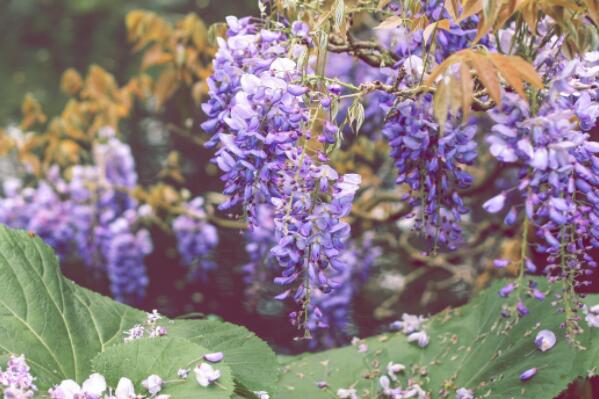
How do you sow wisteria seeds?
Wisteria planting methods and steps:
1. Seedlings grow extremely slowly. In the first year they only grow a few leaves, and the young plant is shrub-like. Only after three to five years do they send out vines, and flowering is even further off. Therefore, in production, unless a large number of seedlings are being raised, seed propagation is generally not used; asexual propagation such as cuttings and layering is generally used. For home flower growing, simply buying seedlings is enough.
2. Wisteria seeds have a very thick seed coat and are very difficult to germinate. Before sowing, soak the wisteria seeds in water to make them swell and to speed up sprouting; about one day of soaking is enough. Next, place the seeds horizontally in a shallow layer of soil. Pay attention to loose soil texture; clayey soil tends to hold water, and the seeds easily rot. If the soil layer is too deep, or the soil is too hard, the sprouts will find it very hard to emerge. Then just wait for them to germinate on their own.
3. Wisteria seeds are best sown in spring. After temperatures rise in summer, they are especially prone to rotting and pests; in winter, temperatures are too low, which is not good for their growth. If growing in pots, it is best to sterilize the soil before sowing. After the seeds are sown, keep the soil moist, and do not let water accumulate in the pot.
When is the best time to plant wisteria?
Japanese wisteria is a variety of the wisteria group. Its tenacious vitality is not what you would expect from a flower; that is precisely the characteristic of wisteria. In particular, it can also tolerate cold shade and severe cold, and a low temperature of minus 15 degrees Celsius is no problem at all. It likes sunlight, but Japanese wisteria has a short flowering period and still produces many flowers, making it especially easy to form a waterfall-like scene, accompanied by fragrance, so it has become a variety loved by the public. As for planting Japanese wisteria, except that it cannot be planted in summer, it can be planted in all the other seasons.
What kinds of wisteria are there?
1. Silver Wisteria
Also called white-flowered wisteria, with white flowers and a relatively strong, rich fragrance. The main vines and stems are numerous and rather slender and lush. It has relatively poor cold resistance. It is a variant of wisteria and is relatively rare.
2. Red Jade Wisteria:
Also known as native Red Jade Wisteria, with peach-red color and large flowers, and a medium-length inflorescence. It is a rare potted treasure. A tropical and subtropical plant, a giant woody vine of the rainforest, with branches and vines reaching 20 m in length. Pinnately compound leaves are alternate; the 3 leaflets are round with acute tips. Racemes are axillary, and the small flowers are scarlet. It has pods, and the seeds are rectangular. It is in the same genus as white-flowered Mucuna birdwoodiana and Mucuna nigricans.
3. White Jade Wisteria:
Also known as native White Jade Wisteria, with pure white color and large flowers, and a short inflorescence. It is a small variety suitable for potting.
4. Three-Foot Wisteria
The inflorescence reaches about 67 cm in length and is pale violet-blue in color. It can be either potted or planted in the ground.
5. Japanese Wisteria:
A very stunning wisteria variety, with the rare pink flowers of wisteria. The flowers have the fragrance of pea flowers. Its characteristic is a long inflorescence, about twice as long as that of Chinese wisteria, reaching 30-50 cm, with many flowers that are slightly smaller. The corolla is pale blue-green, and it is commonly cultivated in Jiangnan.
6. Double-Flowered Wisteria
The flowers are double-petaled and violet-purple. Double-flowered wisteria is relatively rare. Its drooping inflorescences are shorter than those of single-flowered wisteria. From a distance, each cluster of flowers looks like a bunch of grapes, with a rich fragrance.
7. Jade Vine:
Also known as emerald vine, [I am] fascinated by the blue-green flowers of this plant native to the tropical rainforests of the Philippines. After watching Grandfather David Attenborough's documentary, that scene of bats pollinating under the moonlight kept circling in my mind.