When does the daisy bloom, and when is the best time to sow it?
The daisy, also known as horse-head orchid, ever-living chrysanthemum, spring chrysanthemum, sun chrysanthemum, etc., is a plant of the Asteraceae family, a perennial herbaceous plant. It grows about 10 cm tall. So when does the daisy bloom? And when is the best time to sow it?
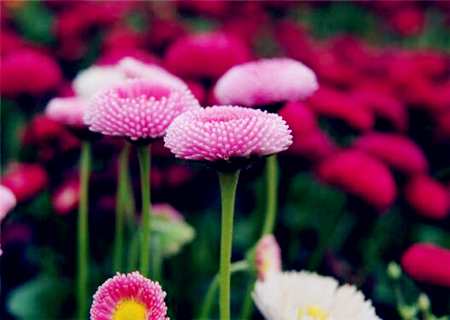
Under natural conditions in many regions of our country, the daisy can begin blooming in early March each year; in warmer regions, the flowering period may also be somewhat earlier, with the specific timing varying slightly depending on the cultivation environment.
When is the best time to sow daisies
The daisy is a biennial herbaceous plant, about 10 to 15 cm tall. The leaves are basal, spoon-shaped, with rounded blunt tips and bases that taper gradually into stalks. The flower heads are solitary, and the scapes are hairy. The ligulate florets are strip-shaped, female, and spreading; the tubular florets are bisexual. The achenes are obovate, flat, with marginal veins, covered in fine hairs, and without a pappus. The daisy is cold-hardy in its ecological habits and prefers sunny, cool climates. It is not tolerant of shade, high temperatures, or severe frost. Under hot conditions, flowering is poor and the plant easily dies. Generally, the sowing time for daisies is chosen for August to September.
How to grow daisies:
1. Plug seedling stage:
The radicle germination stage begins when the radicle breaks through the seed coat, the young root comes into contact with the soil, and continues until the cotyledons emerge as the first stage. The temperature should be maintained at 18°C. Seed germination is light-loving, so no soil cover is needed when sowing, but the growing medium must be kept moist; never allow the medium to dry out during this stage. During this stage, the pH should be kept between 5.5 and 6.2, and the relative humidity should be 100%. Direct sunlight should be avoided, and the seeds should be shaded after sowing.
2. Cotyledon emergence and growth stage:
This is the second stage, from the emergence of the cotyledons to the appearance of the true leaves. The temperature is still maintained at 18°C. The moisture of the growing medium should be appropriately reduced, but it still must not be too dry; the humidity should be about 70% to 80%, which allows the root system to penetrate the medium and absorb nutrients to support the expansion of the cotyledons. The first and second stages require 14 to 21 days.
3. True leaf growth and development stage:
This is the third stage, from the emergence of the true leaves until 80% of the seedlings are ready for sale. The temperature is lowered to about 15°C. The air humidity must also be gradually reduced, and between two waterings the substrate can be allowed to dry out completely, thereby creating a wet-dry cycle that helps promote root development.
4. Hardening-off stage:
At this stage, the root system has already formed completely, the seedlings are basically ready for sale, and they become cold-hardy through hardening off. This stage lasts about 7 days.
Main values
Medicinal value
The daisy, also called dried chrysanthemum or white chrysanthemum, has very high medicinal value. It also contains volatile oil, amino acids, and various trace elements. Among these, its brass content is 32% to 61% higher than that of other chrysanthemums, and its tin content is eight to fifty times higher than that of other chrysanthemums.
The agronomist Zhang Lüxiang once wrote in his work Supplement to the Agricultural Book: “The white chrysanthemum is sweet and warm in nature, and taking it over a long period is most beneficial. The ancients ate the sprouts in spring, the flowers in summer, and the roots in winter, and there was a reason for this. Plant one or two plants at each field ridge, harvest the flowers, and they can replace half of one's tea; the bitter-cold nature of tea can be brewed together with bitter chrysanthemum.
Ornamental value
The leaves of the daisy are spoon-shaped, growing in clusters in a rosette form, densely packed and low-growing, and emerald green in color. Flower scapes emerge from between the leaves, one flower per scape, arranged in a scattered pattern, with a simple and rustic appearance; the flowers are small and exquisite, with harmonious colors. Flower scapes emerge from between the leaves, one flower per scape, arranged in a scattered pattern, with a simple and rustic appearance; the flowers are small and exquisite, with harmonious colors. It blooms in early spring, full of vitality, possessing the bearing of a gentleman and a carefree, innocent charm. [7]
Horticultural value
1. Daisies have strong growth vigor and are easy to cultivate.
2. Daisy flower stems are moderate in height, with neat blooms and bright, plain colors. They can be potted to beautify courtyards and balconies, and can also be used for garden ornamentation, in pots, flower borders, cut flowers, and more.
3. With a long flowering period and strong cold tolerance, it is the top choice for early-spring groundcover flowers.
4. As a groundcover flower for street green spaces, the daisy has strong appeal and can be planted in combination with pot marigold, pansy, azalea, red-leaf barberry, and others.