Jacaranda Tree Price, Blooming Time, Flowering Period and Planting Techniques Explained
The jacaranda is native to Brazil, Bolivia and Argentina in South America. In China it is cultivated for garden ornament in Guangdong (Guangzhou), Hainan, Guangxi, Fujian and southern Yunnan (Xishuangbanna). It has fairly high ornamental and economic value. So, how much does a jacaranda tree cost? Roughly when does it bloom? How long is the flowering period? How is it planted? It is understood that a jacaranda tree measuring 6 cm in caliper costs around 90 yuan, 8 cm around 120 yuan, 10 cm around 200 yuan and 12 cm around 280 yuan. Prices vary with region and variety.
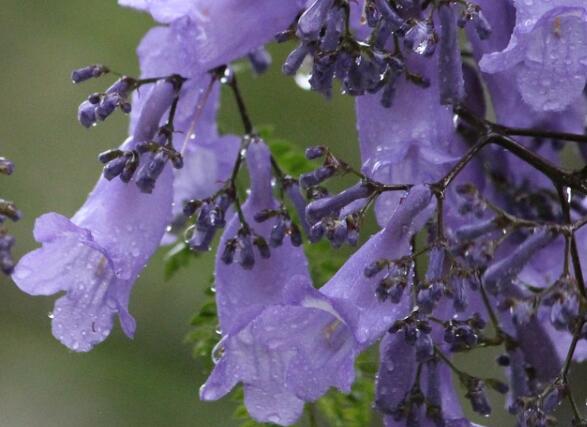
Roughly when does the jacaranda bloom?
The jacaranda grows in southern China and can bloom twice a year, once in late spring (early May) and once in early autumn (July).
How long is the jacaranda flowering period?
The jacaranda flowering period lasts from half a month to one month.
How is the jacaranda planted?
1. Temperature and light
It prefers a warm, humid, sunny environment and cannot tolerate frost or snow. The suitable growing temperature is 22 to 30°C; if the winter temperature drops below 15°C, growth stalls; below 3 to 5°C there is cold damage, and in summer, when the temperature rises above 32°C, growth is also inhibited. It likes light and can tolerate partial shade.
2. Soil and fertilisation
It prefers fertile, moist sandy loam or loam. When planting, apply sufficient base fertiliser; after it has established, top-dress once each in spring and autumn, and carry out pruning and shaping once every early spring. Old plants need heavy pruning. When grown in pots, the trunk can be cut back or dwarfed by grafting, and watering and nitrogen fertiliser application should be controlled.
3. Pest and disease control
The jacaranda has few diseases; the main insect pest is the longhorn beetle. If reddish-brown frass is found at the base of the trunk, use a small knife to slit the bark and capture the larvae; alternatively, before the adults emerge, apply a mixture of 10 parts quicklime, 1 part sulphur and salt to the trunk below 80 cm from the base to prevent the adults from laying eggs.
Main value of the jacaranda
1. Landscape value
An ornamental, foliage and flowering tree species, widely planted in tropical and warm subtropical regions as a street tree, shade tree and landscape tree. It blooms once each in summer and autumn every year; at full bloom the whole tree is covered in violet-blue flowers, very elegant and refined; especially in the tropics, tree species with blue flowers are relatively rare, so the jacaranda is truly a rare and precious woody flowering plant.
2. Economic value
The jacaranda can be used for papermaking. The initial whiteness of the wood powder is relatively low, the lignin content is relatively high, and the solvent extract content is comparable to that of broadleaf woods such as poplar. The fibres are short and the basic density is relatively low.
The wood is yellow-white to grey, soft and light, with straight grain, easy to work, and can be used as furniture timber.