When does Sanhua plum bloom and how many years until it bears fruit? Investment cost and cultivation techniques for planting 4 mu
Sanhua plum, also known as Damili, Jimaili and Xiaomili, is one of the most renowned famous and specialty fruits in the Guangdong region. So when does it generally bloom? How many years until it bears fruit? How much does it cost to plant 4 mu? What are the cultivation techniques? According to Master Feng, a Sanhua plum grower in Shaoguan, it generally bears fruit 3 years after planting, enters the full production period in the 5th year, and the average yield per mu is between 1500-2500 kg.
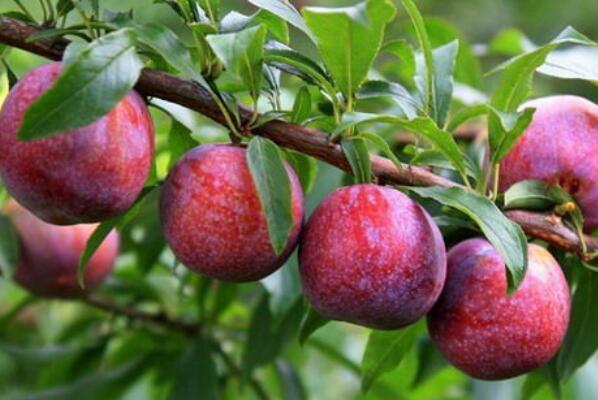
When does Sanhua plum generally bloom?
1. Sanhua plum generally begins to ripen in mid-April. The ripening period of Sanhua plum is closely related to the flowering period. It generally blooms around the Chinese New Year. If the weather is colder and flowering is late, the ripening period of Sanhua plum will be delayed.
2. Sanhua plum is a temperate deciduous fruit tree with strong adaptability to climate, but low-temperature frost or continuous rainy weather during the flowering period can cause severe flower drop or even total crop failure. On the other hand, high temperatures in spring causing leaf emergence before flowering is also unfavorable for fruit formation; Sanhua plum is a light-loving fruit tree and is not suitable for cultivation in places with poor sunlight. Attention should be paid to planting density and pruning to meet its light requirements. Insufficient light not only affects its growth and fruiting, but also affects fruit quality and color; Sanhua plum is not demanding regarding soil, and can be planted as long as the soil layer is relatively deep and not too barren, with slightly acidic soil rich in humus and with a deep soil layer being most suitable for cultivation.
How much does it cost to plant 4 mu of Sanhua plum?
Fruit tree cultivation is a model of planting once and harvesting for many years. As long as you master the methods of fruit tree management, 1-2 people can manage 5-10 mu (temporarily hiring people for fruit counting and picking), and thereafter harvest once and prune once every year.
1. On flat land, with a row spacing of 3 m and a plant spacing of 3 m, one tree per 9 sq m, 75 trees are planted per mu.
2. On hillsides or flat land with relatively barren soil, with a row spacing of 3 m and a plant spacing of 2.5 m, one tree per 7.5 sq m, 89 trees are planted per mu.
3. Some growers also use intensive planting methods, planting about 110 trees per mu.
Planting about 80 trees per mu can maximize profits.
What are the cultivation techniques for Sanhua plum?
1. Seedling raising: Use wild peach as rootstock for grafting to propagate seedlings.
2. Planting:
(1) Time: From mid-December each year to early February of the following year.
(2) Density: Total number of plants planted per hectare of orchard ≤630 plants.
3. Fertilization: Apply ≥15 tons of decomposed organic fertilizer, ≥2.5 tons of bean cake fertilizer, and ≤0.15 tons of nitrogen fertilizer per hectare per year; fertilization requires combining base fertilizer with topdressing. The base fertilizer is mainly decomposed farmyard manure, applying 25--50 kg of decomposed farmyard manure per mature Sanhua plum tree.
4. For topdressing, apply compound fertilizer once before flowering and once after physiological fruit drop. For boron deficiency appearing at the initial flowering stage, spray a 0.2% boric acid aqueous solution. From late May to early September, spray 0.4% potassium dihydrogen phosphate 1--2 times. During the fruit expansion stage, spray 0.2%--0.3% calcium nitrate 1--2 times.
5. Training and pruning: Mainly winter pruning, ensuring ventilation and light penetration in the tree canopy.
Environmental and safety requirements: The use of pesticides, chemical fertilizers, etc. must comply with relevant national regulations, must not pollute the environment, and must not cause excessive pesticide residues.
Harvesting: In mid-June, when the fruit surface coloration is ≥1/3, harvest in batches.