How many years until a Banks' rose (Rosa banksiae) seedling blooms? Detailed explanation of cultivation methods and medicinal effects and uses
Banks' rose (Rosa banksiae) originates from Sichuan and Yunnan, China. It grows beside streams, along roadsides or in hillside thickets, at an altitude of 500-1300 m. It is cultivated throughout the country. It has high horticultural value and is deeply loved by people. So how many years until a Banks' rose seedling can bloom? How to cultivate it? What effects and uses does it have?
How many years until a Banks' rose seedling can bloom?
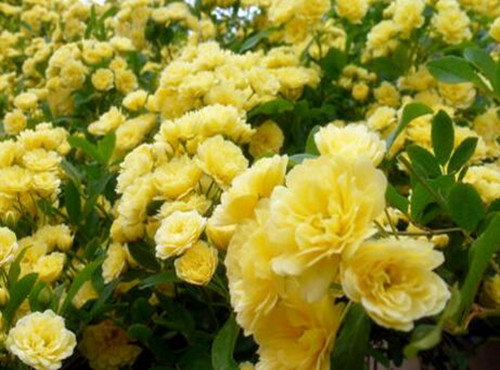
After planting, a Banks' rose seedling can bloom in 2-3 years. Generally speaking, Banks' rose seedlings are planted in early spring, and as long as they are cared for properly, they will bloom 2-3 years after planting. If managed well after flowering, they can then bloom every year. The flowering period of Banks' rose is April-May. The flowers of Banks' rose are small, with many flowers forming umbel-like inflorescences, and the flower diameter is 1.5-2.5 cm; the pedicel is 2-3 cm long and hairless; the sepals are ovate, with a long acuminate tip, entire, and the outside of the hypanthium and sepals is hairless, while the inside is covered with white soft hairs; the petals are double to semi-double, white, obovate, with a rounded tip and a wedge-shaped base; the carpels are numerous, and the styles are free, densely covered with soft hairs, much shorter than the stamens.
How to cultivate Banks' rose?
1. Pot and soil selection
For potted Banks' rose, you need to choose a relatively large flower pot and use suitable soil. Banks' rose likes loose, breathable, relatively fertile soil with good drainage. Applying some base fertilizer can increase the fertility of the soil.
2. Light and temperature
Banks' rose likes a growing environment with plenty of sunlight, can tolerate partial shade, likes warmth, can tolerate cold but avoids intense heat. To cultivate Banks' rose, you need to ensure a suitable temperature. In summer, when temperatures are high, cooling measures can be taken; in winter, when temperatures are low, it can be placed indoors to prevent frost damage. It should be noted that Banks' rose is relatively afraid of direct light during the seedling stage and needs shading.
3. Watering and fertilizing
Banks' rose likes a moist growing environment. During the growing period, the soil needs to be kept moist, but waterlogging must be avoided. Watering is generally done by watering thoroughly after the soil has dried out, and attention should be paid to maintaining air humidity. In addition to applying sufficient base fertilizer, fertilization also requires ensuring sufficient nutrients during daily care. A once every 20 days——30 days application of decomposed dilute liquid fertilizer can be made, and care should be taken not to apply too much nitrogen fertilizer, so as to avoid excessive vegetative growth and few flowers.
What effects and uses does Banks' rose have?
1. The flowers contain aromatic oil, which can be used for preparing perfumes and cosmetics. Root bark: astringent, neutral. Astringes and relieves pain, stops bleeding. Used for chronic dysentery, blood in the stool, infantile diarrhea, sores and boils, and traumatic bleeding.
2. It can absorb exhaust gas, block dust, and purify the air. Banks' rose is dense, brightly colored, strongly fragrant, and its autumn fruits are bright red. It is an excellent vertical greening material, suitable for arranging flower columns, flower stands, flower corridors and walls. It is a good material for hedges and is very suitable for home planting. A famous ornamental plant, often cultivated for climbing over trellises.