How much was sea buckthorn fruit per jin in 2018, how many years until it bears fruit, and what is the yield per mu?
Sea buckthorn fruit is the fruit of Hippophae rhamnoides, a plant in the genus Hippophae of the family Elaeagnaceae, also known as vinegar willow fruit and sour thorn fruit. Sea buckthorn fruit is a small berry plant, a deciduous shrub or small tree. So how much is sea buckthorn fruit per jin? How many years does sea buckthorn take to bear fruit after planting? What is the yield per mu?
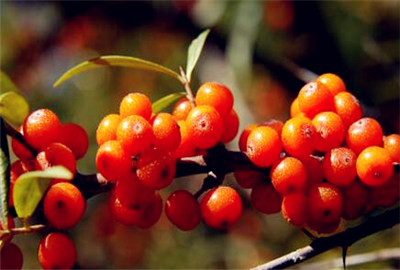
Sea buckthorn grows slowly in the 1st to 2nd years after planting, grows faster in years 4 to 6, and then gradually slows down. Sea buckthorn flowers and bears fruit 3 to 5 years after planting, but the amount of fruit is not large; years 10 to 15 are the full fruit-bearing period, and decline begins after 30 years. After about 3 years, the branches renew, the tree vigor recovers, and a new peak fruit-bearing period can arrive. The fruit yield per plant of sea buckthorn varies greatly with conditions in different regions; during the full fruit-bearing period, the yield per plant is 2 to 5 kg. Improved varieties selected and bred by humans can reach more than 20 kg. Qinghe is located in the cold temperate zone north of 45 degrees north latitude and is the most suitable planting area for large-fruited sea buckthorn, with the highest yield per mu reaching 800-1000 kg.
Sea buckthorn planting density: for sea buckthorn orchards aimed at fruit production, for large-fruited sea buckthorn varieties with larger crowns, the plant and row spacing can be 2 m × 4 m, with 83 plants established per mu; for scion orchards aimed at harvesting shoots, 1 m × 3 m can be used, with 220 plants established per mu. The size of the planting hole depends on the size of the sapling, generally 35 cm in diameter and 35 cm deep. The best seedling age is a two-year-old softwood cutting seedling.
How many years does sea buckthorn take to bear fruit after planting? What is the yield per mu?
Suitable harvest time. The ripening period of sea buckthorn fruit is marked by its distinctive color and fruit size, and the harvest time is decided accordingly. Under normal circumstances, varieties introduced from high-latitude areas such as Russia and Inner Mongolia ripen earlier; for example, varieties such as Qiuyisike and Altai can ripen in early August; varieties such as Youosheng sea buckthorn and Orange sea buckthorn mostly ripen in late August; Central Asian sea buckthorn produced in China mostly ripens in late August. Chinese sea buckthorn comes from different populations, and its ripening period also differs: those produced in North China, such as in Zhuolu and Fengning, mostly ripen from late August to early September; those produced in Northwest China, such as in Gansu and Qinghai, mostly ripen in mid-to-late September.
What is the price of sea buckthorn fruit on the market?
According to sea buckthorn grower Mr. Wang, sea buckthorn fruit on the market now costs 28.5 yuan per jin.
How many plants can be planted per mu?
Sea buckthorn seedlings are relatively small, generally 30-50 cm in plant height and 5-8 mm in ground diameter. The labor intensity of planting sea buckthorn is not great; an ordinary laborer can plant 5-6 mu of sea buckthorn in a day, and generally 220 sea buckthorn plants can be planted per mu.
How many jin of fruit does sea buckthorn yield per mu?
If calculated based on planting 220 sea buckthorn plants per mu, the yield of sea buckthorn fruit per mu is about 600-800 kg.
What are the sea buckthorn planting techniques?
1. Seed propagation
Before spring sowing, soak the seeds until swollen, sow in rows with a row spacing of 10-15 cm, at a depth of 3 cm. Seedlings emerge after 1 week. After the first pair of true leaves appears, begin thinning; when the 4th pair of true leaves appears, thin a second time, keeping a plant spacing of 5 cm. Autumn sowing should be carried out in late autumn; after sowing, cover the seedbed surface, water in winter to seal in freezing, and seedlings emerge the following year.
2. Cutting propagation
Select moderately mature growing branches as cuttings. The best planting time is from mid-June to the end of August. When planting, the row and plant spacing is (10-15) cm × (5-10) cm. Transplant in the spring of the 2nd year, with a row and plant spacing of (30-60) cm × (15-17) cm. Use 1-2 year old vegetatively propagated seedlings for afforestation; dense planting is preferable, with a row and plant spacing of 4 m × 2 m. For types or varieties with different fruit ripening periods, they can be planted in separate plots for easier management. When planting, pay attention to a reasonable ratio of female to male plants; generally 8 female plants are paired with 1 male plant.
3. Field management
To improve soil fertility, pay attention to intertillage and weeding. Sea buckthorn is relatively sensitive to phosphate fertilizer, and superphosphate can be applied as appropriate to promote plant growth.
4. Growth management
The growth of sea buckthorn is divided into four stages: seedling stage, fruit-bearing stage, peak fruit-bearing stage, and decline stage. Within two years after establishment, underground growth is dominant, while aboveground growth is slow. Growth is vigorous in years 3-4, and it begins to flower and bear fruit. An adult sea buckthorn tree is 2-2.5 m tall, with a crown width of 1.5-2 m. It enters the peak fruit-bearing stage in the fifth year. Due to differences in soil conditions and management, the time of entering the decline stage also differs; generally, trees enter the decline stage after 15 years of age.
12