How much is one jin of Flamboyant tree seeds, planting methods, flowering period, and effects and functions
The Flamboyant tree is also known as Golden Phoenix Flower, Red Flower Kapok Tree, Fire Tree, Yangying, etc. It is distributed in southern and southwestern China, and is native to Madagascar and tropical regions around the world. It is known as one of the most colorful trees in the world. So, how much is one jin of Flamboyant tree seeds? How to plant them? In which month does it bloom? What effects and functions does it have? It is understood that the price of Flamboyant tree seeds is 48 yuan/jin, and prices vary in different regions.
How to plant the Flamboyant tree?
Seed sowing and seedling raising are commonly used. The 1000-seed weight is about 400 grams. The seed coat is difficult to absorb water, so the seeds need to be scalded with 80°C warm water to promote germination, then after natural cooling, continue soaking for 24 hours, drain and set aside.
Sow by the drill or spot sowing method. Seedlings are relatively sensitive to frost. In the early stage, compound fertilizer can be applied, with less nitrogen fertilizer. After autumn begins, fertilization should be stopped to encourage early lignification. In winter, if the leaves have not yet fallen, they can be cut off manually, and plastic film can be used for covering or individual plants can be wrapped to prevent frost. One-year-old seedlings can be lifted from the nursery and planted out.
Propagation methods
The Flamboyant tree is mainly propagated by sowing. The seeds mature in December. Collect the pods and take out the seeds for dry storage, then sow in the following spring. Before sowing, soak the seeds in boiling water, and after cooling, continue soaking for 1-2 days, changing to clean water 1-2 times during this period. After sowing, germination begins in 6-7 days, and all seedlings can emerge in more than 20 days. One-year-old seedlings can reach about 1.5 m.
Cultivation methods
It should be planted in a sunny place with fertile, deep soil and good drainage. After 1-2 years of growth, seedlings need to be transplanted once, and transplanting is best done in early spring. The plant and row spacing is about 60 cm, and 3-year-old seedlings can be used for planting out. The planting site should be an open, sunny place, and during dry weather it should be watered sufficiently. The Flamboyant tree does not have high requirements for soil and can also grow well in relatively barren sections because its roots have rhizobia, which can fix nitrogen and increase soil fertility, but waterlogging will cause the rhizobia to die and affect plant growth. The trunk of the Flamboyant tree will grow branches and leaves at any time. If allowed to grow naturally, the plant shape will change greatly, so pruning is needed frequently. The Flamboyant tree is not cold-tolerant, and in northern regions it can only be cultivated and maintained in greenhouses.
For transplanting, the survival rate is high before sprouting in spring. It can also be planted in the rainy season, but part of the branches and leaves must be cut off to ensure survival. The plant has strong sprouting ability, and the trunk-cutting method can be used to cultivate large seedlings. After planting out, loosen the soil and weed 2-3 times each year, water in a timely manner, apply topdressing once each in spring and autumn, and remove root tillers in time to ensure good tree growth.
Pest control
Common pests
The pest found on the Flamboyant tree is an insect of the “noctuid” type. This insect damages plants by having its larvae feed on leaves, often eating all the leaves of the host and seriously affecting tree growth and ornamental value. Flamboyant tree pest damage is most severe in July, August, and September. The Flamboyant tree noctuid is not harmful to humans, but some people will show allergic symptoms because of it.
Control methods
Seize the period when the larvae gather to cause damage and dust powder in the early morning before the dew dries. You can use 2.5% trichlorfon powder or 1.5% parathion (1605) powder, or 1.5% dimethoate powder for dusting, 1.5-2 kg per mu.
In which month does the Flamboyant tree bloom?
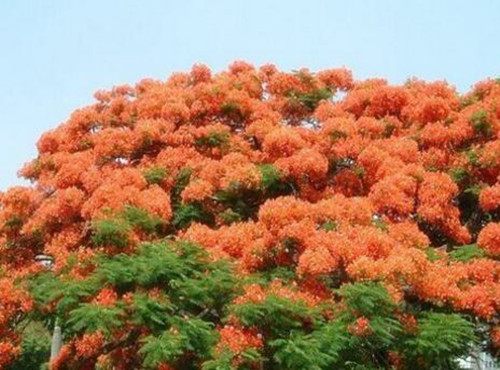
The flowering period of the Flamboyant tree is June-July. The flowering time of the Flamboyant tree is about June-July every year, and the flowering period is relatively long. Whenever the Flamboyant tree is in bloom, there is a scene of bright red everywhere, with flowers all over the tree, a fiery red expanse, contrasting beautifully with the green leaves, and its ornamental value is very high. The flower language of the Flamboyant tree is parting, longing, and fiery youth.
What effects and functions does the Flamboyant tree have?
1. The Flamboyant tree has a tall crown. During the flowering period, the flowers are red and the leaves are green, and the whole tree is like fire, magnificent. Because “the leaves are like the feathers of a flying phoenix, and the flowers are like the crown of a red phoenix,” it is named Flamboyant tree. It is a famous tropical ornamental tree species. It is widely planted in botanical gardens and parks in southern Chinese cities as an ornamental tree or street tree.
2. The resin can dissolve in water and is used in crafts; the wood is light and soft, elastic, and has a special grain, and can be used for small furniture and as a craft material. The pods of the Flamboyant tree are used as percussion instruments in the Caribbean region, called shakers or maracas.