How much is hops per jin? A detailed guide to cultivation methods and benefits
Hops is a perennial climbing herbaceous plant in the Cannabaceae family, genus Humulus. The stems, branches and petioles are densely covered with fine hairs and hooked prickles. It is native to Europe, the Americas and Asia. In China it is distributed in ** and northern Sichuan, and is widely cultivated throughout China. So, how much is hops per jin? How is it cultivated? What benefits and effects does it have? According to reports, hops is priced at around ten-plus yuan per jin, though prices vary from region to region.
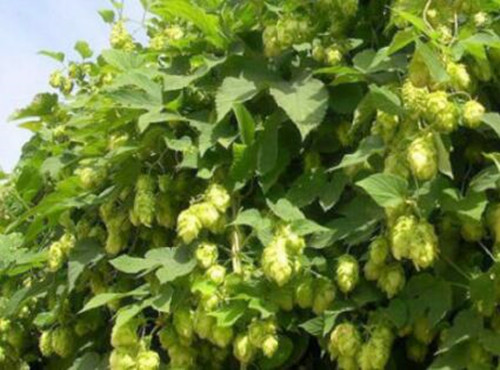
How is hops cultivated?
1. Site selection: According to the growth characteristics of hops, choose a plot with thick soil, and establish the hops garden close to the drying shed and in a place convenient for transport.
2. Land preparation: Before planting, plow the plot 25-30 cm deep, and use machinery to open furrows 50 cm deep and 50 cm wide. For newly planted hops fields, apply 3000 kg of farmyard manure per 667 sq m, spreading it evenly in the furrows and mixing it well with the topsoil.
3. Trellis selection: Trellises are divided into two types, low trellises and high trellises.
① Low trellis: This trellis form requires burying 3 m long concrete posts at set distances in the garden, buried 80-100 cm into the soil, with the surrounding edge posts thicker and tilted slightly outward. The edge post specification is 12×12×300 cm. Secure the guy wires, choosing 12# iron wire for the guy wires. Fix the upper ends of the posts with iron wire or angle iron, and stretch a wire every 45 cm on the trellis. This trellis form is relatively low, with a smaller investment, strong wind resistance and fewer weeds, but poor ventilation and light penetration, which affects hops quality, and thinning branches and leaves is relatively labor-intensive.
② High trellis: The basic structure of the high trellis is the same as the low trellis, the difference being that the posts are taller and the spacing between posts is larger, with the edge post specification being 12×12×350 cm. This trellis form has good ventilation and light penetration, vigorous plant growth and is convenient for mechanized management, but requires a large investment and a high level of mechanized management.
4. Planting:
(1) Planting time: Seedlings can be planted when the average early-spring temperature reaches 10-12°C. In our county this is generally in early to mid-April.
(2) Planting method: According to differences in climatic conditions, variety and trellis form, the spacing for first-year plants is 0.5 m between plants and 2.5-3 m between rows; the following year, every other plant is thinned out so that the spacing between plants stays at about 1 m. Before planting, soak the seedlings in 0.5% Bordeaux mixture for 5 minutes to prevent infection by pests and diseases. When planting, set them at a 45° angle facing the sun in the center of the furrow pit, cover with soil and firm it so that the top of the seedling is 10-12 cm below the surface, then after filling level, cover with another 5 cm of soil, and irrigate after planting. About 20 days after spring planting they emerge from the soil; check emergence promptly and replant early where needed.
5. Mulching:
(1) Choose plastic film 1.4 cm wide and more than 0.008 mm thick.
(2) After planting and irrigation, once there is no standing water in the furrow, lay the film promptly. To ensure the mulching effect, a wooden stick or other support can be set up at set intervals over the furrow to provide support. When laying the film, press the edges down well to prevent it being rolled up by the wind.
(3) When the seedlings in the furrow have grown to about 20 cm, release the seedlings promptly, and seal the film openings well when doing so.
(4) In mid to late June, when the seedlings have grown to about 2 m, break the film and promptly collect the residual film.
6. Field management
(1) Bud cutting: This means cutting away excess buds and leaving a few strong ones, so that nutrients are concentrated in these strong buds, developing into robust above-ground stems and underground roots, and also removing rotten roots, diseased roots and insect pupae. In most parts of China, bud cutting is done in spring; spring bud cutting should be early rather than late, and the bud-cutting time should not be dragged out too long. The method is to dig up the soil around the rhizome until all the old roots are exposed, then use a wooden knife to clear the soil out of the pit, and use a sharp bud-cutting knife to cut off new rhizomes or rotten roots 1.5-2 cm from the new and old rhizomes, leaving only 5-8 healthy buds at the new and old rhizome. The bud-cutting knife cuts must be smooth, and the rhizome must never be cut through; after cutting, let it dry in the sun for 1-2 hours before covering with soil.
(2) Thinning and final singling: Begin thinning after the seedlings emerge, and finalize the stand when the seedlings are about 20 cm tall. The number of seedlings to keep depends on soil fertility, variety, plant and row spacing and trellis form. Generally, for plots with wide plant spacing and tall trellises, keep 2-3 plants per spot.
(3) Training the vines: When the seedlings are 40-60 cm tall, use thin cable or plastic string to tie the branches and vines to the galvanized wire along their natural growth habit, tying once every 3-5 days. Do this on sunny days when the plants are slightly wilted, to prevent breaking the branches and vines. When the seedlings reach 2 m tall, begin thinning branches and leaves, removing side vines below the galvanized wire and any overly dense, overlapping or diseased branches and leaves, so as to improve ventilation and light penetration, promote robust growth of the main vines and reduce disease infection.
(4) Irrigation: If water is lacking during the growing period and before overwintering, both growth and yield are affected. In particular, sufficient water must be ensured during the flowering period. In ** the whole growing period requires about 7-8 irrigations.
(5) Fertilization: Fertilization can be carried out together with irrigation. Apply nitrogen fertilizer at the seedling stage, 10-15 kg per mu, and apply compound fertilizer once each at the budding stage and the flowering stage, 8-10 kg per mu. Apply organic fertilizer before overwintering, about 3000 kg per mu.
(6) Cultivation and weeding: After each irrigation or rain, cultivate and weed promptly. Generally, deep hoeing is suitable in the early and late growth stages, while shallow hoeing is suitable during the flowering period, to avoid damaging the roots and affecting yield.
What benefits and effects does hops have?
1. Medicinal
The immature green fruit spikes (hops): bitter, slightly cool. They invigorate the stomach and aid digestion, calm the mind, and promote urination. Used for indigestion, abdominal distension, edema, painful urination, pulmonary tuberculosis, and insomnia.
2. Landscaping
Used for climbing on flower stands or fences and trellises. The female inflorescences can be made into dried flowers.
3. Food use
The flowers are the raw material for brewing beer. In beer brewing, hops play an irreplaceable role.