What does the deciduous tree Cornus officinalis look like? How much do seeds and saplings cost approximately? What are the cultivation techniques?
Cornus officinalis is also known as Shanyurou, Rouzao, Jizu, Yurou, Yaocao, Tianmuzi, and Shizao'er. Its flowering period is March to April; its fruiting period is September to October. So what does it look like? How much do seeds and saplings cost approximately? What are the cultivation techniques? According to grower Uncle Wang, 5CM saplings of Cornus officinalis cost around 35.00 yuan each.
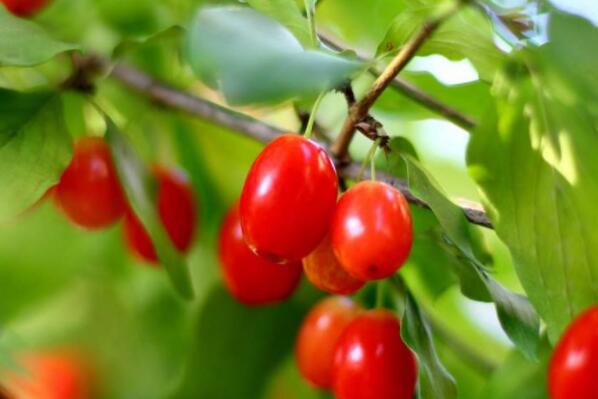
What does Cornus officinalis look like?
1. Deciduous tree or shrub, 4-10 m tall; bark grayish-brown; branchlets slender and cylindrical, hairless or sparsely covered with appressed short soft hairs; winter buds terminal and axillary, ovate to lanceolate, covered with yellowish-brown short soft hairs. Leaves opposite, papery, ovate-lanceolate or ovate-elliptic, 5.5-10 cm long, 2.5-4.5 cm wide, apex acuminate, base broadly cuneate or nearly rounded, margin entire, upper surface green, hairless, lower surface light green, sparsely covered with white appressed short soft hairs, vein axils densely bearing light brown tufts of hair, midvein prominent on the upper surface, raised on the lower surface, nearly hairless, lateral veins 6-7 pairs, curved inward in an arc; petiole slender and cylindrical, 0.6-1.2 cm long, with a shallow groove on the upper side, rounded on the lower side, slightly covered with appressed sparse soft hairs.
2. Umbels borne on the sides of branches, with 4 involucral bracts, ovate, thickly papery to leathery, about 8 mm long, purplish, slightly covered with short soft hairs on both sides, falling off after flowering; peduncle stout, about 2 mm long, slightly covered with gray short soft hairs; flowers small, bisexual, opening before the leaves; calyx lobes 4, broadly triangular, equal to or slightly longer than the disk, about 0.6 mm long, hairless; petals 4, ligulate-lanceolate, 3.3 mm long, yellow, recurved outward; stamens 4, alternating with the petals, 1.8 mm long, filaments subulate, anthers elliptic, 2-celled; disk cushion-shaped, hairless; ovary inferior, receptacle obovate, about 1 mm long, densely covered with appressed short soft hairs, style cylindrical, 1.5 mm long, stigma truncate; pedicel slender, 0.5-1 cm long, densely covered with sparse soft hairs.
3. Drupe long elliptic, 1.2-1.7 cm long, 5-7 mm in diameter, red to purplish-red; stone bony, narrowly elliptic, about 12 mm long, with several irregular ribbed lines.
How much do Cornus officinalis seeds cost approximately?
The price of Cornus officinalis seeds is about 20-30 yuan per jin, but prices vary depending on seed quality, variety, place of origin, and market conditions. Cornus officinalis is a heliophilous tree species of the warm temperate zone, with an optimum growth temperature of 20-30°C, strong cold resistance, able to withstand a brief low temperature of -18°C, relatively shade-tolerant but also fond of sufficient light, suitable for planting in well-drained, organic-rich, fertile sandy loam soil. Propagation methods include seeding, layering, cutting, and grafting; in production, seed propagation and grafting propagation are mainly used, with a sowing rate of 10-12 jin per mu. It can be sown in spring, summer, and autumn, and is planted nationwide.
What are the cultivation techniques for Cornus officinalis?
1. The outer coat of Cornus officinalis seeds is hard and rich in gelatinous substance, so soaking and degreasing must be carried out before sand storage treatment. The method is: pour the seeds into a corrosion-resistant container, then weigh out white alkali at a ratio of 8%, slowly pour the alkali into heated water to dissolve it, then pour the alkali solution into the container holding the seeds; the alkali solution should preferably cover the seeds by 3-5CM. Stir with a wooden stick, 3-5 times daily. After 3 days, remove the seeds and pour off the remaining water, then soak the seeds again by the above method using 3-5% alkali in proportion to the seeds for 2 days, 5 days in total. Remove the seeds, rinse once with clean water, repeatedly rub them or use a ball mill to grind the shells so that the outer seed coat becomes noticeably thinner, then dry the seeds to 70% dryness for later use.
2. The embryo of Cornus officinalis seeds has after-ripening characteristics, and after collection they need a period of natural dormancy, so sand storage is very important. To break the overly long dormant period, a suitable temperature must be provided for germination forcing. The method is:
(1) Choose sunny, dry, well-drained land and dig a pit; the size of the treatment pit depends on the amount of seeds. The pit should not be too deep, generally 20-30CM is suitable.
(2) Use about 3CM of cattle, sheep, mule, or horse manure; sprinkle a thin layer of 1-2CM of fine sand on the manure, then evenly spread the seeds on the sand. The thickness should be 2-4CM and must not be too thick, so as not to affect the quality of germination forcing. Sprinkle another thin layer of sand on the seeds, then spread 3CM of cattle, sheep, mule, or horse manure, and sprinkle another layer of sand on the manure. Layer in this way, generally 3-4 layers are enough. If too thick, germination forcing will be insufficient and the germination forcing rate will be affected.
3. Temperature is one of the necessary conditions for seed germination. In the rapid treatment of Cornus officinalis seeds, suitable temperature can also break the overly long seed dormancy period and promote earlier germination. The methods generally adopted are:
(1) Greenhouse heating method;
(2) Flue heating method;
(3) Plastic greenhouse warming method. Among the three, the plastic greenhouse method has lower cost and is relatively convenient and commonly used. The method is to cover with film using an arched frame according to the size of the treatment pit. Use ropes on top to pull it tight to prevent wind blowing.
4. After the greenhouse is set up, daily management is also very important. There are three main technical points:
(1) Moisture: because Cornus officinalis seeds have already fully absorbed water during the soaking and degreasing process, generally do not water during sand storage germination forcing unless the sandy soil is very dry, so as to prevent the seed embryos from rotting.
(2) Ventilation: seeds are also alive and need necessary respiration, so once a month it is necessary to open a corner of the greenhouse to allow airflow. Each time 8-12 hours is enough.
(3) Time: after seed treatment, generally after 3-4 months the shed should be opened for inspection; when 10-20% of the seeds are found to have broken shells and embryos are in a state of germinating growth, they can be sown. This avoids excessive growth affecting the seedlings and wasting seeds.
5. Sowing and seedling raising:
With seeds that have undergone germination forcing, the germination rate can generally reach more than 60-70%. Each mu of seedling raising requires 40-50 kg of seeds, and can produce 30,000-60,000 commercial seedlings. Calculated at 0.5 yuan per plant, the annual output value per mu is more than 15,000 yuan, and the benefit is very considerable.
In addition, there is another germination forcing treatment method in which seeds are directly soaked in human urine and feces and then stored in water, but this method is affected by factors such as temperature, climate, and the pH value of human urine and feces, and the soaking time is not easy to control. Although the cost is relatively low, the germination rate and success rate are also relatively low.
In addition, there are several rapid seed soaking treatment methods using sulfuric acid, caustic soda, or hormones, but because the concentration of acid and alkali is not easy to control, although the seed coat is corroded, it is easy to damage the seed embryo, so these are mostly not used in production practice.