How much do Japanese maple saplings and seeds cost, how do they differ from red maple, and how should bonsai be cared for?
Japanese maple (Acer palmatum) belongs to the Aceraceae family and is also called chicken-claw maple, maple, etc. Its crown is umbrella-shaped. The bark is smooth. The bark is dark gray. The twigs are purple or pale purple-green, and the old branches are pale gray-purple. So roughly how much do Japanese maple saplings and seeds cost? How do they differ from red maple? How should bonsai be cared for? From a nursery company in Jiujiang County we learned that Japanese maple saplings 30-50cm tall cost about 0.85 yuan each; those 80-90cm tall cost about 2.80 yuan each.
Roughly how much do Japanese maple seeds cost?
1. Japanese maple seeds cost about 200 yuan/jin, and the sowing rate per mu is 6-8 jin. The best time to sow Japanese maple seeds is February to April and August to October; seeds sown in these two periods have the highest germination rate and grow best.
2. For example, February in spring is the best period, because they can sprout in late March. To avoid the effects of sun exposure, it is recommended to provide shade during the high temperatures of July to August, water more, and avoid drought. When the seedlings grow to 30-50cm tall, they can be transplanted.
What is the difference between Japanese maple and red maple?
1. Red maple is a variety of Japanese maple (the original species and the variety each have their own ornamental strengths). There are many red maple cultivars, and they are all very beautiful foliage plants.
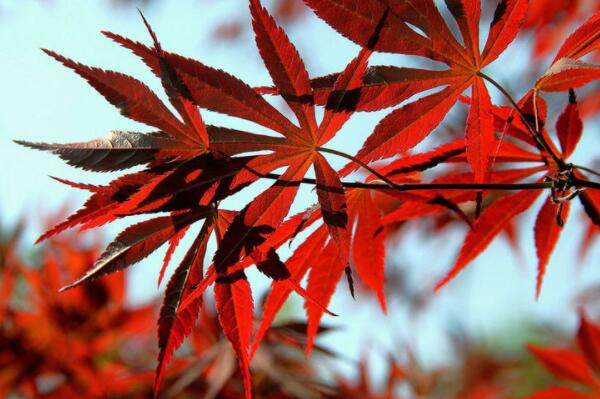
2. Red maple has an elegant leaf shape; the leaves are palmately 5-7 lobed. Its red color is very long-lasting, the branch order is neat, the layers are distinct, and the tree form is light and graceful, suitable for bonsai or ground planting. The roots, stems and branches of red maple are red-brown, while the branches of Japanese maple are usually green.
3. The branches of red maple are thick and hard, while the branches of Japanese maple are thin and soft.
4. The lobes of Japanese maple leaves are more than half the total length, but do not reach deep to the base. Red maple lobes are split more deeply, almost reaching the base.
How should Japanese maple bonsai be cared for?
1. Japanese maple likes light and a warm, humid climate; it is not very cold-tolerant and is suitable for acidic or neutral soil rich in humus, fertile and moist. Potted plants should avoid west-facing sun and direct sunlight, and should be properly shaded during the high-temperature period in summer.
2. Pot selection: Japanese maple is suitable for a relatively shallow oval or rectangular glazed ceramic pot. For the red-leaf varieties, gray-white, light blue, light green, light yellow and similar colors are suitable, and black also works very well. For green-leaf types, purple, red and similar colors can be chosen.
3. Soil: Japanese maple likes fertilizer and moisture, and is suitable for fertile, loose and moist slightly acidic soil or neutral soil. For potting, humus-rich mountain soil or leaf mold can be used.
4. Planting: This can be done in March in spring or after leaf fall in autumn. When planting, take care to spread the roots out and not let them curl up in the pot soil. For precious varieties, management should be strengthened after planting, keeping the pot soil moist and placing the plant in a shaded spot; once it is growing vigorously, move it to a ventilated, well-lit place.
5. Shaping: Japanese maple is mostly styled by combining wiring and pruning. For wiring, palm fiber is suitable, and it must be removed in time, otherwise it easily cuts into the branch. If metal wire is used for wiring, even more care must be taken to prevent it from cutting in. Wiring and shaping are best done during the plum rain period or after leaf fall. The large branches of Japanese maple can be wired, while the small branches are better pruned. Generally, leave 1-2 nodes on each branch and cut off the front end, so that the two side branches that grow form a Y shape; later prune in the same way in turn, finally forming the crown.
6. Tree form: Japanese maple is suitable for making combined plantings or forest-style plantings. As a single specimen, it can be made into slanting-trunk, curved-trunk and other tree forms. The leaf shape is elegant, red and colorful, and quite beautiful. When making a combined planting, attention must be paid to handling the primary and secondary, sparse and dense, high and low, far and near, and other aspects. Japanese maple often has curves, so when planting in combination, attention must also be paid to the direction and degree of trunk curvature, so as to achieve unity and harmony.