What Does the Russian Olive Tree Look Like? A Complete Guide to Sapling Prices, Planting Methods and Benefits
The Russian olive tree is also known as silver willow, fragrant willow, cassia willow and qilixiang. It has extremely strong vitality and is characterized by drought resistance, wind and sand resistance, salt and alkali tolerance, and tolerance of poor soil. So what does it look like? How much does a sapling cost? What are the planting benefits? What are the methods? According to the Ningxia sapling base, the price of Russian olive saplings is 0.3-0.8 yuan each.
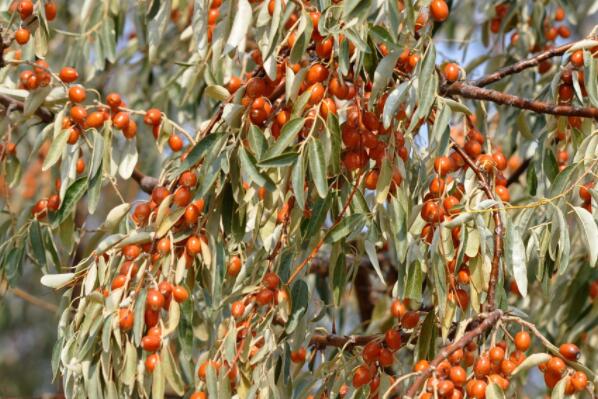
What does the Russian olive tree look like?
The Russian olive is a deciduous tree or large shrub, 5-10 m tall. The trunk is thornless, while the branches are thorny, with thorns 3-4 cm long and reddish brown. Young branches are densely covered with silvery white scales, which later fall off, revealing a chestnut brown color. The leaves are simple and alternate, with slender silvery white petioles; the blades are thin and papery, oblong-lanceolate, 3-7 cm long and 1-1.3 cm wide, with a wedge-shaped base, entire margins, and a bluntly pointed or blunt tip; the upper surface bears silvery white round scales when young, some of which later fall off, while the lower surface is grayish white, densely covered with glossy silvery white scales. Flowers are borne in clusters of 1-3 in the leaf axils of the lower part of the branchlets; the calyx is silvery white, and the petals are golden yellow. It is densely covered with silvery white scales and is fragrant; the calyx tube is bell-shaped, with 4 lobes at the upper end, the lobes broadly ovate or ovate-oblong, the inner surface covered with white stellate pubescence; there are 4 stamens, with almost no filaments; the upper end of the style is curved, with a conical disc surrounding the base of the style. The fruit is elliptical, 2-3 cm long and 1-1.5 cm in diameter, pink or dark red, densely covered with silvery white scales, with powdery flesh that is milky white or pale yellow. The flowering period is from May to July, and the fruiting period is from August to October. It grows in mountainous areas, plains, sandy beaches and deserts, either cultivated or wild.
What are the planting benefits of the Russian olive tree?
Natural Russian olive trees are distributed only in desert and semi-desert areas with precipitation below 150 mm, and are related to the groundwater level; if the groundwater level is below 4 m, growth is poor. The Russian olive tree has relatively high requirements for heat conditions, growing and developing well in areas with an accumulated temperature of 3000°C or more at ≥10°C, while when the accumulated temperature is below 2500°C, fewer fruits are set. It begins to sprout only when the active accumulated temperature is above 5°C, enters the peak growth period above 10°C, and enters the flowering period above 16°C. The fruits are mainly formed during the high-temperature period of midsummer, when the average temperature is above 20°C. Its salt and alkali tolerance is also relatively strong, but it varies with the type of salt; it has strong adaptability to sulfate soils but weak resistance to chlorides. It can grow when the total salt content of sulfate soil is below 1.5%, but it is not suitable for growth on chloride saline soil when the total salt content exceeds 0.4%. The Russian olive tree has well-developed lateral roots and a very large root spread; in loose soil, it can produce many root nodules, and the nitrogen-fixing rhizobia among them can also improve soil fertility and ameliorate the soil. Its lateral branches have strong sprouting ability, while the terminal buds grow weakly. The branches are dense and often form thick clumps. After the branches are buried by sand, they readily grow adventitious roots, giving it a windbreak and sand-fixation effect. In the Hexi Corridor region of Gansu, the sap of the Russian olive tree begins to flow in late March, budding begins in mid-April, and the flowering period begins from late May to early June, lasting about 3 weeks; young fruits appear in early July, fruits take shape in late August, and the fruits mature in October, with a fruiting period of about 100 days. ** and Ningxia have phenological periods similar to those of the Hexi Corridor, while central Inner Mongolia has a slightly later phenological period.
What are the planting methods for the Russian olive tree?
1. Sowing and seedling raising: Sowing and seedling raising are mostly done in spring. For spring seedling raising, the seeds must be treated in December of the previous winter. The method is to wash the seeds clean, mix them evenly with an equal amount of fine sand, and place them in a previously dug seed treatment pit (80 cm deep, 100 cm wide, and the length depending on the amount of seed), or pile them on the ground in a layer 40-60 cm thick, build a ridge around them with sand, and irrigate thoroughly (with 10-20 cm of water standing above the seeds); after the water seeps down or freezes, cover with 20 cm of sand to overwinter. For seeds that have not been stored over winter, before sowing they can be soaked in warm water at 50-60°C for 2-3 days, then removed and mixed with horse manure, placed in a sunny place, and kept moist to promote germination; once 30-40% of the seeds have split open, they can be sown. Seeds sown in autumn do not need germination treatment. For Russian olive seedling raising, field-style drilling can be used, with a row spacing of 25 cm and a sowing depth of 3-5 cm; about 100 seeds are usually sown per meter of sowing furrow, and about 40 jin of seed are sown per mu; after sowing, cover with soil, thin the seedlings in early June to a spacing of 7 cm, and keep 30,000-40,000 seedlings per mu. Current-year seedlings reach 50-60 cm in height and can be lifted for afforestation.
2. Cutting propagation: Softwood cuttings are often taken from current-year branches in late spring and early autumn, or hardwood cuttings are taken from branches grown in early spring. For softwood cuttings, when the plants are growing vigorously from late spring to early autumn, select robust current-year branches as cuttings. After cutting off the branches, select the sturdy parts and cut them into sections 5-15 cm long, each section bearing more than 3 leaf nodes. When cutting the cuttings, note that the upper cut should be made flat about 1 cm above the topmost leaf node, and the lower cut should be made at an angle about 0.5 cm below the bottommost leaf node; both the upper and lower cuts should be smooth (the knife must be sharp). For hardwood cuttings, after the temperature rises in early spring, select vigorous branches as cuttings. Each cutting usually retains 3-4 nodes, and the cutting method is the same as for softwood cuttings. (1) Temperature: The optimum temperature for rooting of cuttings is 20°C-30°C; below 20°C, rooting of cuttings is difficult and slow; above 30°C, the upper and lower cuts of the cuttings are easily infected by pathogens and rot, and the higher the temperature, the greater the proportion of rot. When low temperatures are encountered after cutting, the main measure for keeping warm is to wrap the flowerpot or container used for cutting with plastic film; when the temperature is too high after cutting, the main measure for cooling is to shade the cuttings, blocking 50-80% of sunlight, and at the same time mist the cuttings 3-5 times a day; on sunny days with higher temperatures, mist more often, while on cloudy and rainy days with lower temperatures and higher humidity, mist less often or not at all.
(2) Humidity: After cutting, the relative humidity of the air must be maintained at 75-85%. The basic requirement for rooting of cuttings is that before the cuttings root, they must remain fresh and tender enough to carry out photosynthesis to produce rooting substances. However, cuttings that have not rooted cannot absorb enough water to maintain their internal water balance; therefore, misting must be used to reduce water evaporation from the cuttings: under shaded conditions, mist the cuttings 3-5 times a day; the higher the temperature on sunny days, the more frequent the misting, while the lower the temperature on cloudy and rainy days, the less frequent the misting or no misting at all. However, excessive misting makes the cuttings susceptible to infection by pathogens and rot, because many kinds of pathogens exist in water.
(3) Light: Cutting propagation cannot do without sunlight, because the cuttings still need to continue photosynthesis to produce nutrients and rooting substances to supply their rooting needs. However, the stronger the light, the higher the temperature inside the cuttings, the more vigorous the transpiration of the cuttings, and the more water they consume, which is not conducive to the survival of the cuttings. Therefore, after cutting, 50-80% of sunlight must be blocked; after the root system grows out, gradually remove the shade net: on sunny days, remove the shade net at 4:00 p.m. each day, and cover it again before 9:00 a.m. the next day.
3. Layering propagation: Select a vigorous branch and remove a ring of bark about 15-30 cm below the top shoot; the width of the wound after peeling should be about 1 cm, and the depth should be just enough to remove the outer bark. Cut a piece of plastic film 10-20 cm long and 5-8 cm wide, place some moistened garden soil on it, and wrap the girdled part as if bandaging a wound, tying the upper and lower ends of the film tightly so that the middle bulges. Roots form after about four to six weeks. After rooting, cut off the branch together with the root system, and it becomes a new plant.