How to Grow Coral Vine, the Queen of Vines, and Its Main Value
Coral vine is also known as phoenix crest and phoenix gem. It belongs to the Polygonaceae family, genus Antigonon, and is an evergreen woody climbing vine. It is native to Central America. It is now cultivated in Taiwan, China, Hainan, Guangzhou and other places in China. It is one of the ornamental flowers. So, how do you grow coral vine? What are its main values?
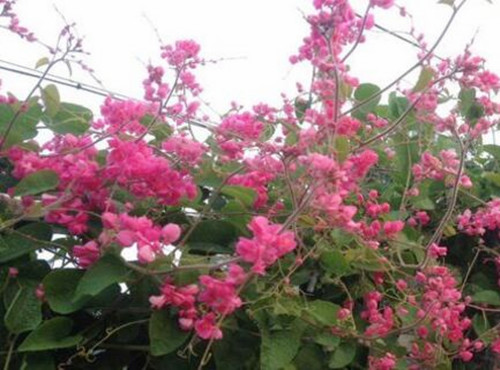
How to grow coral vine?
1. Soil: The best growing medium is fertile loam or humus-rich loam, with good drainage and sunlight; if sunlight is insufficient, flowering is sparse and the color is pale. After the stems and vines of young plants elongate, support stakes need to be set up for climbing. If there are many branches, select and keep 2-3 as main branches and prune the rest. After they grow onto the trellis, pinch the tips to encourage more branching.
2. Fertilizing: Coral vine prefers fertile soil, and grows best in loose, fertile and moist soil. When fertilizing, dig a ring-shaped trench around the plant and apply decomposed human and livestock manure. Depending on the size of the plant, 100-250 kg can be applied per plant. Do not fertilize in winter, but do prune and shape the plant. Pruning makes the branches evenly distributed; cut off overly dense branches, thin and weak branches, inner branches, withered branches, and diseased and pest-infested branches, so that the coverage is neat and nutrients are concentrated on the flowering branches, achieving the goal of a trellis full of blooming flowers.
3. Watering: Coral vine likes moisture during the growing season, but the growing site must not be too low-lying, and especially must not have standing water, because coral vine and other tuberous-root plants are not tolerant of waterlogging. Generally, spring has little rain and dry air, and this is exactly the critical period when the plant sprouts flowering branches. Growers must replenish water at any time according to the moisture content of the local soil, generally watering 2-3 times per month. For autumn watering, according to the plant's growth, water thoroughly after applying heavy fertilizer to help the fertilizer decompose, making the soil moist and fertile and laying a foundation for flowering in late autumn and early winter. In areas with lower winter temperatures, watering should be controlled; generally in a dry winter, watering once a month is enough to protect the plant through the winter safely.
4. Light: Coral vine remains green with lush foliage all year round and grows extremely vigorously, so it needs a certain amount of sunlight for both vegetative growth and reproductive growth. When growing it, in addition to choosing a sunny location, also pay attention to pruning and shaping so that it receives sunlight all over. If light is sufficient and water and fertilizer management is good, the plant's photosynthesis is especially vigorous, more nutrients accumulate in the plant, flowers are densely set on the branches, and its reproductive capacity is extremely strong.
5. Temperature: Coral vine likes warmth and is not cold-tolerant. Its most suitable growing temperature is 20-30°C. If the temperature continues to rise, the plant's growth actually weakens. If the temperature continues to drop below 10°C, the leaves change from fresh green to dark green, and sometimes the branches wilt and the leaves wither. If the temperature drops further, the plant's new branches will die. Therefore, in the growing environment, the winter temperature must not be lower than 10°C, so that the plant can enter dormancy for the winter with luxuriant branches and leaves.
What are the main values of coral vine?
Coral vine has delicate flower shapes, an extremely long flowering period, brilliant colors, and branches full of blooms. It is exceptionally beautiful. Coral vine flowers profusely and has a slight fragrance, making it a rare famous flower in summer.
Coral vine is called the queen of vines. It can be planted in flower beds, and it is also a good material for potted displays on both sides of windows in hotels and assembly halls. It is suitable for flower stands and shady trellises, can be used as a trellis plant, and is a good material for vertical greening. There are double-flowered horticultural cultivars. It can also be used as a cut flower for flower arrangements and flower baskets. Its tuberous roots are edible.
Coral Vine Plant Culture
The Chain of Love
According to legend, in Western mythology, there was a beautiful goddess who attracted the pursuit of many gods, but no one could move her heart.
The mother of the mountain god wanted to win the beauty for her son. One day, this mother went into the mountains and gathered many vines and grasses, weaving them into a vine garment and a necklace, and asked the mountain god to wear them when he went to the goddess's dwelling again. When the goddess opened the door, the sunlight happened to shine on the vine garment and the vine necklace. In an instant, thousands of pink, brilliant coral-shaped little flowers bloomed, along with heart-shaped small leaves representing countless true hearts. The goddess could not help blurting out: “What a beautiful coral vine!” So the mountain god put the vine necklace around the goddess's fair neck and from then on won her heart.
Therefore, coral vine is also called the “Chain of Love” (Lover`sChain)