Is lupine, the roadside flower, suitable for growing in the north? Seed price per jin and planting methods
Lupine, also called “lupin”, is a plant in the order Rosales, family Fabaceae, genus Lupinus. The flowering period is March-May, and the fruiting period is April-July. So is lupine suitable for growing in the north? Roughly how much does a jin of seeds cost? How do you plant it? According to Jiujiang Seed Company, the price of lupine seeds is about 200 yuan/jin, and the sowing rate per mu is 4--5 jin.
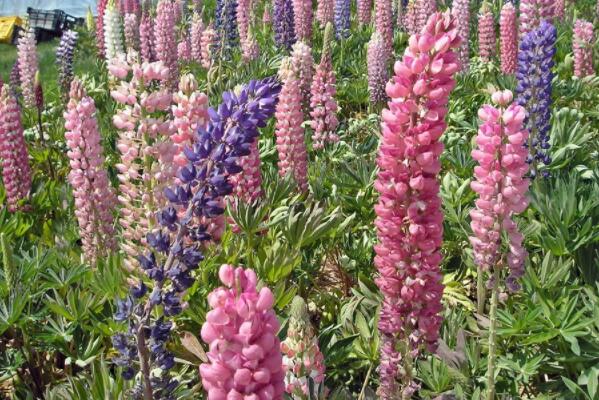
Is lupine suitable for growing in the north?
Lupine can be grown in the north.
1. It likes cool conditions and abundant sunlight, dislikes heat, and is slightly shade-tolerant. It has a deep root system and few root nodules. It grows in sandy soil and requires deep, fertile, loose, well-drained acidic sandy loam (pH 5.5); plants grow poorly in neutral and slightly alkaline soil.
2. If growing in pots, pay attention: the soil for indoor potted plants is not the same as in open ground, so choose loose, fertile soil. In northern regions, choose acidic soil; if the soil is alkaline, treat it before use. Although lupine has a relatively well-developed root system, its soil requirements must not be overlooked.
Lupine takes one month to go from seedling to mature plant, so it is best to choose a deeper flower pot to promote root growth.
How do you plant lupine?
I. Suitable environment for lupine
The quality of the soil directly determines the quality of lupine seedling growth. If the soil is especially good and the growing environment is especially good, then manual care will be much easier. Lupine is not strict about soil quality and can grow in sandy soil, loess, or clay, but soil with a high sand content gives only average germination. Lupine fears waterlogging, so the site should be relatively high and easy to drain. When the dog days arrive and rainfall increases, standing water must be drained immediately, otherwise some seedlings may die. The land mainly needs to be good for draining standing water, the soil can be ordinary, and there should be plenty of sunlight.
II. Land preparation
1. Plowing: Lupine is especially sensitive to nutrients. When the soil is nutrient-rich, the flowers it opens are large and beautiful, and the plants are healthy. However, the soil at many construction sites is land with only average nutrients, so if you want beautiful flowers, you still need to apply enough organic fertilizer before planting, spreading 2.5~8 tons of cow manure or chicken manure per mu. After spreading the fertilizer, plow deeply once and harrow finely once, so that the soil and fertilizer are fully and evenly mixed together, with no large clods, making planting easier and increasing emergence.
2. Making beds: To make irrigation, weeding, fertilizing, and other necessary care and management easier during the one-year growth period of lupine seedlings, Changjing Landscape suggests making the land into beds with a fixed standard width of 1.6 m and a length of 16~22 m, with the actual situation depending on the terrain.
III. Planting
Lupine seeds are medium in size and have strong emergence ability, so shallow planting is recommended, with soil cover no deeper than 5 cm. Broadcast sowing is generally used. Choose conditions with little wind, mix the lupine seeds into moist sand, then scatter them on the ground. After planting, cover the soil by raking by hand or machine. After covering the soil, water once, and emergence can generally be increased in about 8~9 days.
IV. Care
There is only one main point in the care and management of lupine during the growing period: it rarely has pests or diseases, and its growth is good. The key matters are basically all concentrated in the flowering period. Before flowering, apply 50 kg of compound fertilizer per mu. Topdressing fertilizer before flowering is to make the flowering time longer, the number of flowers greater, and the flower color more vivid. After flowering, there is no need to fertilize. During the period when lupine is blooming, sufficient water is needed; during this time, water according to weather conditions at the right opportunity.