How much do safflower seeds generally cost per jin, and the planting, harvesting time and methods
Safflower is also known as honglanhua and cihonghua, with a distinctive aroma and a slightly bitter taste. Those with long petals, bright red color and soft texture are considered the best. It is mainly produced in Henan, Hunan, Sichuan, **, Tibet and other places. So how much do safflower seeds generally cost per jin? When to plant and harvest? How to plant? According to Mr. Wang from Shuyang Seed Company, the price of safflower seeds is generally around 28 yuan/jin, and the sowing rate per mu is 8-10 jin.
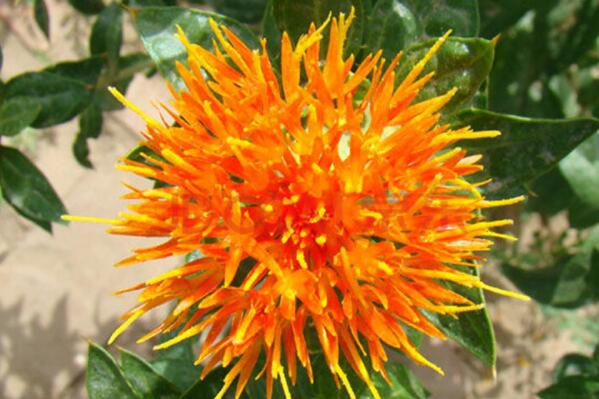
When is safflower planted and harvested?
Planting:
It is mainly propagated by corms. Mature corms have multiple main and lateral buds, and after flowering, new corms are formed by swelling from the base of the leaf cluster. Every year from August to September, the new corms are dug out and planted, and they can bloom in the same year. Seed propagation requires 3-4 years of cultivation before flowering.
Harvest:
1. Harvest begins when the corolla lobes open, the stamens begin to turn yellow, and the flowers are bright red and glossy. It is best to pick them every early morning, when the corolla is not easily broken and the bracts do not prick the hands. Special note: safflower flowers cannot be harvested too early or too late; if harvested too early, the flowers have not yet been pollinated and the color is yellowish. If harvested too late, the flowers turn purplish black. Therefore, harvesting too early or too late both affect the quality of the flowers, and the flowers are not suitable for medicinal use.
2. When the safflower plant turns yellow, there are only a few green bract leaves on the flower head, the flower head loses water, and the seeds harden and show the inherent color of the variety, it can be harvested. Generally, an ordinary grain combine harvester is used for harvesting.
How is safflower planted?
Cultivation: For propagation methods, saffron can be propagated by corm division and sowing, but corm division propagation is the main method.
1. Corm division propagation. It is generally carried out from August to September. Mature corms have multiple main and lateral buds. After flowering, new corms are formed by swelling from the base of the leaf cluster. After the aboveground part withers in summer, dig out the corms, grade them, dry them in the shade, and store them. Early planting time is beneficial for forming strong seedlings. Each mature corm has several main buds and lateral buds. When planting, large corms above 8 grams should be planted separately from small corms. Small corms weighing below 8 grams cannot bloom in the same year and need to be cultivated for another year. For pot cultivation, it is advisable to select spring-flowering varieties with corms weighing about 20 grams in October, and use flower pots with an inner diameter of 15 cm, with 5 to 6 corms per pot. After planting, place them outdoors for care first. They take root after about two weeks, then move them indoors to a place with sufficient light and fresh, humid air, and they can bloom around New Year's Day. After flowering, remove the residual flowers immediately to avoid nutrient consumption, and apply 1 to 2 times a compound fertilizer solution mainly containing phosphorus and potassium to promote strong corm growth. Continue normal care until the aboveground part withers and turns yellow in early summer, then take out the corms, dry them in the shade and store them. Saffron can also be grown in water for ornamental purposes, in the same way as soaking narcissus.
2. Sowing propagation. Because saffron does not easily set seed, seeds can only be obtained after artificial pollination. After the seeds mature, sow them as soon as they are collected in an open-field seedbed or in a pot. The sowing density of seeds should not be too high; it is better to sow them sparsely, because the plants need to grow corms, and they generally cannot be dug up within 2 years. From sowing seeds to plant flowering often takes 3-4 years.
Season:
1. Cultivation and management. Saffron likes a warm and humid environment and is afraid of extreme heat. It likes sufficient sunlight and can also tolerate semi-shade. The suitable growth temperature is around 15°C, and the suitable flowering temperature is 16°C to 20°C. It is afraid of extreme heat, relatively cold-tolerant, and avoids continuous cropping. It requires loose, fertile, well-drained sandy loam soil with a pH of 5.5 to 6.5. It avoids heavy clay soil and long-term waterlogging. Its growth characteristics are dormancy in summer, root development and leaf growth in autumn, flowering from October to November, and flowers opening by day and closing at night. Under general cultivation conditions it does not set seed, and the entire growth period is about 210 days. Whether spring-flowering or autumn-flowering, it is an autumn-planted bulbous flower. That is, it begins to sprout in autumn, grows and blooms through winter and spring, sets seed in seed-setting types, and enters dormancy in summer. The lifespan of the corm is one year, similar to tulips, with new and old corms alternately renewed once each year.
2. Plant from September to October in autumn. The soil should be plowed, turned and finely leveled, and sufficient decomposed organic fertilizer and a small amount of superphosphate should be applied as base fertilizer. The plant spacing and row spacing are 1Ocm×20cm, the depth is 8-1Ocm, and the covering soil is 5-8 cm. During the growth period, weed in time, pay attention to drainage after rain, and loosen the soil and water during autumn drought to keep the soil moist to facilitate rooting. It blooms in October. Apply a quick-acting phosphate fertilizer once during the bud stage, and the flowers will be large and brightly colored. After flowering, topdress 1-2 times with decomposed cake fertilizer water in time to promote corm growth. In northern regions, straw curtains and other materials are needed in winter to protect against cold. In the second year in spring, pay attention to watering to promote the expansion of new corms. In the next summer it enters dormancy, and the aboveground part of the plant dries up. The entire growth period is about 7 months, and the optimum growth temperature is 10-15°C. Forcing cultivation is also possible. After one planting, it can be dug out and divided for replanting after several years when the corms become crowded. Store the corms in a dry room at 17-23°C.
3. For household pot cultivation of saffron, it is advisable to choose spring-flowering varieties. Generally, a clay pot with a diameter of 15-18 cm can hold 5-7 seed corms, planted from September to October. After planting, water thoroughly and first place outdoors for cultivation. After rooting, move them into a cold room with a room temperature slightly higher than the outdoor temperature, and give sufficient light so they bloom at the expected time. Saffron can also be cultivated hydroponically,
Pest and disease control:
Sclerotinia harms corms and seedlings. When storing corms, injured or diseased corms must be removed to prevent corm deterioration and infection and spread of pathogens. It can be controlled by spraying with 500 times dilution of 50% thiophanate-methyl wettable powder.