Honeysuckle Seed Prices, Planting Methods, and Flowering and Harvesting Times Explained
Honeysuckle, also known as Japanese honeysuckle (Lonicera japonica), is sweet in nature, cold in energy, and aromatic; being sweet and cold, it clears heat without harming the stomach, and its aromatic property penetrates and dispels pathogenic factors. It is distributed in every province of China. So roughly how much does a jin of honeysuckle seeds cost? How do you plant them? How long until they flower and can be harvested? From Manager Fang at the Jiujiang Seed Company, we learned that honeysuckle seeds cost roughly 135 yuan/jin, with a sowing rate of 5-6 jin per mu, and they can be sown in spring, summer, and autumn.
How do you plant honeysuckle?
1. Honeysuckle seeds are generally best sown from the first ten days of March to mid-June. When sowing honeysuckle, the seeds need to be treated in advance; then place the treated seeds in warm water at about 40 degrees, soak them for about one day, then mix them into moist sandy soil, cover with a protective film, and place them in a warm spot, and the seeds will germinate.
2. Prepare a seedbed in advance, place suitable soil in it, then add appropriate base fertilizer and insecticide, the purpose being to help the seeds effectively prevent pests and diseases. When sowing, the broadcast sowing method is generally chosen; after watering the seedlings, place the honeysuckle seeds in sandy soil for management. After sowing, you can also cover the seedbed with about 5 mm of sandy soil, and it is best to cover it with a straw curtain.
3. After sowing honeysuckle, mainly keep the seedbed moist, because the moisture in the seedbed directly affects the emergence rate of honeysuckle; it is best to spray water every morning or evening, and after the seedlings emerge, apply appropriate topdressing according to the growth of the seedlings.
How long does honeysuckle take to flower and be harvested?
Flowering:
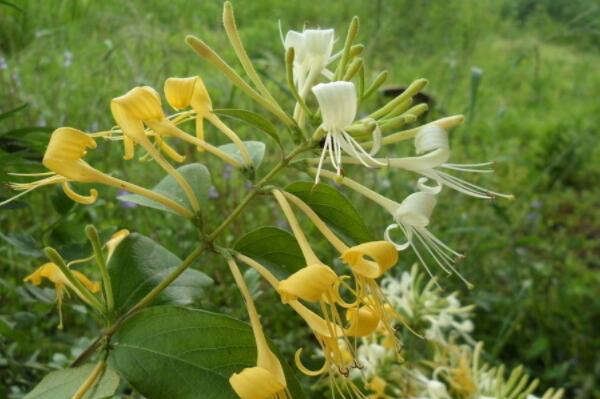
1. Honeysuckle flowers in March, with five petals, a slight fragrance, and a red tint at the base; the flowers are white when they first open, and turn yellow after one or two days.
2. The young branches of honeysuckle are clean reddish-brown, densely covered with yellow-brown, spreading, stiff, rough hairs, glandular hairs, and short soft hairs, and are often hairless in the lower part. The leaves are papery, ovate to oblong-ovate, sometimes ovate-lanceolate, rarely round-ovate or obovate, very rarely with 1 to several blunt lobes, 3-5 cm long, the apex acute or acuminate, rarely blunt, rounded, or slightly notched, the base rounded or nearly heart-shaped, with rough marginal hairs, dark green above, light green below; the leaves on the upper part of the branchlets are usually densely covered with short rough hairs on both sides, while the lower leaves are often smooth and hairless and more or less grayish-green below; the petiole is 4-8 mm long and densely covered with short soft hairs.
Harvesting:
1. The best time to harvest honeysuckle is in the early morning and before noon, when the picked flower buds do not easily open and have sufficient nutrients, a strong scent, and good color. Afternoon harvesting should be finished before the sun sets, because the opening of honeysuckle is restricted by light, and after the sun sets the mature flower buds will open, affecting quality. Do not include young buds or leaves; after picking, put them into wicker or bamboo baskets. When gathering them, do not pile them into a big heap; spread them out instead, and do not leave them for more than 4 hours.
2. For commercial honeysuckle, flower buds are best; those mixed with opened flowers or stem and leaf impurities are of lower quality. Flower buds that are plump, greenish-white, and clean when held are best. Harvest in May and June, picking the flower buds on a clear morning just after the dew has dried, and spread them on reed mats, stone platforms, or on the ground to dry in the sun or air-dry in a ventilated place; drying within 1-2 days is best. When sun-drying the flowers, do not turn them, otherwise the flower color will turn black and the quality will be reduced; when they are 90 percent dry, pick out the branches, leaves, and impurities. Avoid exposing them to the blazing sun. On cloudy days they can be dried over a low fire, but the flower color will be darker, which is not as good as sun-drying or air-drying.