How much does a jin of Japanese snowbell seeds cost? Plus planting and bonsai care methods
Japanese snowbell, also known as Muxiangchai, wild ginkgo tree, and mountain ginkgo, is a traditional Chinese medicine name, with the effect of dispelling wind and removing dampness. It is used for wind-dampness arthralgia. So roughly how much does a jin of Japanese snowbell seeds cost? How to plant it? How to care for it as a bonsai? According to Jiujiang Seed Company, the price of Japanese snowbell seeds is 45--55 yuan/jin, and the sowing rate per mu is 4--5 jin. It is a perennial herbaceous flower, with flower width 3.5~6 cm, plant height 38~125 cm, and flowering period 70~105 days, with slight variations from place to place.
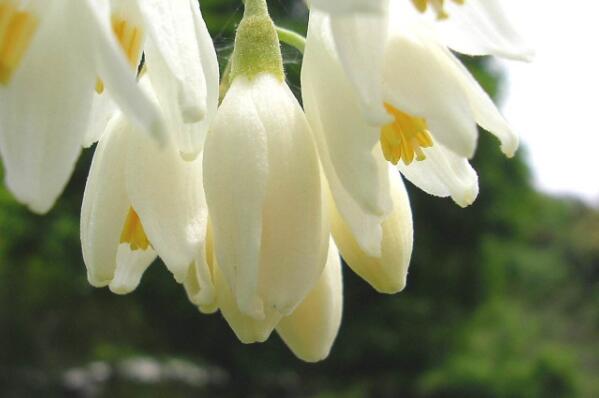
How to plant Japanese snowbell?
I. What kind of environment is Japanese snowbell suited to
The quality of the soil directly determines the quality of Japanese snowbell seedling growth. If the soil is especially good and the growing environment is especially good, then staff management will be much simpler. Japanese snowbell has few restrictions on soil type; it can be sandy soil, loess, or clay, but soil with too much sand gives poor seedling emergence. Japanese snowbell fears waterlogging, so the terrain should be relatively high and drain easily. When summer comes and rain gradually increases, water must be able to drain away immediately, otherwise a large number of seedlings may die. The nursery must mainly be good for drainage; ordinary soil is generally fine, and sunlight duration should be sufficient.
II. Land preparation
1. Plowing: Japanese snowbell is quite sensitive to fertility. If soil fertility is sufficient, the flowers will be large and beautiful, and the plants robust. However, much of the soil at landscaping sites is nursery soil with only average fertility. For this reason, if you want beautiful flowers, you still need to apply enough organic fertilizer before sowing, broadcasting 2.5~6.5 tons of cow and horse manure per mu, then plowing once after topdressing and harrowing once finely, so that the soil and fertilizer are mixed evenly together, with no large clods, making sowing convenient and improving the germination rate.
2. Making beds: To make watering, weeding, topdressing, and other necessary care work convenient during the one-year growth period of Japanese snowbell seedlings, Changjing Landscape recommends making the land into beds of a fixed width of 1.6 m and a total length of 10~25 m, with the details depending on the plot.
III. How to plant Japanese snowbell
Japanese snowbell seeds are medium in size and have good emergence ability, so shallow sowing is recommended, with soil cover no deeper than 4 cm. Broadcasting is commonly used. Choose a breezy day, mix the Japanese snowbell seeds into moist sand, then scatter them onto the soil. After sowing, cover the soil by hand raking or mechanical raking. After covering the soil, irrigate once, and in about 5~9 days the germination rate can be improved.
IV. How to care for Japanese snowbell
There are fewer care tasks during the seedling stage of Japanese snowbell; it has few diseases and strong growth. The main tasks are mostly concentrated during the flowering period. Before flowering, apply 30 kg of chemical fertilizer per mu. Applying fertilizer before flowering is to extend the flowering period and make the flowers more vividly colored. Do not fertilize during full bloom. During the blooming period of Japanese snowbell, more water is needed. At this time, the number and timing of watering should be decided according to weather conditions.
How to care for a Japanese snowbell bonsai?
For a jasmine potted plant, the growing medium is required to be rich in organic matter and to have a certain ability to retain water and fertilizer, while also having permeability and aeration. To retain water and fertilizer while also draining and aerating and being rich in organic matter, a single planting material cannot meet the requirements, so potted soil should be made by combining several planting materials. According to the requirements, it is generally garden soil and humus soil mixed with a certain amount of granular planting material.
1. Garden soil: You can use the surface mature soil from a vegetable plot. After collecting it, heat it by burning to kill bacteria and weed seeds in the soil. At the same time, after heating, the garden soil will improve its aggregate structure. Flower friends with experience should understand this point.
2. Humus soil: Humus soil is rich in organic matter. Humus soil can be made at home. The method is: use a bucket, first spread a layer of garden soil on the bottom (I generally use the old soil removed when repotting), then spread a layer of kitchen waste (vegetable leaves, melon rinds, fruit peels, etc.). In this way, one layer of soil and one layer of kitchen waste, fill the bucket using the “sandwich” method. After composting for about a year, it becomes excellent humus soil. Before use, just sterilize it by sunning.
3. Granular soil: For granular soil, you can use honeycomb coal briquette cinders. After the honeycomb coal briquettes are burned, crush them, then sieve out the powder and keep the granules. After soaking in water, they are ready to use.
4. Mixed soil: Mixing garden soil, humus soil, and granular soil in a certain ratio gives excellent soil for potted jasmine. Generally, mix 5 parts garden soil, 2 parts humus soil, and 3 parts granular soil.