White Cucumber Cultivation Methods, Yield per Mu, and Effects and Functions Explained
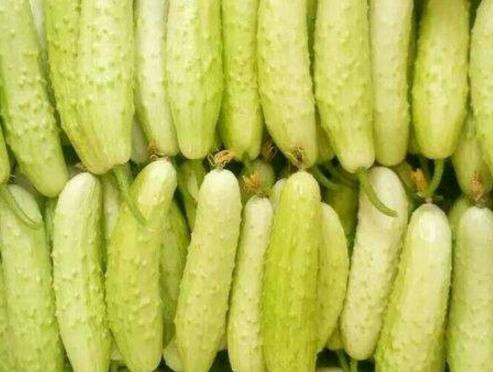
The white cucumber has a pale white-green skin, glossy, without ridges or grooves, with few spines and tubercles. The flesh is white, crisp in texture, and excellent in taste. It is deeply favored by consumers and has high promotional value. So, how is white cucumber cultivated? How many jin per mu does it yield? What effects and functions does it have?
How is white cucumber cultivated?
1. Apply sufficient base fertilizer
Generally, for high-yield fields, apply 5000 kg of high-quality farmyard manure, 50 kg of nitrogen-phosphorus-potassium ternary compound fertilizer, and 20-50 kg of superphosphate per 667 sq m, spread evenly, deep plow 25 cm, then prepare the land and make beds, with flat beds 1.1-1.2 m wide.
2. Sow at the right time
For cultivating strong seedlings in the Huang-Huai River basin, spring open-field cultivation can be sown and raised as seedlings in mid-March; autumn cultivation can be raised as seedlings or directly sown from mid-June to late July. Sawdust can be used for seedling raising, because sawdust is breathable, keeps warmth and moisture, allows seedlings to emerge quickly and robustly, and does not easily damage roots when transplanting seedlings. Strong seedlings require a stem about 1 cm thick, short internodes, about 10 cm long, petioles about 10 cm long, 4-5 true leaves, spreading horizontally, thick and fleshy, green in color, with a large but not pointed plant crown, many roots that are relatively thick and whitish, and the seedling has strong but stocky growth vigor.
3. Reasonable close planting
This variety has strong growth vigor. To improve light energy utilization, the plant spacing is 30 cm × 60 cm, maintaining about 3700 plants per 667 sq m, cultivated on tall trellises.
4. Scientific pruning
Because this variety can bear fruit on both the main vine and side vines, during spring cultivation, the seedlings are generally not pinched at the seedling stage; when the main vine is about to reach the top of the trellis, pinch it. For high-yield cultivation, the "one main vine and two side vines" pruning method can be used, so that they are evenly distributed on the trellis surface, making full use of light energy to synthesize more nutrients.
5. Strengthen fertilizer and water management
During the cucumber growing period, promotion and control should be combined to make both vines and fruit flourish. In the early stage, strengthen intertillage and practice seedling restraint, so that restraint continues until the first fruit sets firmly and is enough to hold the vine, and only then water to promote fruit development; otherwise, watering too early easily causes excessive vegetative growth and the danger of fruit abortion. In the early flowering stage, "control" is the main approach; in the fruiting stage, "promotion" is the main approach. The principle of topdressing is frequent and light application. After harvesting the first fruit, alternate "one clear watering and one mixed watering" and apply urea with irrigation water, 8 kg per 667 sq m each time, or 20 kg of ammonium bicarbonate, so as to achieve stable and high yields.
6. Control pests and diseases
The main diseases of white cucumber include downy mildew, angular leaf spot, and powdery mildew, which can be controlled by spraying DuPont Curzate, Anke Mancozeb, metalaxyl, DT fungicide, streptomycin, thiophanate-methyl, and triadimefon. The main pests include aphids, yellow squash beetles, and black squash beetles, which can be controlled with insecticides such as dimethoate, imidacloprid, trichlorfon, and beta-cypermethrin.
How many jin per mu does white cucumber yield?
Cucumber is a vegetable eaten as tender fruit. When the increase in fruit length and thickness reaches a certain size and the seeds and skin have not yet hardened, it should be harvested in time; if too late, it not only affects quality but also burdens the vine and delays the development of the next fruit. In particular, the first fruit should be harvested appropriately earlier. White cucumber generally yields 3000-4000 kg per 667 sq m.
What effects and functions does white cucumber have?
The white cucumber has a crystal-clear white skin and has obvious effects of clearing heat and detoxifying, and promoting body fluid and quenching thirst. It is rich in vitamin B2, vitamin C, vitamin E, carotene, and other nutrients, and also contains cucurbitacin, soft fine fibers, and other components. It is a rare ideal food for detoxifying and beautifying, and promoting metabolism.