How to grow Star Jasmine (Trachelospermum jasminoides)? Toxicity, benefits and effects explained
Star Jasmine, also known as Shiling, Mingshi, Xuanshi, Yunzhu, Yundan, Hongduiyeshen, Baihuateng. It is distributed in Henan, Shandong, Anhui, Jiangsu, Zhejiang, Fujian and other places. It has relatively high medicinal value. So, how do you grow Star Jasmine? Is it toxic? What are its benefits and effects?
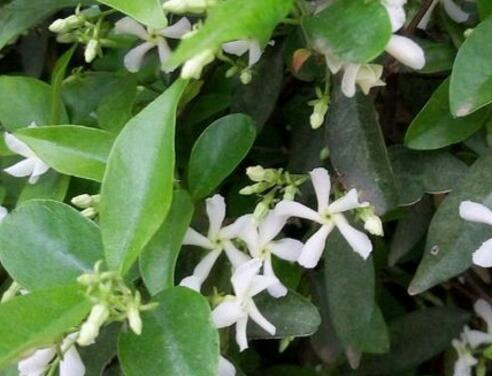
How to grow Star Jasmine?
1. Planting and management: Star Jasmine prefers shade and is fairly cold-tolerant, so it can overwinter outdoors. It has low requirements for soil and fertilizer, and any fertilizer can be applied. It can be grown in ordinary soil. Star Jasmine blooms in April, and the flowers last about half a month. It grows very fast, reaching a height of 1.5 m in a year. Star Jasmine is generally planted on the north side of a house. Star Jasmine grown from seed generally does not bloom. For potted Star Jasmine, the soil should be a light soil, and it should be given one appropriate watering of manure water, but newly rooted layer-propagated seedlings must not be fertilized. Repot about every 4 years, and the best time to repot is around March. Move it indoors before Frost's Descent, and move it back outside before Qingming the following year. Before moving it outside, pay attention to watering. When there are heavy rains in summer, the flower pot must be tipped on its side so that water does not accumulate in the pot and cause root rot. Star Jasmine is generally not pruned or shaped during the growing season. When transplanting and repotting, the root ball must be kept intact. The stems and branches of Star Jasmine are slender and can be trained into various shapes.
2. Propagation methods: Star Jasmine is mainly propagated by layering, and can also be propagated by cuttings and sowing. Layering can be done in spring and autumn every year, around March. Use old branches for layering; in July, use tender branches for layering. Either pot layering or open-ground layering can be used. When pot layering, one branch can be layered continuously into several pots. The depth at which the layer is buried in the soil is generally about 3 cm, and at least 3 buds must be buried, with the middle bud pressed into the soil and the other two buds exposed above the soil but kept in contact with the pot soil surface; this way it roots fastest. Roots can form at both the internodes and the nodes, but the internodes do not produce as many roots as the nodes. Generally, old branches of Star Jasmine layered in spring root slowly and can only be separated from the mother plant around August, then moved indoors to overwinter in winter. For open-ground layering, a straw curtain must be added in winter to prevent freezing. For the part of the branch buried in the soil during layering, the green leaves are generally removed. After layering, Star Jasmine is not watered. Old branches often have dense leaves and many flowers, while tender branches often have sparse leaves and few flowers.
Is Star Jasmine toxic?
Star Jasmine is toxic. The sap of Star Jasmine is toxic, that is, the milky latex that flows out when a branch is broken. Eating it by mistake can harm the heart and cause poisoning, so do not try it rashly. Apart from this, Star Jasmine has no other toxicity, so as long as you do not eat Star Jasmine, there is no need to worry at all about being poisoned.
What are the benefits and effects of Star Jasmine?
1. Its main effects are: dispelling wind and clearing heat, promoting blood circulation and dredging collaterals.
2. It is used to treat rheumatic arthritis, muscle pain, etc., and is especially effective for those with limb contracture and difficulty in bending and stretching.
3. It has a very good effect on treating carbuncles and sore throat, especially tonsillitis and pharyngitis.
4. According to classical research, it also has the effect of preventing miscarriage.