2018 Yew Fruit Prices, the Value of a Ten-Year-Old Tree, and How to Grow It at Home
The yew is a shallow-rooted plant with an inconspicuous main root and well-developed lateral roots, and it is recognized worldwide as a rare natural anti-cancer plant on the verge of extinction. So how much is a jin of yew fruit in 2018? How much is a 10-year-old yew worth? How do you grow it at home?
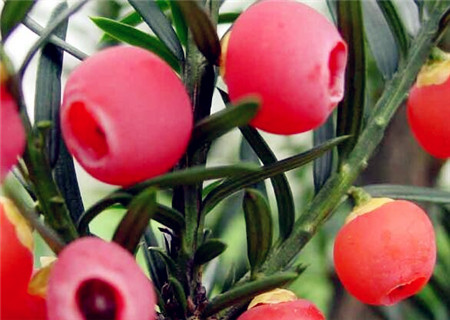
How much is a jin of yew fruit in 2018? On Taobao it sells for 120 yuan/jin, we have always sold it for 50 yuan/jin, and dried yew fruit sells for 158 yuan/jin.
How much is a 10-year-old yew worth? The market price is already very clear. Generally, one about 50 cm tall is about 2.50 yuan, one 20 cm tall is 0.85 yuan, one 15 cm tall is 0.40 yuan, and one 10 cm tall is 0.25 yuan. In addition, the Maire yew (Taxus x media) is slightly more expensive.
Precautions for potted yew care:
1. For newly purchased potted yews that have just sprouted new buds, try not to spray fertilizer solution on the leaves, because at this time the potted yew has not truly established itself or the leaves are too tender; fertilizing now will make the tender leaves or buds shrivel and curl. This in turn affects the normal sprouting of new roots. Do not spray too much plain water on the leaves; the standard is that water droplets can be seen on the leaf surface but do not drip down. Spray in the afternoon, two hours before dark, and do not leave water droplets on the leaves at night (even less so when the amount is larger), otherwise it will affect the normal growth of the tender leaves or cause the leaves to turn yellow, affecting the healthy growth of the plant. (The underside of the leaf can be sprayed more than the upper side, because the upper side of the leaf has a waxy protective film that hinders the absorption of nutrients and water, while the underside has no waxy layer and more stomata, giving it a stronger ability to absorb water and fertilizer. Therefore the underside absorbs faster and more than the leaf surface.) Depending on conditions and temperature, do it once a day or two to three times a day. Note that the room needs frequent ventilation.
2. For newly purchased potted yews, because transplanting from the growing base into a pot damages part of the root system, the nutrient supply between the roots and the branches and leaves becomes unbalanced. Especially for those potted plants with luxuriant branches and leaves, the transpiration from the leaves is greater than the absorption by the roots, and while the potting soil stays moist, the terminal leaves become curled and dry. At this time it is best to prune the branches and leaves appropriately to reduce the excessive consumption of water and nutrients by the branches and leaves and to restore root growth as quickly as possible. At the same time, watering should be controlled and the potting soil kept slightly dry to help the fibrous roots grow as quickly as possible and speed the restoration of normal nutrient supply. At the same time, the yew has a strong sprouting ability, especially strong new-branch growth, and tolerates pruning very well; after it establishes itself it will soon sprout new branches and leaves. When necessary, a plant rooting or root-increasing agent can be used to water the potting soil about once every seven days, for three to four times in a row (use a better-quality product and do not use too much water at once) so that the root system can grow quickly and healthily. This restores the supply balance between roots and leaves as quickly as possible so that the yew grows well.
3. Because a potted yew is grown in a pot where nutrients are limited and can only supply about half a year of growth needs, or because the current plant shape is larger and consumes a great deal of nutrients, consumers are advised to repot the original pot as soon as possible after purchase. This is because our company gives the potted plants a repotting recovery period of more than a month, and they are then stored for a period at the distribution company, and in addition the yew likes fertile, loose soil. It is best to repot as soon as possible; when repotting, calculating by the inner diameter of the pot, the new pot's inner diameter should be at least 5 cm larger. Do this before new buds sprout in February or March each year, and when the potting soil is neither dry nor wet, tip the tree and potting soil out together. Try not to break up the original root ball; if after it establishes itself you find there are too many roots, you may appropriately cut away the bad roots. Place the tree into the new pot, fill nutritional soil around it and press it lightly firm. Only when the soil in the pot is in close contact with the roots can the survival rate be raised; otherwise the plant is unlikely to survive or will not grow vigorously. But do not press the soil too firmly either; if it is too firm, the roots cannot breathe air, which will cause root rot and plant death. Immediately after planting, water once thoroughly. Then place the pot in a cool place for a few days. After watering, the potting soil must not be turned or pressed again, otherwise the potting soil will easily cake, or the soil will be too firm and poorly aerated and easily cause root rot.
4. Fertilization methods for potted yews: the three major elements of plant growth are nitrogen, phosphorus, and potassium fertilizers. Nitrogen fertilizer can promote the growth of flowers, grass, branches, and leaves; phosphorus fertilizer can promote the formation of flowers and fruit; potassium fertilizer can promote the growth of stems and roots.
Because a potted plant is grown in the limited space of a pot and in limited cultivation soil, organic matter is decomposed by bacteria into inorganic salts that are absorbed by the roots. As the yew grows and consumes them, the nutrients in the potting soil gradually become deficient, so that they are no longer enough to supply the needs of growth. Although the potted plant uses a prepared nutritional soil, do not fertilize within three months after buying it and taking it home. Just water with about a 1000-fold potassium dihydrogen phosphate solution in the evening every seven to ten days, or spray it on the leaves. Control the amount of watering well; do not water too much. Only when the leaf color becomes pale, the plant is thin and weak, the leaves are yellow-white, and the leaf edges and tips show "dry scorched edges," and the leaves age prematurely and drop, apply a 1000-fold urea solution or an 800-fold quick-dissolving high-quality compound fertilizer solution of potassium sulfate, remove the sediment, and water the potting soil with it, applying it about once a month. It is best to use fully decomposed diluted soybean cake fertilizer water (about 10%-15%), avoiding the trunk area when applying and spreading it along the pot wall as much as possible, applying once every half month. The next day after fertilizing, water once more with plain water to dilute it in case the applied fertilizer is too concentrated. The above two fertilizers can be used alternately, or you can dig two small holes in each pot and put five or six granules of urea and seven or eight granules of high-quality compound fertilizer in them. Then cover with soil and water so the fertilizer dissolves. Potted yews should not be given raw fertilizer or concentrated fertilizer. Topdressing should be mainly nitrogen and phosphorus fertilizer, and must not be too concentrated.
5. Watering methods for potted plants: the principle is "do not water if not dry; when watering, water thoroughly"
Water is an important component of the body of flowers and trees, and all life activities of flowers and trees proceed with the participation of water. Whether photosynthesis or transpiration, neither can do without water. Water can maintain the turgor pressure of cells and keep branches and leaves upright. But beyond a limit, the plant instead grows thin and weak; if there is too much water in the potting soil for a long time, it will cause the leaves to turn yellow, leaf drop, root rot, and even death.
1. When the surface color of the potting soil becomes slightly lighter, the leaves are slightly curled, pressing the potting soil with a finger feels somewhat soft and loose, and tapping the upper middle part of the pot body with a finger joint gives a relatively dull sound, the potting soil does not need watering; just mist the leaf surface to supplement the leaves' moisture. When the soil surface turns white, pressing it with a finger feels relatively hard, a circle of cracks appears between the pot and the soil, tapping the upper middle part of the pot body with a finger joint gives a clear "bang bang" sound, and the young shoots and tender leaves wilt, the potting soil should be watered. Before watering, press the cracks between the soil and the pot firm with a hard object, then water with a large ladle. When pouring, the ladle should be close to the pot rim, pour the water in all at once, and water thoroughly in one go so that the potting soil absorbs enough water. If you pour a small amount of water into the pot and after a moment see the water quickly flow out from the bottom of the pot, this shows that the soil and the pot are not completely pressed firm; use an object to press the gap between the pot wall and the soil tight before watering. When the potting soil structure is normal, about 40 seconds to one minute after watering, the water should slowly seep out from the bottom of the pot, which is best. The water temperature for watering must be close to or the same as the air temperature at the time. When using tap water, first put the water in the sun for about three hours before watering, because light helps decompose the oxides in tap water and can raise the water temperature. You can also put the water in a large basin for half a day or overnight before watering. If you have many potted plants, it is best to put the water in a large vat so that the water temperature is as close as possible to the air temperature and soil temperature. Especially in the hot season, in addition to watering the potting soil, you should also spray water mist on the leaves to keep them moist, which is beneficial to growth. The potting soil can be kept slightly dry and must not be too wet. When there are many pots, be sure to check each pot according to the actual situation, taking care not to miss watering any or to overwater any.
2. Yew leaves are evergreen all year round and are suitable for placing indoors. But a potted yew should not be placed at the air outlet of an air conditioner, otherwise the leaf transpiration of the yew will increase, easily causing the branches and leaves to dehydrate quickly and the leaves to curl and dry up. If placed in an air-conditioned room where the air conditioner is on every day, spray the leaves every day to keep them moist, and place a basin of plain water in the room. If in a room with heating in the northern winter, it should be kept farther from the radiator, and a basin of plain water should be placed on the radiator to increase indoor air humidity. In summer and autumn, when the temperature exceeds 30°C, shade and cooling should be strengthened; it can be moved to a ventilated room facing north. When necessary, spray water to lower the temperature, creating a cool, humid environment to favor yew growth. Also avoid rooms where direct west-facing sunlight shines onto the potted yew. In winter, the amount of watering for the potted plant should be controlled to avoid the potting soil being too wet for a long time. Because in winter the plant grows less vigorously and the leaves evaporate less water, if the potting soil is too wet for a long time, the surface of the potting soil will cake and be impermeable, easily causing root rot. When growing yews indoors, be sure to ventilate the room frequently.
3. The soil for growing yews should preferably be loose, rich in humus, fertile, and slightly acidic (pH between 5.5 and 7). Do not pour tea water into the potted yew. If leftover tea water is often poured in, because tea water contains theophylline and other raw alkalis, it will first change the soil's acidity and alkalinity, and will also have a relative destructive effect on the organic nutrients in the soil. It inhibits yew growth and will also cause excessive soil moisture, hindering aeration of the potting soil and causing root rot and stem rot. If conditions permit, about once a week at night move the potted yew onto a balcony to receive dew, and in the morning place it in sunlight for about one or two hours to receive light (before ten o'clock in the morning); this is beneficial to yew growth and improves disease resistance. In summer and autumn, prevent direct west-facing sunlight from shining through windows onto the yew, to prevent high temperatures from scorching the leaves and affecting its ornamental value.
6. Key points to note
1. Because the yew tree is small, pay attention to adjusting light. It needs light but should not be placed in strong light for too long; generally in summer and autumn, about two hours of sun before ten in the morning or after five in the afternoon is enough. At ordinary times, receive more scattered sunlight. Otherwise, strong light will scorch the leaves and cause the leaf tips to become scorched yellow. Also keep the room ventilated so that the plant does not wilt, droop, or show other poor growth due to indoor air that is too dry.
2. If a new potted plant shows dark yellow, lusterless tender leaves and wilting at the growing tip, it is generally caused by watering too frequently and too much, caking the soil and making it impermeable, so that part of the fibrous roots rot and the ability to absorb water and fertilizer weakens. For mild symptoms, control the amount of watering, and use a hard but blunt object to gently loosen the surface soil of the pot so the potting soil can breathe. Move it at night to a place where it can receive dew, and move it to a shady, cool place at eight or nine in the morning; this helps the root system recover healthy growth. If within a short period the leaves yellow and curl, this indicates severe root rot, so immediately turn out the pot to check the root rot condition (normal fibrous roots are tender, plump, and white in shape); if more than half are affected, it generally cannot be saved.
3. Old leaves turning yellow from the bottom upward, while new leaves generally grow normally, is generally caused by not watering thoroughly in one go and applying too little water, leaving the roots short of water. Sometimes the terminal leaves dry up and curl, and when touched the dry leaves fall off, while the old leaves still grow normally; this is generally also caused by the roots being short of water, and the plant should be watered thoroughly in one go. When watering, be sure first to press the cracks at the pot rim firm with an object to prevent the water from quickly leaking out through the cracks after watering, creating the false impression of thorough watering; over time this will cause the roots to die from lack of water and make the trunk die. At night move it outdoors to receive more rain and dew, and in the morning and evening receive two hours of sunlight so the yew can recover its growth.
4. The yew is suited to weakly acidic soil. If it is watered for a long time with water that tends to be alkaline, the leaves will turn from green to yellow and may even drop. Therefore add acidic nutrients, or spray the leaves or water the potting soil with a 2-per-thousand ferrous sulfate solution, once every ten days for three times in a row. This can make leaves that have yellowed due to alkalinity turn green again.
5. Every year in March and April, the yew will sprout a large number of tender buds, which will consume a great deal of nutrients. At this time you can pick off the tender buds growing toward the inside, to prevent the branch shape from becoming too dense and poorly ventilated, which would make the leaves turn yellow or drop. Thin out crossing branches, inward-facing branches, and leggy branches; this can improve ventilation and light penetration and can also save the excessive consumption of water and nutrients. When the tender buds have just sprouted, it is best not to spray liquid fertilizer on the leaves or water concentrated fertilizer at the roots.
6. For normal fertilization amounts, if urea alone is used as a nitrogen topdressing, the concentration is generally 1 per thousand; if potassium dihydrogen phosphate alone is used as a phosphorus topdressing, the concentration used is 1 to 2 per thousand, with one topdressing every seven to ten days.