How much is goji berry per jin in 2018? Main production areas and the best origin explained
Goji berry is the general term people use for commercial goji berries, the plants Lycium barbarum, Lycium chinense and other species under the genus Lycium. So what was the market price of goji berries per jin in 2018? Where are the main growing areas in China? Which origin produces the best?
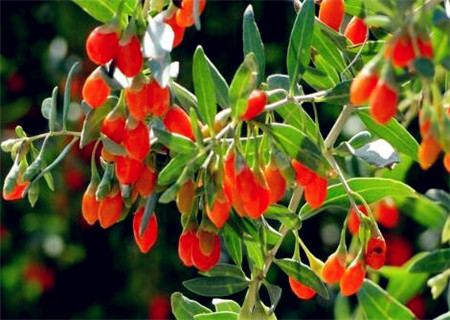
How much was the market price of goji berries per jin in 2018? Goji berries come in many prices, from different places and of different grades; for example, the smaller ones cost around 20 yuan per jin, while the larger ones cost 35 yuan per jin or more.
They are distributed across China's Henan, Northeast China, Hebei, Shanxi, Shaanxi, Ningxia, Gansu, eastern Qinghai, Inner Mongolia's Urad Front Banner, as well as the provinces and regions of the Northwest, Southwest, Central China, South China and East China; they are cultivated or have become wild in Korea, Japan and Europe. They often grow on hillsides, wasteland, hilly land, saline-alkali land, roadsides and beside villages and homes. China's famous goji berry production areas are in the western regions such as Ningxia, Gansu and Qinghai. In China, besides growing widely in the wild, they are also cultivated in various places for medicinal use, as a vegetable or for landscaping.
Ningxia: the original home of goji berries
Goji berry is one of the Five Treasures of Ningxia, and the best of the goji berries, Ningxia 369 goji, is the most famous! And Zhongning County is China's famous hometown of goji berries, with a cultivation history of more than 600 years. 369 goji is a high-quality goji berry launched on the basis of this environment.
The soil in the Zhongning area is strongly alkaline, and the temperature difference between day and night is large; such natural conditions suit the growth of goji berries. As early as the Ming Dynasty, the goji berries here were listed as tribute. Although Zhongning goji has been introduced and planted in various places, the goji berries produced elsewhere all differ from Zhongning goji in both nutrition and appearance. Zhongning goji berries are oval, red or purplish red in color, with a clearly white fruit scar. After opening the package there is a special fragrance, and they will not sink quickly when placed in clear water. The price of Zhongning goji berries is around 50 yuan per jin, and the price varies with quality.
Qinghai: natural and pollution-free
Besides the well-known Ningxia goji, Qinghai goji is also favored by people for its natural quality. Qinghai goji is also called Chai goji, mainly produced in the Qaidam Basin.
The Qaidam Basin has a plateau continental climate, with an average of up to 10 hours of sunlight and a large temperature difference between day and night. At the same time, the altitude here is relatively high and the air humidity is low, so the goji berries produced are natural and pollution-free, and their flavonoid content is higher than in other regions, making them very suitable for drying as dried fruit or processing into concentrated juice.
Qaidam goji berries are relatively large, with few seeds and thick flesh, and taste fairly sweet. Because they are not yet particularly widely planted, the price of Qaidam goji is relatively high, about 60 yuan per jin.
Julu: hometown of Hebei goji, with large output
Julu: output accounts for a quarter of the national total, hometown of Hebei goji
Julu County is located in the Heilonggang River basin and is a key county for goji production in Hebei Province, with its output accounting for a quarter of the national total. The goji berries produced are sold well in Thailand, Malaysia, Japan, the United States and countries and regions such as Hong Kong, China and Macao, China.
Julu County has a history of more than 50 years of goji cultivation, with an area of 5.0 mu, an annual output of 5 million kg of dried fruit, and its area and output accounting for 1/4 of the country's; Julu County is the national distribution center for goji berries. In 2002, the People's Government of Hebei Province named Julu “Hometown of Hebei Goji”.
Julu goji is mainly sold to provinces and cities across the country and to various countries and regions in Southeast Asia, and has been praised by foreign merchants as “China 01 Blood Goji”.
It is understood that in the Compendium of Materia Medica, Li Shizhen took Ningxia goji as the authentic medicinal material and said its nutritional value is high, and Ningxia goji is also the only goji berry from a main production area recorded as a medicinal material in the Chinese Pharmacopoeia. This is also why Ningxia goji tastes less sweet than Qinghai goji, is especially small in size, and even has a slightly bitter aftertaste, yet its price is much higher than that of Qinghai goji.