Deciduous tree Paulownia purchase price, sapling price, and flowering and leaf-fall times
Paulownia is also called downy paulownia, smooth paulownia, Lankao paulownia, catalpa-leaf paulownia, white-flowered paulownia, and Taiwan paulownia. It is cultivated or wild, and some regions are introducing it. So what is the purchase price of paulownia? How much is one sapling? When does it flower and drop its leaves? How is it planted? From the Changsha building materials market we learned that purchases are calculated by cubic meter, and the current price is 350-400 per cubic meter.
How much is one paulownia sapling?
| Nursery stock name | Diameter (cm) | Unit (plant) | Price (yuan) |
| Paulownia | 6 | plant | 35 |
| Paulownia | 8 | plant | 70 |
| Paulownia | 10 | plant | 120 |
| Paulownia | 12 | plant | 160 |
| Paulownia | 13 | plant | 220 |
| Paulownia | 14 | plant | 280 |
| Paulownia | 15 | plant | 350 |
When does paulownia flower and drop its leaves?
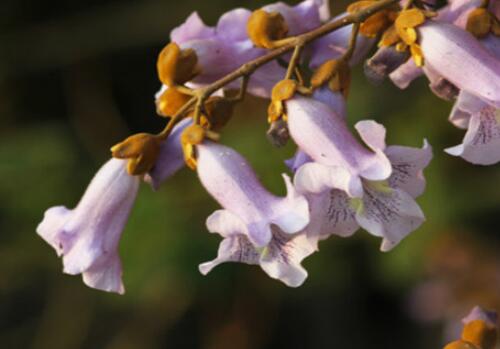
1. Paulownia usually flowers from March to April, and the flowering period lasts about 1 month. Paulownia flowers form small cymes of 3-5 flowers, with or without a common peduncle, but because the overwintering leaf-like involucre and bracts fall off, most small cymes form large inflorescences. The lateral branches of the inflorescence branches vary in length, making the inflorescence conical, pyramidal, or cylindrical. The corolla is large, purple or white, funnel-shaped bell-shaped to tubular funnel-shaped, with two longitudinal folds on the belly (only white-flowered paulownia has no obvious longitudinal folds), often with dark purple spots inside, and yellow at the raised longitudinal folds.
2. Young trees have smooth bark but prominent lenticels. Large trees gradually develop longitudinal cracks, the leaf branches are sparse, and the crown is conical or umbrella-shaped. Most tree species have false dichotomous branching, and the terminal buds wither after overwintering. Leaves are opposite, large, and long-stalked. As the tree ages, the leaf area gradually becomes smaller. The inflorescence is a cymose panicle, the flowers are stalked, the calyx is fleshy, obconical or bell-shaped, and the corolla is large, purple or white. The fruit is a capsule, ovoid or elliptical, and the seeds are elliptical, very small, and numerous.
How is paulownia planted?
1. Choose improved varieties: what is usually called paulownia is actually the general name for the genus Paulownia. This genus has 9 species in total. The species suitable for growing in the south is white-flowered paulownia or a hybrid with white-flowered paulownia as the parent. The 6 paulownia clones selected and bred by the Forestry Science Research Institute of Fuzhou City, Jiangxi Province, grow rapidly, have straight trunk form, high trunk below the branches, and strong adaptability, and are excellent strains suitable for promotion in areas south of the Yangtze River.
2. Root burying for seedling propagation: the seedling bed can be chosen as a nursery site sheltered from the wind and facing the sun, mainly sandy loam or loam, made into high-ridge seedling beds 15-20 cm high. Use 1-2 year old seedling roots, with straight root burying being best. The plant and row spacing for burying roots should preferably be 1 m × 0.8 m or 1 m × 1 m. Apply sufficient base fertilizer, and during the vigorous growth period from June to August, apply quick-acting chemical fertilizer as a top dressing to promote rapid growth.
3. Afforestation: for planting around the four sides, large holes should be dug and sufficient base fertilizer applied. For mountain afforestation, strip terrace site preparation is required, with a loose soil layer thickness of 50-70 cm, and sufficient base fertilizer should be applied to achieve rapid growth in the year of afforestation. For forestry-oriented afforestation, the density is 5 m × 5 m, planting 26 plants per 667 sq m (1 mu); for combined forestry and grain afforestation, the density is 5 m × 10 m, planting 13 plants per 667 sq m; for grain-oriented afforestation, the density is 4 m × 30 m, planting 6 plants per hectare.