Red-fruited Holly: 10 cm Price, Fruit Edibility, Benefits, and Planting Methods
Red-fruited Holly is an evergreen tree that bears red fruits, and the red fruits stay on the tree for a long time, generally from October of the current year to April to May of the following year, reaching up to 20 m tall. It is produced in southern Gansu, Hubei, Hunan, and other places. So, what is the price of a 10 cm Red-fruited Holly? How is it planted? Are its fruits edible? What benefits and effects does it have? According to the nursery stock market, the price of a 10 cm Red-fruited Holly is 400 yuan per plant, with large price differences among different regions.
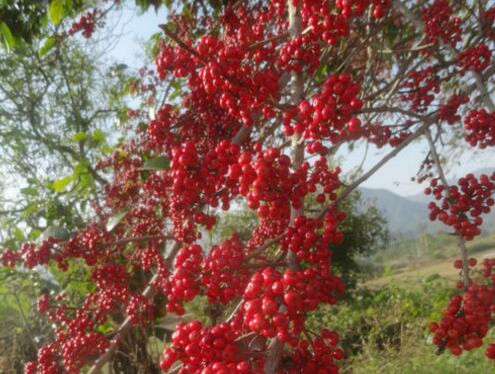
How is Red-fruited Holly planted?
Sowing Techniques
Red-fruited Holly is mainly propagated by sowing, and can also be propagated by cuttings.
(1) Propagation by sowing: Harvest after the fruits ripen in autumn, remove the fruit peel, rinse clean, stratify the seeds with moist sand at low temperature for germination, and sow before March of the following spring. Seedlings grow slowly and require careful maintenance and management. If holly seeds are not treated for germination, they often take until the next year to sprout.
(2) Propagation by cuttings: Softwood cuttings should be taken during the plum rain season. The cuttings should be 6 to 8 cm long, with the lower leaves removed, leaving 1 to 2 upper leaves and cutting them back by 1/3. After soaking the cuttings in a 200 mg/L NAA solution for 3 hours, insert them to a depth of 1/2 their length, using sand or perlite and peat soil (3:1) as the substrate. After insertion, build a shed for shade, spray water frequently, and keep moist. Roots can form after about 1 month.
Cultivation Management
Conventional cultivation management: After the seedlings are cultivated in the nursery for 2 to 3 years, they can be transplanted and planted out. Transplanting should be done in spring, and care should be taken not to damage the roots when digging up the seedlings, and to transplant with soil. At the initial planting stage, pay attention to intertillage and weeding, water when dry, and strengthen management.
Disease Control
Holly is susceptible to damage by white wax scale, and sooty mold is likely to occur among dense branches and leaves and at scorched bark areas, so attention should be paid to timely control. In places where winters are relatively cold, measures such as mounding soil for cold protection can be taken. Diseases are mainly leaf spot, which can be controlled with carbendazim and chlorothalonil.
Harvesting and Storage
It can be collected throughout the year. The leaves can be used fresh or dried in the sun. The roots should be washed clean of soil and dried in the sun.
Are the fruits of Red-fruited Holly edible?
The fruits of Red-fruited Holly are non-toxic, with a taste that is sour with sweetness. After ripening, they can be eaten directly, and they can supplement the human body with various amino acids and vitamins. In addition, the fruits of Red-fruited Holly also contain some natural anti-inflammatory components, which can reduce inflammation and kill bacteria, remove bad breath, and also reduce the occurrence of common diseases such as oral ulcers and sore throat.
What benefits and effects does Red-fruited Holly have?
1. Not only are the fruits of Red-fruited Holly edible, but its leaves and roots can also be used as medicine. After being used as medicine, it is sweet in taste and cool in nature, can clear heat and detoxify, and can also reduce swelling and relieve pain. It is a commonly used medicine for treating human head sores, swelling and pain, and burns. When needed in daily life, it is mainly used externally, and can be ground into powder and applied directly.
2. Red-fruited Holly can clear heat, detoxify, and relieve pain. It has a clear therapeutic effect on human burns and scalds. During treatment, the leaves of Red-fruited Holly can be ground into fine powder, mixed evenly with tea oil, and applied directly to the injured area, changing the medicine once a day. It can prevent infection of the wound, relieve pain, and also speed up wound healing.
3. Red-fruited Holly also has a certain therapeutic effect on head sores that occur frequently in children. During treatment, the leaves or roots of Red-fruited Holly can be ground into fine powder, mixed evenly with rapeseed oil, and applied directly to the affected area. In addition, Red-fruited Holly can also treat human joint swelling and pain and pain caused by overexertion. During treatment, the leaves of Red-fruited Holly can be decocted with clean water and then used while hot to fumigate and wash the affected area, or the resulting medicinal liquid can be taken directly orally, both of which can play an important role in quickly relieving pain.