Perennial Hosta: Seedling Prices, Varieties, Growing Methods and Flower Meaning Explained
Hosta, also known as Yu Chun Bang, White Crane Flower, Yu Pao Hua and White Jade Hairpin, is a perennial herbaceous plant of the genus Hosta in the family Asparagaceae. It blooms from summer to autumn, with flowers as white as jade. So how much does a hosta seedling cost per plant? What varieties are there? What are the growing methods? What is the flower meaning? What is the seed propagation method? It is reported that the flower meaning of hosta is tranquility and tolerance. Like the lotus, hosta grows in soil yet remains unstained, elegant and pure.
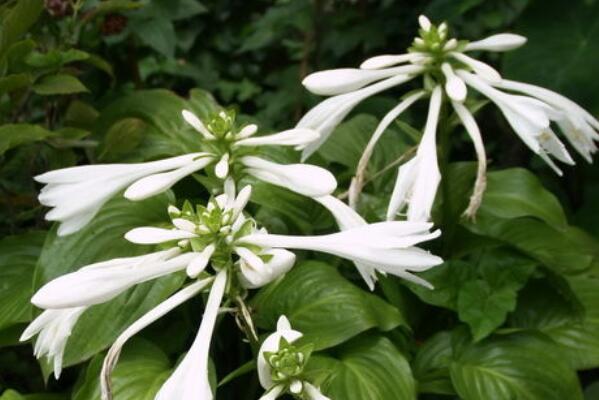
How much does a hosta seedling cost per plant?
| Nursery stock name | Height (cm) | Price (yuan) |
| Green-leaf hosta | 15~25 | 0.38~0.45 |
| Green-leaf hosta | 30~45 | 0.5~0.65 |
| Variegated-leaf hosta | 15~25 | 0.4~0.6 |
| Variegated-leaf hosta | 30~45 | 0.5~0.7 |
What varieties of hosta are there?
1. Hosta clausa var. normalis (Northeast Hosta)
A small to medium-sized hosta. The plant can grow to 10-15 cm and produces more than 20 flowers. The flowers are purple, blooming from July to August, and can set seed. It tolerates strong light and has stronger environmental adaptability than ordinary hostas.
2. Wide-margin hosta
A medium-sized hosta. Mature plants can grow to 30 cm, bloom from June to July, and can bloom a second time in mid-September. The flowers are funnel-shaped with flat-spreading lobes. Avoid direct strong light; for garden planting, plant in semi-shade or deep shade.
3. Christmas Eve hosta
A large hosta variety. Mature plants are 45 cm tall. The leaves are relatively thick, with a faint white color in the center of the leaf, and the flowers are funnel-shaped and open relatively wide. It likes shade and tolerates strong light.
4. Francee hosta
Mature plants are 50 cm tall, belonging to the large hosta group. This variety grows vigorously and quickly, and is the best white-margin hosta; it is currently rather scarce in gardens.
5. Big Daddy hosta
Mature plants are 30 cm tall, with blue-green leaves, a relatively round shape and a large plant form. The flowers grow in clusters, making it an important accent in large garden landscapes.
6. Mixed white-margin hosta
A large hosta variety; mature plants are 40 cm tall. The leaves are heart-shaped, green with white margins. It is one of the white-margin tall hostas, and its greatest feature is that the white margin is clear and stable.
What are the growing methods for hosta?
1. Soil: Hosta is not particular about soil, but it grows better in moist, fertile, well-drained sandy loam.
2. Watering: During the growing period, it is best to keep the soil consistently moist. If watered too much, the roots are prone to rot and the leaves turn yellow. In summer, supply water adequately; when the air is dry, spray water on the leaves every day to prevent the leaves from drying out.
3. Sunlight: Hosta dislikes scorching sun exposure. It is best planted on the shaded side of buildings or under large trees, in places where sunlight cannot shine directly.
4. Temperature: Hosta is vigorous and cold-tolerant. Move it indoors at the end of November, and keep the room temperature above freezing.
5. Fertilizing: Start fertilizing hosta in early May, applying a dilute liquid fertilizer about once a month; in July-August it can be slightly more concentrated, and stop fertilizing after late September. After each fertilizing, water and loosen the soil promptly to keep the soil loose and aerated.
Appendix: Seed propagation method for hosta
1. Soil disinfection
Disinfect the soil used for sowing. You can crush the soil and spread it in the sun for a few days. The best method is to find an unused pot and heat the soil in it; any pests or diseases will be killed by the heat.
2. Seed germination
Put the seeds into warm hot water (feel it with your hand; it should not be too hot) and soak for 12-24 hours. Watch closely during soaking; once the seeds absorb water and swell, take them out.
3. Sowing
Handle them separately according to seed size:
(1) Smaller grains
For seeds that are too small and hard to pick up, moisten one end of a toothpick and stick the seeds one by one onto the surface of the soil, keeping a distance of 1 cm between seeds; cover the seeds with a layer of soil about 1 cm thick, not too deep. Then place the flower pot into water, with the water depth at 1/2 the height of the pot, and do not let the water cover the seeds. Use the soaking method to keep the soil moist.
(2) Larger grains
For larger seeds, place them directly into the soil with a spacing of 2-3 cm; after sowing, cover with soil to a thickness 2-3 times that of the seeds. Use a spray bottle or a finer watering can to wet the soil. In the following days, water again when the potting soil is slightly dry, following the principle of small amounts but frequent watering. When watering, do not use too much force, so the seeds are not washed out of the soil.
4. Management after sowing
When sowing in autumn, cold waves are very likely, so you can wrap the flower pot in plastic film to keep it warm and moist. Once seedlings can be seen, uncover the film promptly. Before 9:30 in the morning or after 3:30 in the afternoon each day, let the seedlings get more sun. After the seedlings emerge, you can thin them appropriately, pull out the unhealthy seedlings and leave enough growing space for the remaining seedlings.
When the seedlings have grown 3 or more leaves, they can be transplanted into pots.