How much does a small sapling of the evergreen shrub Ligustrum japonicum 'Howardii' cost per plant? What is the difference from golden-leaf privet? How to grow it? Common dise
Ligustrum japonicum 'Howardii', alias: Howard's privet, is a large evergreen shrub with white flowers and purple fruit. The flowering period is from May to July, with conical inflorescences and white flowers. So how much does a small sapling of Ligustrum japonicum 'Howardii' cost per plant? What is the difference from golden-leaf privet? How to grow it? What are the common diseases? Learned from a Jiangsu nursery base, Ligustrum japonicum 'Howardii' with a crown width (cm) of 80 costs 35~55 yuan; Ligustrum japonicum 'Howardii' with a crown width (cm) of 100 costs 55~75 yuan; Ligustrum japonicum 'Howardii' with a crown width (cm) of 120 costs 80~90 yuan.
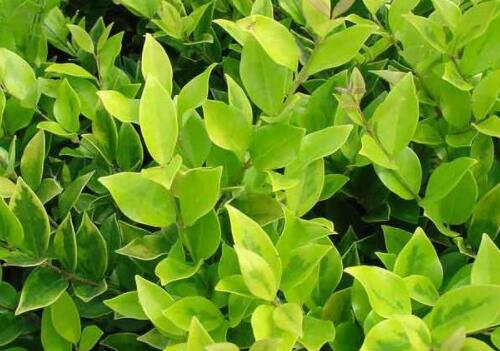
What is the difference between Ligustrum japonicum 'Howardii' and golden-leaf privet?
1. Differences in tree shape and leaves
Golden-leaf privet is a semi-evergreen small shrub with a plant height of 1~2 m. The leaves of golden-leaf privet are dense with many branches, and the leaves are slightly smaller and thinner;
Ligustrum japonicum 'Howardii' is a large evergreen shrub with a plant height of 3~5 m. The branches of Ligustrum japonicum 'Howardii' are sparser with fewer branches, and the leaves are also larger and thicker; the leaves of Ligustrum japonicum 'Howardii' appear more leathery and have a higher gloss.
2. Different heat tolerance and cold resistance
Golden-leaf privet is not as heat-tolerant as Ligustrum japonicum 'Howardii'. High temperatures above 35°C will not affect the ecological and ornamental characteristics of Ligustrum japonicum 'Howardii'; golden-leaf privet, however, shows wilted leaves.
The degree of cold resistance is different. Golden-leaf privet is more cold-resistant than Ligustrum japonicum 'Howardii'. Golden-leaf privet can be planted in Beijing, but Ligustrum japonicum 'Howardii' can only be planted in areas south of Beijing.
3. Different times for leaves to turn yellow
The golden-leaf period of golden-leaf privet is spring and summer, and in autumn and winter most of its leaves fall off; while Ligustrum japonicum 'Howardii' has golden leaves in spring, autumn, and winter, with some leaves turning green in summer, and it does not lose its leaves in winter.
4. Different resistance to pests and diseases
Ligustrum japonicum 'Howardii' has stronger resistance to pests and diseases than golden-leaf privet. Under the same conditions, Ligustrum japonicum 'Howardii' has a higher transplant survival rate than golden-leaf privet.
5. Differences in geographical distribution
Golden-leaf privet is mainly distributed in the warm temperate deciduous broad-leaved forest region from southern North China to northern East China, the southern warm zone deciduous broad-leaved forest region, the northern subtropical deciduous and evergreen broad-leaved mixed forest region, and the mid-subtropical evergreen and deciduous broad-leaved forest region.
Ligustrum japonicum 'Howardii' is mainly distributed west of Kanto in Japan, in Honshu, Shikoku, Kyushu, and Taiwan, China.
How to grow Ligustrum japonicum 'Howardii'?
Ligustrum japonicum 'Howardii' has good cold resistance. In areas south of the Yellow River, it can overwinter safely, has almost no pests or diseases throughout the year, and has extremely strong resistance. In July in summer, the chance of black spot disease is relatively high, so remember to use medication for prevention. Propagation is mainly by cuttings. May is the best time for raising seedlings. Cut current-year branches, with each cutting 4~7 cm long and having two leaf buds. The seedling bed soil should be loose and breathable with good drainage, preferably a mixture of vermiculite, perlite, and humus soil. After cutting, it can take root and sprout in 40 days. After being divided and planted in the field, compound fertilizer can be broadcast for fertilization. For container seedlings, drip irrigation fertilization is best. Do not fertilize during high summer temperatures; fertilize twice each in spring and autumn.
What are the common diseases of Ligustrum japonicum 'Howardii'?
1. Ligustrum japonicum 'Howardii' will show different pest and disease damage in different regions, such as rust disease. It should be noted that in areas with many pear trees and cypress trees around the nursery, due to more sources of infection, large-scale outbreaks are likely to occur, and sufficient attention must be paid.
2. Reasonable placement density is an effective measure to prevent diseases. Generally, the placement density per mu should not exceed 40,000 pots. Excessive density often causes outbreaks of diseases. Rust disease occurs most severely from June—September and should be given key attention. From May—June, focus on prevention and control. Agents such as triadimefon, Score, chlorothalonil, and DuPont Fuxing can be used alternately, once every 10—15 days, for 3—5 treatments. During prevention and control, 0.2% water-soluble fertilizer or trace element fertilizer can be added for topdressing and supplementing trace elements, enhancing the disease resistance of the plants. Among insect pests, root-feeding pests such as grubs and cutworms are the most serious. The occurrence period is around July—September. The control method is to promptly remove weeds around and in the pots. For severely affected areas, irrigate the roots with 800 times phoxim. When irrigating the roots, be careful to avoid high-temperature periods and maintain humidity in the pots to prevent phytotoxicity.