Where is Orah mandarin suitable for planting? Years to flowering, yield per mu and high-yield cultivation techniques
Orah mandarin mainly uses early autumn shoots as bearing mother branches, and the bearing shoots are mostly leafy flower shoots; generally the fruit-setting rate is higher in the middle and lower parts of the canopy. So where can Orah mandarin be planted? How many years until it flowers? How many kilograms per mu? Here we have compiled the high-yield cultivation techniques for you.
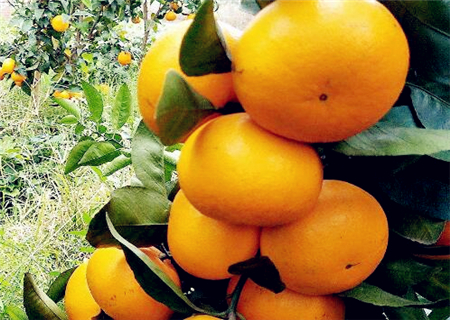
Where Orah mandarin can be planted
There is a history of planting in both the north and the south.
Orah mandarin is a high-quality, high-sugar late-ripening hybrid citrus variety with characteristics such as strong tree vigor, easy cultivation and management, early fruiting and high yield, attractive fruit appearance, tender and melting flesh, plenty of juice and sweet taste, and high sugar with low acid. Its fruit ripens right around the Spring Festival, so it has obvious market prospects and a price advantage. Many late-ripening citrus varieties currently being developed, such as Shiranui, the new line of Tarocco blood orange, Kiyomi, and few-seeded Murcott, all show obvious fruit drop in winter in Chongqing and require spraying with fruit-retention agents to hold the fruit; Orah mandarin, however, hangs on the tree for a long time and drops little fruit in winter, making it very suitable for vigorous development in the mid-subtropical citrus production areas with an average annual temperature above 17.8°C. In the Chongqing area, it can be promoted for planting in the Three Gorges Reservoir area below an altitude of 420 m.
When planting on purple soil and poor-quality sloping land, soil improvement should also be strengthened, with more organic fertilizer and phosphorus and potassium fertilizer applied, to ensure that the leaves are dark green, reduce the occurrence of nutrient deficiency symptoms, and lay the foundation for rapid canopy formation and early fruiting. Orah mandarin trees are robust with dense leaves. To promote early fruiting of young trees, tree training should be strengthened, the light inside the canopy should be improved, and the production of high-quality fruit should be promoted.
Orah mandarin has many exposed-stigma flowers during the flowering period, which does not have much effect on the fruit-setting rate, but because of its high yield and the long time the fruit hangs on the tree, the tree's nutrient consumption in winter is relatively large. Under poor management, alternate bearing is also likely to occur. Therefore, in production, to ensure continued high yield, attention should be paid to the fruit load of the tree and the fruit should be harvested in a timely manner. At the same time, after harvesting, soil, fertilizer and water management should be strengthened promptly; applying organic fertilizers such as oil cake to the soil after harvest can help restore tree vigor.
In addition, foliar fertilizer should also be applied promptly before flowering, preferably by spraying 0.5% monopotassium phosphate and 0.2% borax. Orah mandarin has a relatively large number of seeds; in production, the number of seeds can be reduced by isolated planting or concentrated block planting. Pest and disease control can follow the cultivation and management practices for general citrus varieties.
Yield performance
This variety mainly uses early autumn shoots as bearing mother branches, and the bearing shoots are mostly leafy flower shoots; generally the fruit-setting rate is higher in the middle and lower parts of the canopy. For grafted "Orah" seedlings on trifoliate orange rootstock, trial flowering begins 3 years after field planting; by the 4th year the yield per tree can reach 5.1 kg, and by the 5th year the yield per tree can reach 19.7 kg. "Orah" top-grafted onto Nichinan No. 1 as an interstock can begin trial flowering in small amounts in the 2nd year, with yield per tree between 3.4 kg and 10.4 kg, and by the 3rd year the yield per tree can reach 17.2 kg, with a yield of about 1400 kg per mu.
High-yield cultivation techniques for Orah mandarin
Preparation of Orah mandarin seedlings
When cultivating Orah mandarin, make sure the seedlings have a good plant shape and a complete root system, and especially that they do not carry the pathogens of quarantine diseases such as citrus huanglongbing, canker, and tristeza. For dry sloping land or alkaline soil, mainly Ziyang fragrant orange or sour orange, red tangerine, etc. are used as rootstock; for paddy fields, large-leaf trifoliate orange is used as rootstock (using trifoliate orange or citrange as rootstock makes nutrient deficiency yellowing symptoms more likely to appear).
Soil tillage in the orchard
Choose loose, fertile land with good drainage and irrigation, sheltered from the wind and facing the sun, or paddy fields to establish the orchard. For sites with a relatively small slope, a high-horsepower tractor with a single plow can be used for deep plowing and subsoiling of the whole orchard. Plow when soil moisture is not high, with the direction along the contour lines or perpendicular to the road; one plowing can reach a depth of 60-70 cm, then harrow once or twice until level. Then, according to the drainage conditions of the sloping land, flat land or paddy field, use an excavator to dig drainage ditches. Alternatively, a large excavator can be used to deep-dig the whole orchard to a depth of more than 60 cm in one pass, and then level it by harrowing. Or dig planting pits 1 m long and wide and 0.6 m deep, put 50 kg of well-composted organic fertilizer and 1 kg of superphosphate mixed with soil back into the pit, and backfill soil to above ground level.
Planting techniques for Orah mandarin
1. Planting density: For Orah mandarin, the planting spacing is 2-3 m between plants and 3-4 m between rows, with 56-110 plants per mu, and this can be chosen according to planting preferences and management level.
2. Planting time: In southern regions, the best planting time for Orah mandarin is from February to early May, when temperatures rise and there is more rainfall or cloudy weather; planting can also be done from September to November during rain or cloudy weather. Container seedlings can be planted year-round.
3. Planting method: For bare-root Orah mandarin seedlings, the whole seedling can be soaked in a 0.1% potassium permanganate solution for about 2 minutes, taken out and left to dry for about 3 minutes, then rinsed once with clean water, which can kill pathogens present on the surface of the plant. Then soak the roots of the Orah mandarin seedling in a solution of fungicide, insecticide, nutrient solution, etc. for about 8 hours. After taking out the seedling, dip it in yellow mud slurry made with this solution and it is ready for planting.
Management of young Orah mandarin trees
1. Fertilizer and water management: Orah mandarin grows very vigorously and needs plenty of water and fertilizer. A water-fertilizer integrated drip irrigation system should be installed as much as possible; the system mainly includes a fertilizer dissolving tank, water tank, filter, water pump, main pipe, branch pipes, switches, drip tapes, and drippers. For young trees, the goal is to rapidly build the canopy, so apply frequently and lightly, with a reasonable ratio of nitrogen, phosphorus and potassium. Apply organic fertilizer as base fertilizer only once a year, about 15 kg of organic fertilizer and about 2 kg of compound fertilizer per tree per year.
2. Training and pruning: Orah mandarin has a very strong ability to send out shoots. Under good water and fertilizer conditions in Nanning, Guangxi, young trees can sprout new shoots 6-7 times a year; if not controlled, they often grow in clumps, and the shoots are short and weak. After planting the seedlings, set the main trunk height at about 20-30 cm, then prune according to the guiding idea of the "one fork, three branches" method, that is, keep about three evenly spaced, thick and strong branches at each fork, remove the excess, and when the overly long branches mature, cut them back short, keeping each branch 20-25 cm long. This method has a clear guiding idea for shaping, is easy to operate, and can also make the whole tree shape reasonable, with branches that are relatively thick and strong and that mature as quickly as possible and sprout new buds, which is conducive to simplified management of Orah mandarin trees.
Management of mature Orah mandarin trees
1. Fertilizer and water management: This can be summarized in three sayings: "nitrogen in spring, potassium in summer, compound fertilizer in autumn; during the enlargement period, drench with bran water; after harvest, apply heavily to promote recovery." Apply well-fermented organic fertilizer once a year at 50 kg per tree, together with peanut bran, superphosphate, etc. During the fruit enlargement period from September to December, attention should be paid to strengthening water and fertilizer irrigation during drought, applying frequently and lightly. During the fruit ripening period from January to March, attention should be paid to controlling water to increase sugar accumulation.
2. Training and pruning: This can be summarized in four sayings: "keep spring shoots as appropriate, prune off summer shoots, release autumn shoots uniformly, strictly control winter shoots." That is, when spring shoots grow to 5 cm long, keep 2-3 strong buds in different directions on each shoot; the principle for keeping buds is to thin where dense and keep where sparse, thin the short and keep the long, thin the weak and keep the strong. For overly vigorous branches, keep 6-7 leaves and pinch off the growing tip. Cut off all summer shoots. From early August to early-to-mid September, release autumn shoots uniformly and wipe out scattered buds. For weaker trees, a small number of late autumn shoots may be kept as appropriate, and all the rest and all winter shoots should be wiped out. Winter pruning is based on ventilation and light penetration, reasonable shoot distribution, and a compact canopy; cut off diseased and pest-damaged branches, burn them in a centralized manner, and at the same time clean the orchard.
3. Flower and fruit management: Orah mandarin has many flowers, a high fruit-setting rate, and little late fruit drop, which easily leads to insufficient nutrient supply, poor growth and development of flowers and fruits, small fruit, rough peel, and poor quality, and can also easily cause alternate bearing. Therefore, in an on-year, attention should be paid to fruit thinning, which can be done twice to thin out excessively dense fruit. Thin fruit after physiological fruit drop is complete; at the second thinning, leave about 300 fruits, calculated at 3 fruits per jin; for 3-4 year old bearing trees, 40-50 kg of fruit per tree according to tree vigor is sufficient. In an off-year, attention should be paid to spraying foliar fertilizers such as monopotassium phosphate to retain flowers and fruit. In this way, a bumper harvest can be achieved every year.
4. Timely harvest: Orah mandarin can begin to be harvested in early January, and reaches relatively high maturity around mid-February. It can mainly supply the two important festivals of Spring Festival and Lantern Festival, and should be harvested before early-to-mid March; it should not be harvested too late, so as to avoid affecting flowering in the next season. Clean Orah mandarin can be stored at room temperature for more than 1 month; unclean fruit with surface residue on the peel is susceptible to green mold and blue mold. The main commercial processing flow for Orah mandarin includes harvesting - transporting - washing - fungicide treatment - waxing - grading - labeling - packing, etc. For fungicide treatment, imazalil at 2000 mg/kg, 45% prochloraz 2000-fold solution, etc. can be used.