Shrub oleander seedling prices, is it toxic, when does it bloom, and how to plant and care for it
Oleander, also known as red-flowered oleander, willow-leaf peach tree, foreign peach, jiaochudong, willow-leaf tree, foreign peach plum, and gouna, is an evergreen upright large shrub that can reach 5 m in height. It is cultivated in various provinces and regions of China, especially in southern China. So how much does an oleander seedling cost per plant? Is it toxic? When does it bloom? How to plant and care for it? According to the Hunan Horticultural Farm, oleander prices range from 3-28 yuan, and prices naturally differ by height and variety.
Is oleander toxic?
This species is a toxic plant included in the Chinese plant atlas database, and its toxicity lies in the leaves, bark, and roots. The toxicity of fresh bark is stronger than that of the leaves, the toxicity weakens after drying, and the toxicity of the flowers is relatively weak.
The whole oleander plant is highly toxic. Symptoms after poisoning include nausea, vomiting, lethargy, and irregular heartbeat. In severe cases, loss of consciousness or even death is possible, so when facing oleander, it is best to just admire it and not touch it! The stem bark fiber is an excellent blended textile raw material and can also be used to extract cardiotonic agents; the roots and bark contain cardiac glycosides, phthalein-like crystalline substances, and a small amount of essential oil; the stems and leaves can be used to make insecticide, and its stems, leaves, and flowers are all toxic. The milky white sap it secretes contains a toxic substance called oleandrin, and accidental ingestion will cause poisoning.
Oleander stems and leaves are used to make insecticide, so you can imagine how strong its toxicity is. Oleander is not suitable for indoor planting, and households with pregnant women, children, or pets especially must not grow it.
When does oleander bloom?
Oleander is an evergreen shrub plant, and when cultivated, its flowering period is actually quite long, almost year-round, but it blooms most vigorously in summer and autumn. After oleander blooms, it also produces fruit, and the fruiting period is generally in winter and spring.
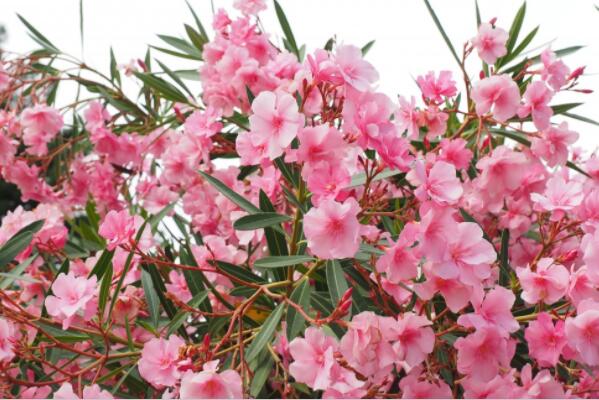
When oleander blooms, the flower shape is relatively simple. The funnel-shaped flowers have 5 petals, and the color is mostly dark red or pink.
How to plant and care for oleander?
Propagation time: Oleander cuttings can be propagated in spring and summer.
Soil medium: Oleander grows best in fertile neutral or slightly acidic soil.
Temperature requirements: Oleander should be planted in a wind-sheltered, sunny spot. In winter, move it indoors to prevent freezing, and a room temperature not lower than 0°C is sufficient; in addition, if the temperature is too high, it consumes nutrients and is unfavorable for growth and flowering the following year. Where outdoor winter temperatures are high, soil can be banked up around the plant to protect it from the cold.
Light requirements: Oleander likes sunlight, so during the growing period it needs to be cared for in a sunny place, otherwise it will produce fewer flowers and the color will be pale.
Fertilizer application: Oleander likes fertilizer. From the time it is moved outdoors until the flowers fade (Frost's Descent), a dilute liquid fertilizer can be applied about once every 20 days. After the Beginning of Autumn, oleander grows rapidly. At this time, fertilizer water can be applied about once every 15 days until just before it is moved indoors.
Watering key points: Although oleander likes water, it fears waterlogging. During continuous rainy days, accumulated water in the pot should be poured out promptly to prevent root rot. If watered too much, the leaves will turn yellow and fall off one after another, affecting flowering the next year. In spring and autumn, watering should follow the principle of watering when dry and stopping when wet, and it is best to keep the potting soil moist.
Summer is exactly the period of vigorous growth and flowering for oleander, so it needs more water. It is best to water once each morning and evening, and pay attention to frequently spraying and washing the branches and leaves to keep the leaf surface fresh and emerald green. Move it indoors in mid-October. After moving indoors, watering should be controlled, and it is especially important not to use too much water, otherwise root rot and leaf loss are likely, affecting growth the next year.
Pruning key points: If oleander is left unpruned, the plant shape becomes too large, so when cultivating it as a clumping plant, the branches or trunk should be organized. Oleander has strong sprouting ability. If cut in the middle of a branch, many small branches will emerge from the cut and affect the plant shape, so in principle, pruning must be done by cutting at the base of the branch.
Through pruning, the branches are evenly distributed, the flowers are large and vivid, and the tree shape is beautiful. The upper branching of oleander has the characteristic of dividing into three. It can be pruned and shaped as needed. If a three-fork, nine-top shape is desired, part of the top of the three forks can be cut off, and nine tops will be produced. If nine tops and eighteen branches are desired, six branches can be retained and cut from the top leaf axils, and eighteen branches will grow. Pruning time should be after each flowering.