When does the ornamental peach bloom, and can it bear fruit? A detailed guide to seedling prices and planting methods
Ornamental peach, also known as double-flowered peach blossom, is a variety of the peach plant in the genus Prunus (subfamily Amygdaloideae). It belongs to the semi-double and double-flowered ornamental peach blossom varieties, collectively called ornamental peach. So when does ornamental peach usually bloom? How much does a seedling cost? Can it bear fruit? How do you plant it? According to Rosaceae records, in East China the flowering period of ornamental peach is from March to April. The flowers are plump and full, with bright, rich colors and many flower forms. Common varieties include ornamental peach with red flowers and green leaves, ornamental peach with red flowers and red leaves, and the white-and-red bicolor "sajin" ornamental peach, among other variants. Ornamental peach has high ornamental value and is a beautiful plant seen everywhere in residential communities, parks and along streets.
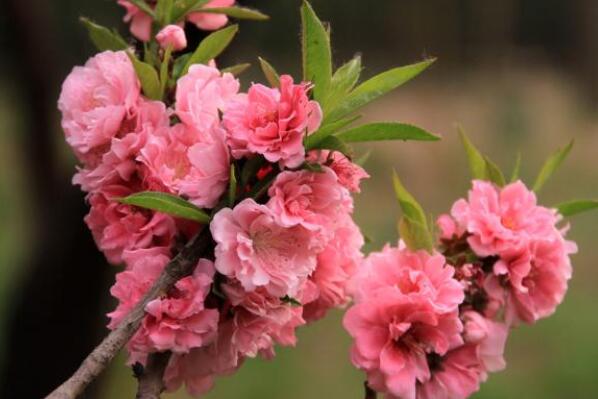
How much does an ornamental peach seedling cost?
| Nursery stock name | Height | Crown width | Ground diameter | Loading price |
| Ornamental peach | 200 | 60 | 2 | 4~7 |
| Ornamental peach | 200 | 80 | 3 | 9~12 |
| Ornamental peach | 250 | 100 | 4 | 15~25 |
| Ornamental peach | 250 | 120 | 5 | 26~35 |
| Ornamental peach | 250 | 150 | 6 | 45~60 |
| Ornamental peach | 300 | 170 | 7 | 110~180 |
| Ornamental peach | 300 | 180 | 8 | 160~280 |
| Ornamental peach | 300 | 180 | 9 | 220~330 |
| Ornamental peach | 300 | 200 | 10 | 270~380 |
| Ornamental peach | 300 | 240 | 12 | 450~550 |
Can ornamental peach bear fruit?
Yes, it can bear fruit.
Red-leaf peach belongs to the genus Prunus in the Rosaceae family and is a variant of ornamental peach. It naturally belongs to the fruit tree group, and its fruit has white flesh that is juicy and sweet, making it a fine food suitable for all ages.
Its flowering period is generally from April to May, and after the flower buds fully develop, it is from July to August. It blooms only once a year; it begins to flower in early April, with five petals per flower, and the flowering period is generally about 10-15 days. The fruiting period is from June to August, generally ripening in late August. The fruit produced is purplish-red, with white flesh and plenty of juice, making it a fine product suitable for all ages.
How do you plant ornamental peach?
Ornamental peach can be planted on hillsides, beside water, next to rocks, along walls, in courtyards and at the edges of lawns; it can also be grown in pots, used as cut flowers, or trained as a stump specimen.
To maintain good quality, it must be propagated by grafting, using wild peach (Prunus davidiana) as the rootstock. Using spring bud grafting or branch grafting, the grafting survival rate can reach more than 90%. The specific steps are as follows:
Scion selection
The mother ornamental peach tree should be robust and free of pests and diseases, with excellent flowers and fruit. Select vigorous new shoots of the current year with plump buds as the scions.
Grafting method
For summer bud grafting, you can cut a bud shield, or a bud shield with a little wood, and peel back the bark at the stem of the rootstock. Cut the scion from the mother tree, that is, remove the leaves but keep the petioles. At 1 cm below the scion bud, use the tip of a knife to cut upward, 1.5-2 cm long; the inner side of the bud should carry a little wood, and the bud should sit in the middle of the graft bud. For the rootstock, choose a seedling about as thick as a pencil, with the stem 3-5 cm above the ground, and use the vertical part on the north side of the trunk. Make the first cut straight down 2 cm with a little wood, cut away 1/2-2/3 of the peeled bark, insert the graft bud into the rootstock so the cambium layers fit closely together, and in particular make sure there is no gap at the lower part of the cut on the rootstock, so the union is tight. Below the graft bud, wrap plastic tape 2 turns to the left, then 2 turns to the right, binding evenly upward so as to keep the bud from drying out and ensure a firm union, leaving the graft bud exposed. Pay attention to the timing of bud grafting: in the south, mid-June to mid-July is best, while in the north, mid-July to mid-August is preferable.
Aftercare following grafting
10-15 days after bud grafting, if the petiole turns yellow and falls off, this is a sign that the graft has taken; if the petiole turns black, it means it has not taken. Once the surviving seedling grows new shoots and has healed completely, remove the plastic tape, and cut the rootstock 1 cm above the graft union. After budding, remove any sprouts from the rootstock, and combine this with fertilization, generally applying compound fertilizer 1-2 times, to encourage the new shoots of the scion to become woody and develop cold resistance. To control aphids, spray a 2000-fold dimethoate solution; when leaf curl disease occurs on the leaves, lime sulfur mixture can be used.
Appendix: The flower language of ornamental peach
The flower language of ornamental peach has two meanings: one is the meaning of dispelling resentment, and the other is being a captive of love. People who like ornamental peach are themselves very confident, and in matters of love they will not use too many sweet words, but when they find the person they love, they become captives of love.